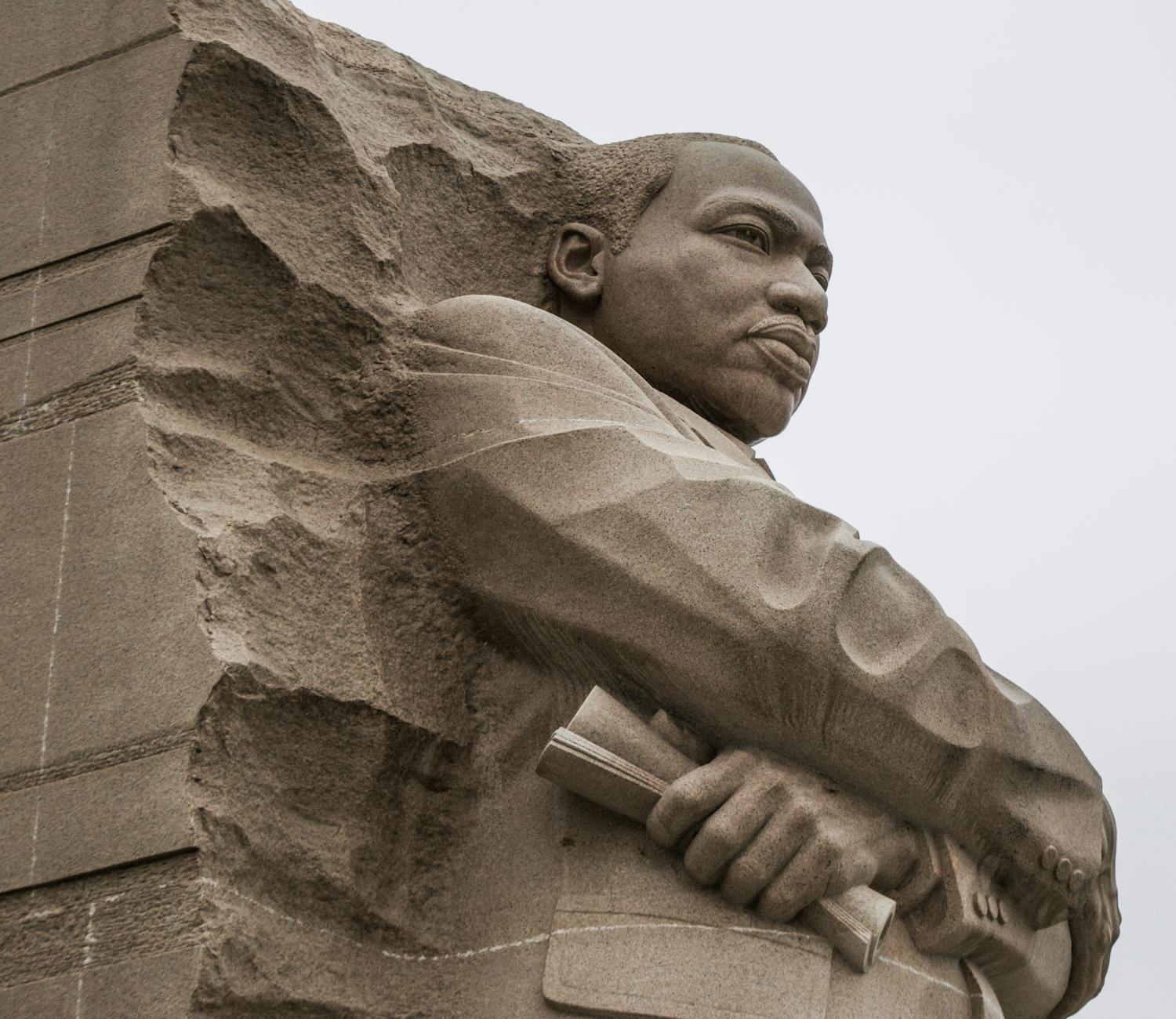
It is an irregular day for a post, but considering all that is happening, I thought I’d write a little something. An attempt to put a little good in the world.
A few years ago, I was asked to preach on MLK observance Sunday, and it was my first time preaching at the new church I was on staff at. To say it was a little intimidating would be correct. But, a few good things came from it, and as far as sermons go, not the worst I’ve preached. This is a bit of an updated excerpt from it waking toward the idea of how we can move forward.
How can we fight for a world that is aligned with our kin-dom ideals while making room for those who may not like or agree with us? We advocate. In his letter from Birmingham Jail, Dr. King lays out the four basic steps to nonviolent protesting, to paraphrase they are:
- Collect the facts and determine from those facts whether injustice is alive and well in the community you’re focusing on.
- Negotiation. Engage in conversation with the gate holders and see if there is a way to work within the law to change what is going on.
- Self-purification. The attempt to purge the injustice from oneself, so that their eyes can no longer be shut to them.
- Non-violent direct action. Showing up and protesting whether it is a sit in, letter writing, or some other form.
When I was a student at the University of Toledo, I minored in Peace Studies and Education, and through those courses, these four markers came up in class almost every other week. It’s tempting, when preaching to draw upon the model that Dr. King left behind, at least, the perceived model he left. For a very long time, evangelicals and other white people have used the likeness and words of Dr. King in a way that has almost made him a caricature of who he was. 2018 marked the 50th anniversary of his cold-blooded murder, and Michael Harriot wrote an article for The Root labeled, From Most hated to American Hero: The Whitewashing of Martin Luther King Jr. Harriot does not beat around the bush when he states:
Contrary to popular belief, when King Died, he was not an icon of freedom and equality. In fact, most of the country disliked him. Sadly, on April 4, 1968, a bullet splattered bits of Martin Luther king Jr.’s brains and blood across the balcony of Memphis, Tenn.’s Lorraine Motel. Then, and only then, was white America ready to make him a hero. [1]
In part, it was Dr. King’s approach to injustice through non-violent direct action that led to his unpopularity. However, there is another way to put it, a way that I prefer, and it was said by one of his contemporaries, Rabbi Abraham Joshua Heschel. To quote Rabbi Laurie Green:
Upon marching with Dr. King in Selma, Rabbi Abraham Joshua Heschel famously said: ‘I felt my legs were praying.’ Heschel was as passionate about social justice as he was about the Sabbath and prayer. He taught that prayer must be revolutionary…[2]
Growing up, I was often taught that prayer was a direct communication from myself to God, and that was about it. When I was introduced to concept of praying with one’s feet by my former mentor Don, it kind of broke my brain open about the possibilities of prayer.
- So, when I say something like, advocate for the world we want, not the one we live in, that to me is an act of prayer.
- Going after systems of oppression through non-violent direct action is a type of prayer.
- Realizing that our liberation isn’t just wrapped up in Christ, but the breaking of chains of oppression for all peoples is an act of prayer.
- Working hard for justice in an unjust is an act of prayer.
So, on this Dr. Martin Luther King Jr. Day, 57 years since his assassination, may we remember that the work Dr. King stood for is still on going, and that in the work, we are called to be merciful, just as our God is merciful. We have a lot of work to do, and a ton of dirt to get under our nails.
Grace and peace.
 George of Sylvania
Leave a comment