Category: theology

  • Prisoners of Prophetic Hope

    Prisoners of Prophetic Hope

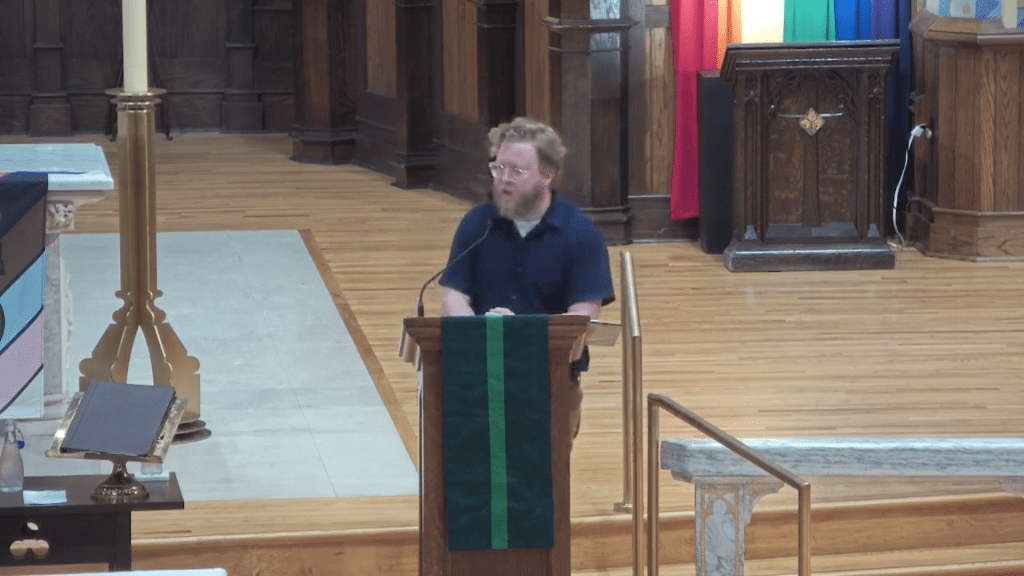
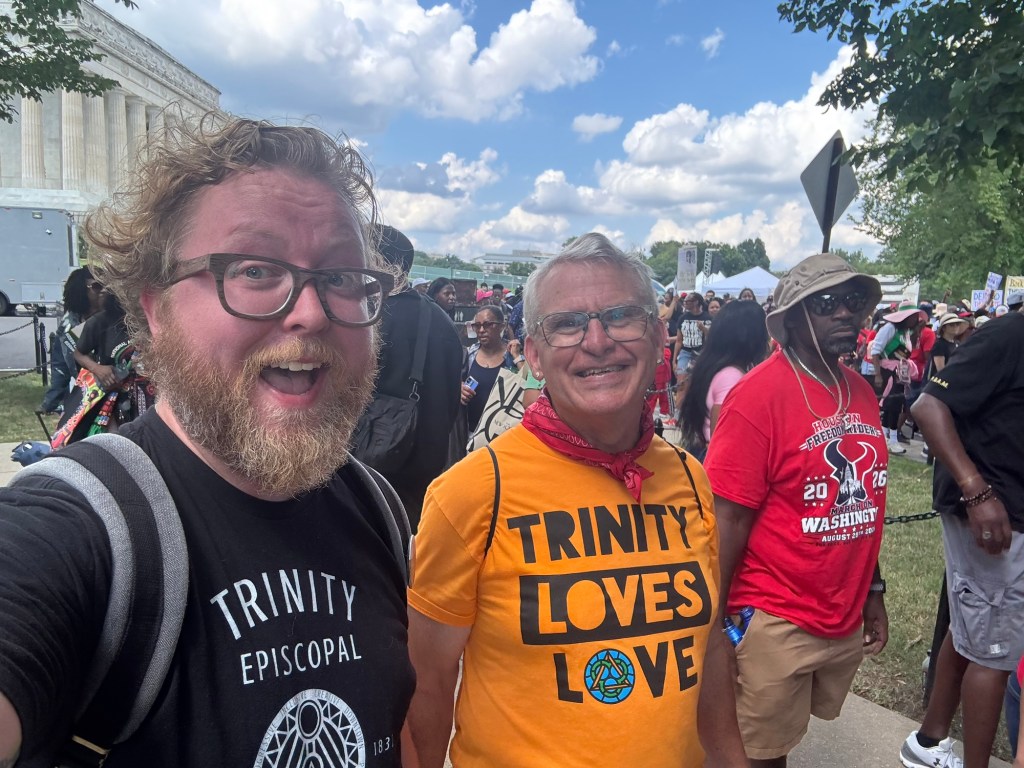
    Yesterday I had the honor to preach the sermon at my home, Trinity Episcopal Church, a progressive, inclusive, creative, downtown church. It has been a cornerstone of Toledo since 1837, and a bedrock of those seeking to act justly, love mercy, and walk humbly with God. If you’d like to watch the service you can follow the link here, or watch the sermon itself on my Facebook which is linked here. All of the quotes from Bishop Barber, including the Walter Brueggemann quote, can be found in the book, Revive Us Again: Vision and Action in Moral Organizing by Bishop Barber. A video of his 2015 MLK Jr. Day sermon can be found here. Also, I have updated some action items that allow for online reach out, so here we go!

    I am going to start with just naming one of the many elephants in the room, yesterday, the country we call home celebrated its 250th birthday. There is tension, joy, anger, and a weird dash of patriotism if, you have been following Europeans visiting for the world cup. Some of us were on the plaza celebrating until the early hours of the morning, some of celebrated with family, and others, friends of mine, to paraphrase a song written by Ben Stalets, who just wanted to be holed up in a hotel room, hoping to God they could get through the night. There is a lot to sit with in this moment we find ourselves, as Christians in this country. To quote Michael W. Austin, co-author of American Christian Nationalism: Neither American nor Christian, “in one sense love of country is a good thing. But in another, it is deeply problematic. Love of Jesus and love of country can come into conflict.”

    It is that conflict, and a way to advocate the world we want, not the one we live in, I would like to spend some time talking about.

    The passage from Zechariah is very small but powerfully packed. Something that was important to ancient Israel, and current Judaism, is the story of the exodus from Egypt. The origin story of where these people called by God, were brought up out of slavery, rescued from the oppressors, welcomed into covenant with God at Mount Sanai, and ultimately brought through the wilderness. There is a constant call back to this story throughout the Jewish and Christian Bibles, and we can see that in how the author of Zechariah phrased the ancient nation of Judah and Israel. Any time we read about chariots or war horses, it should give us pause, because these descriptors are triggers for the original listeners of this story to be brought back to Egypt.

    Pharaoh and his army, with chariots and war horses, chased after the ancient Israelites as Moses led them through the Red Sea. In quick words, the Prophet Zechariah is drawing a one-to-one comparison to Egypt and the people who escaped that oppression to their current status. In their journey to be a blessing to all nations like they promised God to be, the ancient Israelites have become the opposite, they have become the new Egypt, oppressing and enslaving others. This group of people that pledged themselves to God have instead become an empire seeking its own means, claiming it is from God because they are clearly prosperous. It is to this point that Zechariah calls out from God for the dismantling of the military industrial complex, the command that peace be waged in all nations, and for the people who will be doing this work, the prisoners of hope, to be restored.

    Over two thousand years later the people of God, these prisoners of hope, continue to call out this need to dismantle our faith from the oppression, violence, and injustice of empire.

    But how do we do this work, after all, for the past decade there has been an incredibly charged political climate with culture wars and the like dictating new fronts to fight on. While it is incredibly overwhelming, even if we only have the energy in ourselves to voice opposition and to support the marginalized, targeted, and oppressed it can be enough. There is a Palestinian priest in the Evangelical Lutheran Church named Munther Isaac, and in his book, The Other Side of the Wall: A Palestinian Christian Narrative of Lament and Hope, he writes, “Our silence towards injustice is a political statement itself” and he is right.

    With so much turmoil, what are we to do? Zechariah reminds us we need to take our instruments of oppression, and to turn them into plowshares, garden tools, or fine art. Whatever these 21st century swords and shields we still cling to need to be laid down by the riverside, and we must study war no more. When we start to practice this laying down, we can move from prisoners of hope to what Disciples of Christ Bishop, former North Carolina NAACP President, and current co-chair of the Poor People’s Campaign, Bishop William Barber II has coined, Prisoners of Prophetic Hope.

    Touching back on the conflict between the love of country and Jesus, it is easy to get frustrated. However, when I look around this room, think of our ministries, I see the truth in the country I love, and it is all of you, and the diversity we offer. When we lay down an old way of life, a new direction and leader is required for us and Jesus offers this in abundance. “Come to me, all you that are weary and are carrying heavy burdens, and I will give you rest. Take my yoke upon you and learn from me; for I am gentle and humble in heart, and you will find rest for your souls. For my yoke is easy, and my burden is light.”

    Every Sunday at 8:20am I give a little pre-breakfast peptalk that touches on this passage, because above the plaza doors in My Brother’s Place lives a sign that reads, “A Place To Nourish Both Body and Soul.” It is a remnant of our past, that screams truth into our future, because we want our friends who come to Breakfast at Trinity to lay their burdens down.

    Trinity has a long history of guiding and advocating for the world we want to live in and trying to reshape America, and I would like to name four examples:

    1. Morrison Waite, who served on vestry from 1852-1874 when he was selected by President Grant to serve as Chief Justice of the Supreme Court during Reconstruction. During his time, he expanded the Freedmen’s Bureau, protected people of color from the KKK, and while there was more work to be done to protect Black and people of color during Reconstruction, he showed up and tried.
    2. There is a legend that the first free kindergarten in Lucas County was founded out of Trinity, and while I am unsure how true that is, what I do know is according to our September 1875 Parish Guide, a new term of school started on Monday the 13th, which the author states, “it is with particular gratification that I have been able to announce the establishment of the Kindergarten department, which I consider a great addition to the educational facilities of our city.”
    3. In March of 1912 Jennie Barnes and Hester Scrafford founded the Business Woman’s Guild of Trinity Church where women who worked downtown could come and eat their bagged lunch safely, in community with one another. There are pictures of the café that started in the basement because of this, and there is a bronze plaque commemorating this ministry that lasted well through the 20th Century in what is now our AA room.
    4. If you were present for the Queer Joy Symposium you heard Toledo Councilman Nick Komives talk about how the first Toledo Pride started in this sanctuary with the first Pride interfaith service.

    Again, and again, and again these walls have housed fellow prisoners of hope as we step forward in works of justice brought out from love. The continued work of making spaces safe for everyone is a justice issue Jesus calls us to be active members in creating.

    “Take my yoke upon you, and learn from me; for I am gentle and humble in heart, and you will find rest for your souls. For my yoke is easy, and my burden is light.”

    These words of Jesus would have called his fellow farmers and working class listeners to think of the oxen in the field shouldering the huge wooden yoke to help plow the fields. Every single one of those examples of Trinity members had days where they wanted to give up.

    At times they may have thought the strain is too much, the world is too dark, and this burden is not light, but too heavy.

    The yoke and burden that Jesus gives us is only light and easy because we have each other to lean on, to help share the load because we mustn’t do this work alone. That is why we must move from being a prisoner of hope, to becoming a Prisoner of Prophetic Hope like those who have come before us.

    In January 2015 at Duke University, Bishop Barber preached the Martin Luther King Jr. Day service, and in that sermon, he speaks on this transition from prisoner to prophet. To become a Prisoner of Prophetic Hope, Bishop Barber says that it is crucial to publicly own the despair in the world we feel and know to be true. The need for this is because when we read the prophets we see how the hope in their words is subversive to the suffering and world around them. Bishop Barber is backed up by the words of Old Testament scholar Walter Brueggemann, when he writes “prophets must be able to speak in both grief and hope.”

    Because of my role here, I find myself in conversations with random people throughout the week, and there is one consistent throughline in almost every talk that comes up about Trinity. It is not about our building, the pride flags, or any of our ministries. While those do come up, the one consistent thing people tell me about their experience with Trinity is, how welcoming and at home the people here make them feel. The reason why we are so good at welcoming people into Trinty, is because almost all of us that find ourselves through these doors in person or online, we have all been rejected from community. At one point or another, we have found ourselves outside of the place we once called home, and we never want anyone else to feel that way again.

    If you feel called to take on the yoke and burden of Jesus, and you want to move from being a prisoner of hope to a Prisoner of Prophetic Hope I have a few opportunities for you. In a way to publicly own this grief we feel, use 5 Calls to contact your senator about HR 1689. It is a recent bill that passed the House with bipartisan effort, House Resolution 1689 which determines the Temporary Protected Status of Haitian and Syrian immigrants.

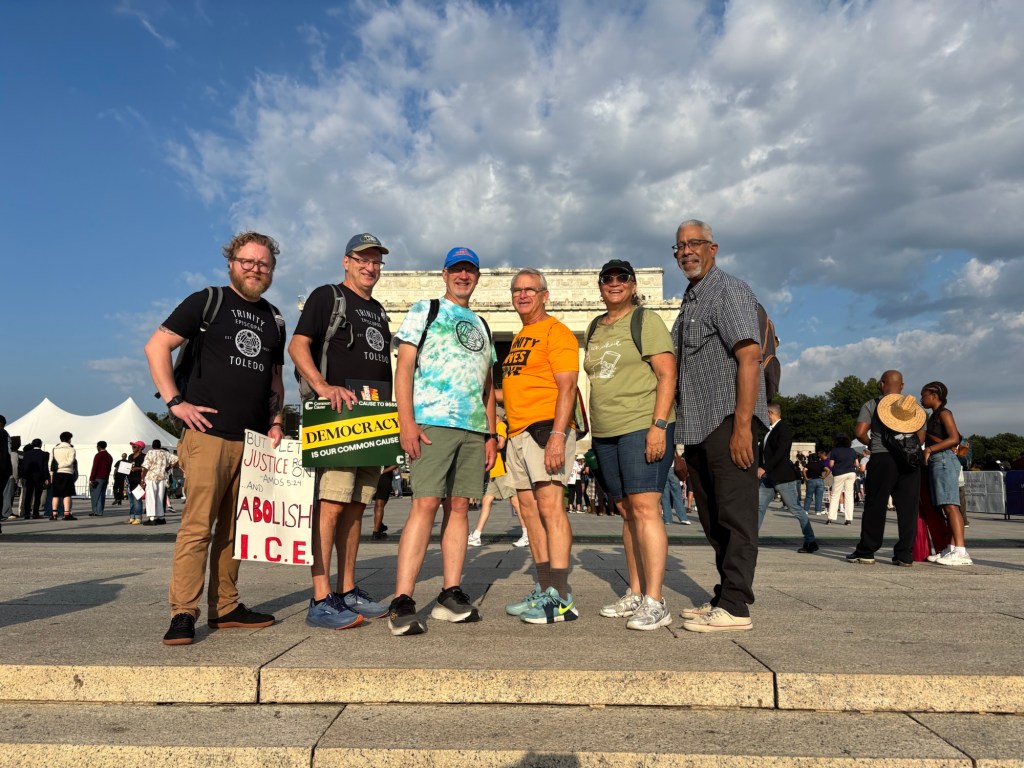
    The second opportunity is on July 22nd from 9-11 there is a protest at the Central Corrections Facility of Northwest Ohio which is now contracted as an ICE detention center. I will be there, reach out and I’d love to have you with us. Finally, It is crucial now, more than ever we show up to support our LGBTQ+ siblings.

    To close, I want to leave you again with words from Bishop Barber, because we can be the hope that is missing in the world. “When the rejected get together they can in fact redeem America from hate and discrimination… when all those hands get together and when the rejected join hands our togetherness becomes the instruments of redemption.”

    Amen.
  • Henrietta Butler

    Henrietta Butler

    A few months ago my wife, child, and I took a little jaunt to New Orleans to visit some family that has lived down there for a long time. It is a trip we try to make every 18 months to two years, and this time it just happened to coincide with New Orleans Jazz Fest where Jon Batiste was closing down Friday night. It was a great time, I got to see almost a full set of The Dirty Dozen Brass Band in between getting snacks and drinks. By the time Jon Batiste was getting ready to go on, our almost four year old was cooked, and I took him back to the house. While I love Batiste, it was my wife’s bucket list item to see him play jazz fest. It was a trip that was hard at the start, but was incredibly enjoyable by the end.

    Whenever we go somewhere, I know there will be downtime in the middle of the day while those two nap to run out and check out something I know others either won’t want to see, or is just too off the beaten path. For this trip, my main goal during this limited time, was to see the Whitney Plantation Museum. Plantations are not places I have ever had any interest in visiting, I do not care for Gone With the Wind, or the revisionist history that white southerners have spent so much time trying to cover up. The whole idea of a tour being focused around the big house makes my skin crawl. So when I read Clint Smith’s book, How the Word is Passed: A Reckoning with the History of Slavery Across America, and his chapter on the Whitney Plantation, I knew I had to try and see it.

    What sets the Whitney apart from other places like this, from their website, “Whitney Plantation is a non-profit museum dedicated to the history of slavery, situated on a historical sugar, indigo and rice plantation which operated from 1752-1975.” Their focus is strictly on the the lives of those enslaved, which was genuinely breathtaking, tear inducing, and uncomfortable which is perfect for every white person that walks those grounds. One thing that surprised me, aside from how stark the big house was (no decorations, no furniture, just there as a reminder which was 10/10), were the carved statues of children all around the grounds.

    When you check into the tour, you are handed a lanyard that has a name and picture of one of these statues because they are real people with real stories about being enslaved. During FDR’s time in office, he pass the New Deal, a sweeping group of legislation from 1933-1939 that was designed to help lift this country out of the Great Depression. One of the projects that came from it was the Work Progress Administration (WPA), and journalists like Zora Neale Hurston, and others were sent out to record the accounts of those formerly enslaved. From those records, the Whitney pulled names, and on the back of the lanyard was written part of their story.

    Henrietta Butler, around 80 years old when she gave her testimony, is who was on my lanyard. Her testimony is held on record at the Northwestern State University of Louisiana, Watson Memorial Library, in the Cammie G. Henry Research Center. The section of her story that is on my lanyard, which lives in my office, states:

    I’se 80 some odd years ole, born at LaFourche. I was born in slavery. I’se not ashame’ to tel it either an’ knows somethin’ about it.

    My damn ol’ missus was mean as hell; I know ever; night I had to wash dat ol’ woman’s foots an’ rub dem ‘fo I could ever go home to bed…they made my ma have babies all de time.

    She was sellin’ the boys and keepin’ the gals.

    If you are interested in reading some of the slave narratives from the WPA, you can access it online through the Library of Congress by clicking here. I cannot recommend visiting this place of history enough. Pick up Clint Smith’s book, read up on the Whitney, and friends, do your part to make sure nothing like this happens again. The 13th Amendment still allows slavery via the prison industrial complex, and those siblings who have been wrongfully or correctly imprisoned deserve the dignity they inherently have. Families are still being torn apart, I encourage you to contact your reps so that we do not find ourselves replaying this history. When we start to dehumanize our fellow image bearers, it becomes easier to think we are above “them” which we are not.

    Grace and peace.

  • Broken Clocks

    Broken Clocks

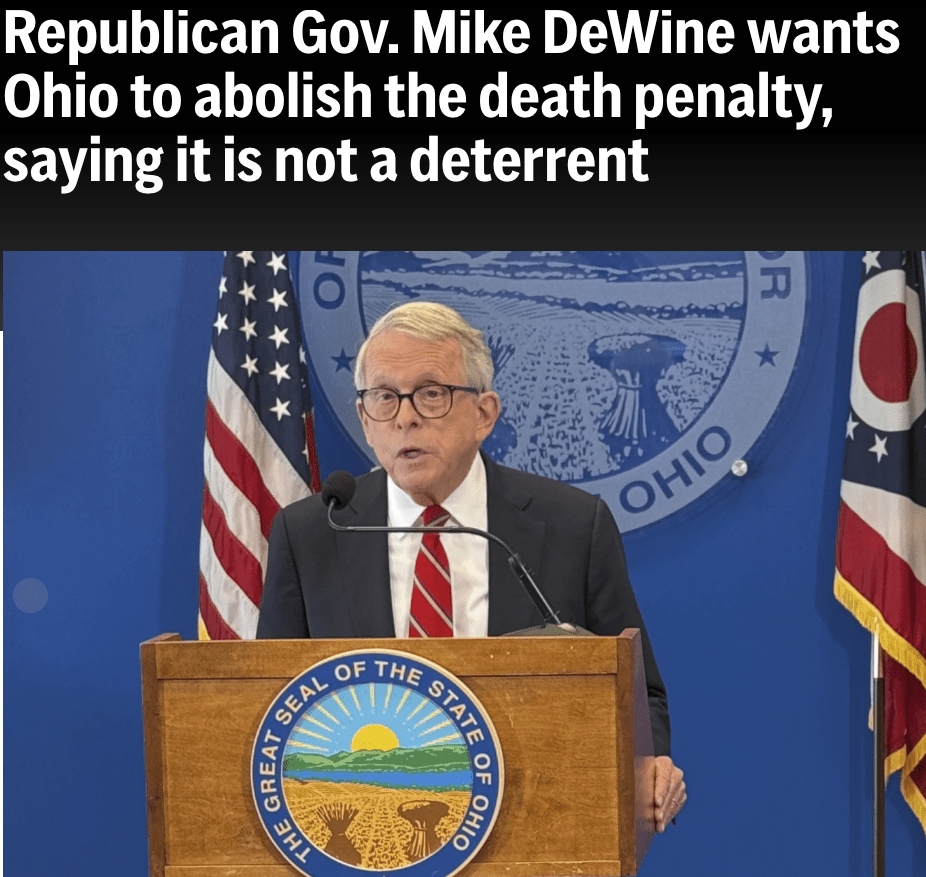
    Imagine my utter surprise when I get a news alert about something Ohio Governor Mike DeWine says, that I not only agree with, but am actively championing. Per our local paper, The Toledo Blade:

    COLUMBUS — The state of Ohio should end the death penalty, Gov. Mike DeWine said Tuesday.

    “I no longer believe that the death penalty is a deterrent,” Mr. DeWine said during a news conference at the Riffe Center. “The moral justification I had for voting for the death penalty simply no longer exists.”

    The governor said the Ohio General Assembly should take action to end capital punishment.

    “If the legislature does not want to make that decision, they can leave it up to a vote of the people of the state of Ohio,” Mr. DeWine said.

    The fact that Gov. DeWine is calling for this is proof that no matter what, if you’re open, you can change. I appreciate that as for part of my life, I was a death penalty purist, if you did the crime worthy of it, your life is forfeit.

    During the first year of marriage, my wife and I were reading Jonathan Wilson-Hartgrove’s book, New Monasticism: What it Has to Say to Today’s Church. A former friend and colleague had recommended it to us as we were interested in the movement, and I will never forget how challenging the chapter on the death penalty was. Through many drives from Chicago to Toledo, we had argued and discussed it ultimately landing on, who are we to say when God is done with someone.

    Today, the day that DeWine has come out against the death penalty should be one we remember. On June 16, 1944 George Stinney Jr. was executed via the electric chair in Columbia South Carolina. It was alleged that he murdered two white girls, and this poor 14 year old Black child, was tried, convicted, and sentenced in one day. Then, 82 years ago today, he became the youngest confirmed person to be murdered by the state in the 20th century America. George Stinney’s case was reopened, and in December of 2014 he was vacated of the crime due to new evidence.

    Per the Equal Justice Initiative, an incredible organization founded by Bryan Stevenson, 202 people have been exonerated and released from death row since 1973, and 1,661 people have been executed in the U.S. since 1973. This means for every eight people executed, one person on death row has been exonerated. The odds are too high to not do something about it.

    As the old adage goes, broken clocks are right twice a day, the same can be said of politicians, and today is one of them.

    Ohioans, call your reps and ask them to support Governor DeWine’s push to abolish the death penalty in Ohio. You can find your State House Rep here, and your State Senator here.

    Grace and peace.

  • Everytown, OH

    Everytown, OH

    By now I am sure you have heard about the mass shooting event that occured on Saturday during the Old West End Festival here in Toledo Ohio. This festival holds a special place in my heart, as my wife and I lived in the OWE when we were first married. The very first place we called “our” home together was an apartment on the corner of Parkwood and Acklin from 2011 to 2013. There are few places in the world where you get the understanding of what a neighborhood and neighbors are, and the first real time I experienced it was here.

    While I was not present for this uncalled for violence, like most people in this wonderful city, I have friends who were. The church we belong to participated in the parade for the first time in years, and my son and I left hours before this occurred. For months members spent planning what was our Pride celebration kick off, and the two mile march was a great time. But the next day, Sunday, our annual Wear Orange/Gun Violence Awareness service which happens the first Sunday in June, was more somber than usual.

    I pray and give thanks that no one was killed, the community and fest goers responded in the way we hope people will, I mourn the fact that it happened. At a vigil I went to with some friends on Sunday, I overheard someone say that they were surprised this hadn’t happen here yet. And I am disgusted that I too found it surprising.

    Ohio ranks 30 of 50 in gun laws, which is down from last year when we were ranked 29th, per Everytown’s website. It was also no surprised that when I too posted about this on social media asking people to call their reps and demand gun legislation that there were people parroting the “it won’t work” talking points. I’m tired of listening to them, or giving that point oxygen.

    Gun legislation now,

    gun legislation tomorrow,

    and gun legislation forever.

    I’m sure there will be more to come on this, but today my heart is weary. While as of writing, there is one suspect in police custody, an 18 year old kid that doesn’t have a fully developed frontal cortex. My friend Alyx I think summed up my thoughts best in their post when they wrote, “You can’t expect kids [or anybody] to care about a future we’ve robbed them of.

    Flood your reps with calls, letters, emails, etc. demanding gun reform. If you happen to find yourself in Toledo this weekend, I highly encourage you to attend Unwanted Firearms Disposal event sponsored by the Multifaith Council of Northwest Ohio. If you’d like a sample letter to send to Governor DeWine to enact common sense gun safety executive orders, I’m happy to provide one.

    We don’t have to live this way.

    Grace and peace.

  • Public Comment

    Last week I was asked to make a public comment by a friend of mine who is involved with AMP’s (American Muslims for Palestine) Toledo Chapter about Lucas County investing in israeli bonds. While I was not able to make the meeting after working on my comment, I thought I would share them with you all.

    Hello my name is George Benson, I am a resident of Lucas County, and I am here today to urge you to not reinvest in the 5 million dollars currently invested in the israel bond that matures in December. In April of 2021, Human Rights Watch released an article titled, A Threshold Crossed: Israeli Authorities and the Crimes of Apartheid and Persecution, which details how israel has treated Palestinians for decades.

    While October of 2023, and the genocide of the Palestinian people that has followed was my wake-up call to this inhumane treatment and serious injustice, I pray it was for you as well. This energy could have gone to investing in our own community, instead of one more dollar being spent in the interest of taking from others. At a time when Lucas County faces growing financial pressure and unmet community needs, the fiscal stewardship required to prioritize stable and liquid investments that can respond to local demands is needed now more than ever.

    Public funds tied up in long-term, illiquid foreign bonds reduce the county’s financial flexibility when our own residents are struggling. I work with unhoused and marginalized people almost every day, and that population is growing in Lucas County. Per Commissioner Sobecki, Lucas County will not receive enough funds from the state to cover food security. Should we be spending money toward an unrestricted general fund for israel, a government currently overseeing the starvation of millions in Gaza, when those same funds could instead help feed people here at home?

    Should we invest in Canadian bonds as well? Especially when safer and more flexible investment alternatives exist, continuing to reinvest despite ongoing volatility and repeated rating fluctuations raises serious questions about whether this represents sound financial judgment. Earlier this week I led a prayer meeting and in it we meditated on John 17, where Jesus is praying for his disciples before he sends them out to the world. According to the writer of John, Jesus says, “I am asking on their behalf; I am not asking on behalf of the world, but on behalf of those whom you gave me, because they are yours.” It is a subtle but powerful line. It is in the spirit of that line, I ask you all not to reinvest.

    We have seen over the past few years the blatant war crimes Netanyahu’s government has committed on multiple fronts which have contributed to ongoing economic instability, repeated credit rating fluctuations, and growing concerns about Israel’s long term financial outlook. Investing in foreign bonds, especially israeli bonds are a poor financial investment when there are better uses for that money here, in our own backyard.

    Responsible fiduciary management requires evaluating the broader pattern of financial stability in areas you choose to invest. Israel bonds have repeatedly been downgraded in rating therefore proven to be unstable and an irresponsible choice for our county. There must come a time where we say no more, and never again. So, I ask, on behalf of those who cannot ask themselves, please do not reinvest, instead, choose to do the right thing.

    If you are a Lucas County resident and feel the same way, I would encourage you to reach out to county commissioners and those in the treasurers office.

  • The Work of the Church

    The Work of the Church

    Today was our last prayer meeting for the season, so I thought I’d just share some reflections from today.

    John’s account in 20:19-23 is the first meeting of the disciples, minus Thomas, after the resurrection all in one room. It is the first giving of the Spirit that recalls the creation story in God giving life to humanity. This experience with Jesus the Christ, is meant to give us that recall in the way we are seeing a new creation go forward. The church hasn’t started yet, but they are on the way. Even after Pentecost, the push is still to create a wholistic version ancient Judaism, which is why we see the disciples continue to worship and praise God in the Temple after these experiences.

    The breaking apart of the Jerusalem community at the beginning of Acts, and the forcing out of these disciples turned apostles to the rest of the world to spread the Good News of Jesus is where the birth of the church really gets its legs. Right now, we are living in a time where this Good News is something to hold on to in a way most white Americans have not experienced. There have been some throughout our history that have stood by the oppressed and felt the power, might, and violence of the federal and local government.

    Now is the time to hold on to this Good News and stand up for our neighbors. While we may not be seeing it on social media as often, these violent attacks by federal agents are still ongoing. On Tuesday, US New Jersey Senator Andy Kim was pepper sprayed by federal agents while protesting an ICE facility. The need to condemn these actions is there and should be ringing from the rooftop of any decent person.

    In considering Jon 20:19-23, the celebration of Pentecost, and the prominence of white christian nationalism, I am also reminded that the work of the church is to call out these horrific occurrences in a way where we are forced to reconcile the dignity of those holding the pepper spray and giving out the orders.

    Now, in a world with an incredible escalation of violence and technology in the aid of violence, from the gas ovens to biological warfare, perhaps we should be extra careful to find a language that is not violent. I’m not referring to what we speak about. I’m referring to how we speak… You feel more powerful when you lambast. That’s the fake prophet’s temptation.  – Krister Stendhal, Roots of Violence, pg 56,57

    It is the work of the Episcopal Church to remind everyone that God loves them, no exceptions. It is our work in that midst to hold on and pray for the inherent dignity and image of God found in all her creation, even the ones actively arguing for our disbandment. But it is also our job to remind people the Good News of Jesus the Christ in that, all things can be reconciled to God. I often ascribe to the phrase of that was played off former First Lady Michelle Obama’s “when they go low, we go high. I cannot remember where I heard it but the, “when they go low, I go to hell and drag them down with me” really spoke to the loud sense of injustice I have around what is happening. My impulse is to want to drag the oppressors down to hell with me and some privilege affords us the opportunity to say and do things like that with little consequence. But the truth is, Jesus is not found in that, and neither is the good news.

    Like Stendhal says, it’s the fake prophet’s temptation because of how we feel when we lambast. It is how we talk about the violence and oppression that is occurring, not the violence and oppression itself. We can talk about the horrors of what the american empire is doing locally and aiding in abroad without giving into to the violent language used by empire. I know this sounds silly, but once you start substituting things like “I killed it in there” to “I did a great job in there” it is odd how much your language and frame of mind will stand out.

    It is the work of the church to help breathe new life, to put new wine in new wine skins, to show up day in and out to show and say “God loves you, no exceptions, and therefore so do I, but there is a better way to live.”

    It is our work to lock arm in arm and help show this new way of life that Jesus the Christ has set us on, and to sometimes, when necessary, use words to describe it.

    Grace and peace friends.

  • This is ameriKKKa

    This is ameriKKKa

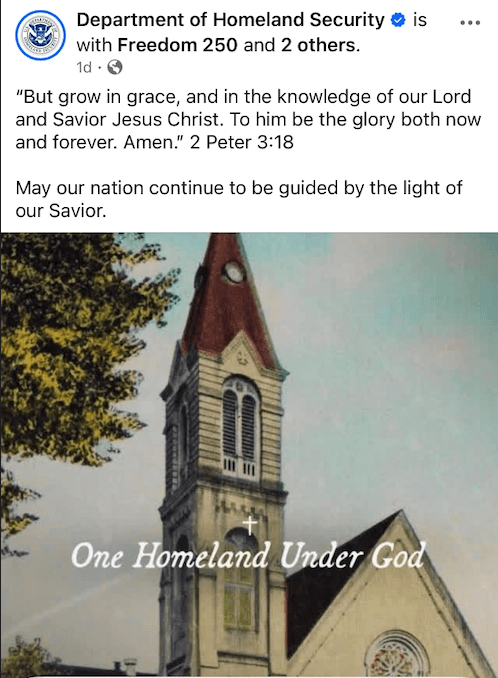
    A few days ago a friend of mine posted an image on social media from the Department of Homeland Security that I thought had to have been photoshopped. Forgetting the people who are leading this country right now, I thought to myself, there is no way this could be real. To my horror and surprise it was real, and it is not fantastic. The image is of a presumably white protestant church with the words, “One Homeland, Under God” with a social media caption reading:

    But grow in grace, and in the knowledge of our Lord and Savior Jesus Christ. To him be the glory both now and forever. Amen.

    – 2 Peter 3:18

    May our nation continue to be guided by the light of our Savior.

    This is white christian nationalism in action.

    This is the type of radical and blasphemous theology that leads to the horrific murders of our siblings.

    Yesterday Mansour Kaziah, Nader Awad, and Amin Abdullah were murdered in a house of worship. Abdullah was acting as the security that made it possible for this tragedy to not have been worse. As of the time of writing, only one of the murderers has been identified, both were teenagers. Hate speech was written on their guns. Allegedly there is a suicide note that contains white supremacist ideology.

    Last week in my post Ignorance Personified, I wrote about the kkk in America, and the fact that the leaders currently in power are still chasing those ideologies. For over a decade (and longer) the vilification of Islam, and the rampant Islamophobia that has been pushed by american leadership has been shameful.

    While walking up to a podium at a press conference, San Diego Mayor Todd Gloria was confronted by an incredible woman who yelled, “This is a fucking direct result of your leadership! Your leadership! Our Muslim brothers and sisters have been talking to you for how long? You had to fucking listen to them, Todd, just like you did with ICE… Zionist propaganda. And you’ll keep doing it as long as it lines your fcking pockets, won’t it? Show something! Worse approval rating than a fascist dictator with shit in his pants.She went on to say a few more things and you can watch the video here.

    Christian national theology is killing our siblings.

    I know I have been beating the drum of ripping out white supremacy wherever it takes root, and believe me I am tired of having to say it. But until all of us are free from this poisoned fruit, none of us will be free from it.

    You can support the community and families of those affected by the nonsensical violence by donating here.

    Grace and peace my friends.

  • Not Soon Enough

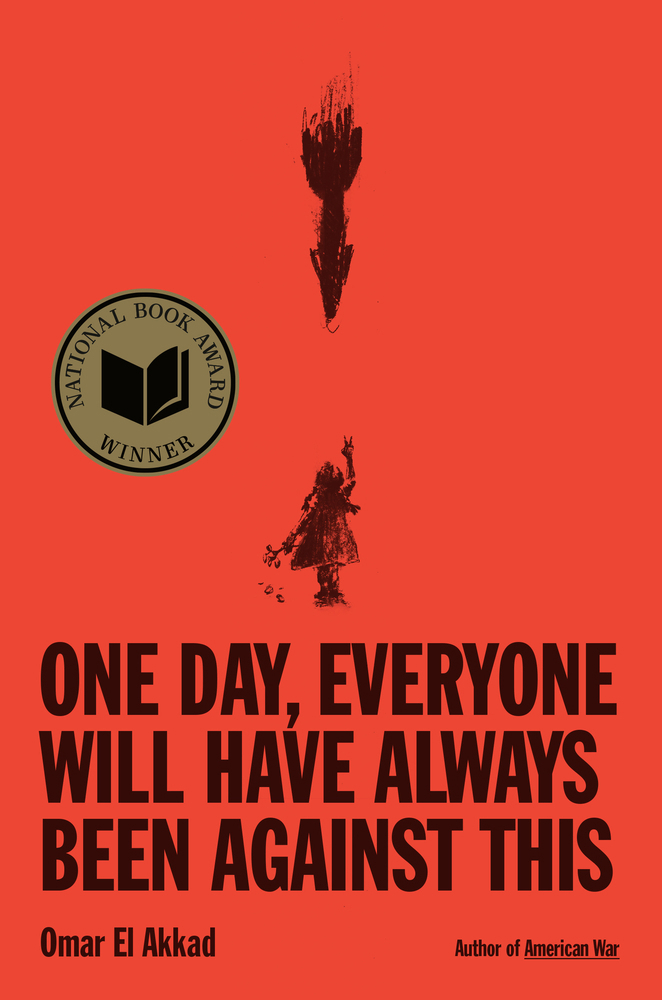
    There are some books that stick with you long after they are finished and one of my 25 of 2025 books, One Day, Everyone Will Have Always Been Against This, by Omar El Akkad is one of them.

    From the National Book Foundation:

    On October 25, 2023, after just three weeks of the bombardment of Gaza, Omar El Akkad put out a tweet: “One day, when it’s safe, when there’s no personal downside to calling a thing what it is, when it’s too late to hold anyone accountable, everyone will have always been against this.” This tweet has been viewed more than 10 million times.

    As an immigrant who came to the West, El Akkad believed that it promised freedom. A place of justice for all. But in the past twenty years, reporting on the War on Terror, Ferguson, climate change, Black Lives Matter protests, and more, and watching the unmitigated slaughter in Gaza, El Akkad has come to the conclusion that much of what the West promises is a lie. That there will always be entire groups of human beings it has never intended to treat as fully human—not just Arabs or Muslims or immigrants, but whoever falls outside the boundaries of privilege. One Day, Everyone Will Have Always Been Against This is a chronicle of that painful realization, a moral grappling with what it means, as a citizen of the U.S., as a father, to carve out some sense of possibility in a time of carnage.

    The way that El Akkad writes, it is like you are walking with him through what is going on, and parts of this book still stick in my mind over a year after reading. El Akkad provides a harsh look at the reality of what has happened to Palestinians, and everyone needs to read this. The title of this post, “Not Soon Enough” comes from my personal view of not understanding the long history of apartheid, and other horrors Palestinians have endured.

    Something I want to be very clear about is, the country of Israel that has been around since 1948, Judaism, and the ancient Israel of the Christian and Jewish Bibles, are not the same thing. I have spent most of my professional life in ministry working to weed out the anti semitic remarks, theology, and general view that Christians I cross paths with have unknowingly adopted. This is true in my writing, and academic pursuits as well.

    I state this because what is happening in Gaza, and Palestine in general is atrocious, and the fact that my tax dollars are helping fund this genocide makes my stomach turn. If like me, you had spent time in the group of believing that supporting Israel was not only the most moral thing, but what God required of you, but no longer feel that way, this book is for you. Like I said previously, it is not an easy read, but one worth doing.

    10/10, you can purchase it here.

  • Ignorance Personified

    Ignorance Personified

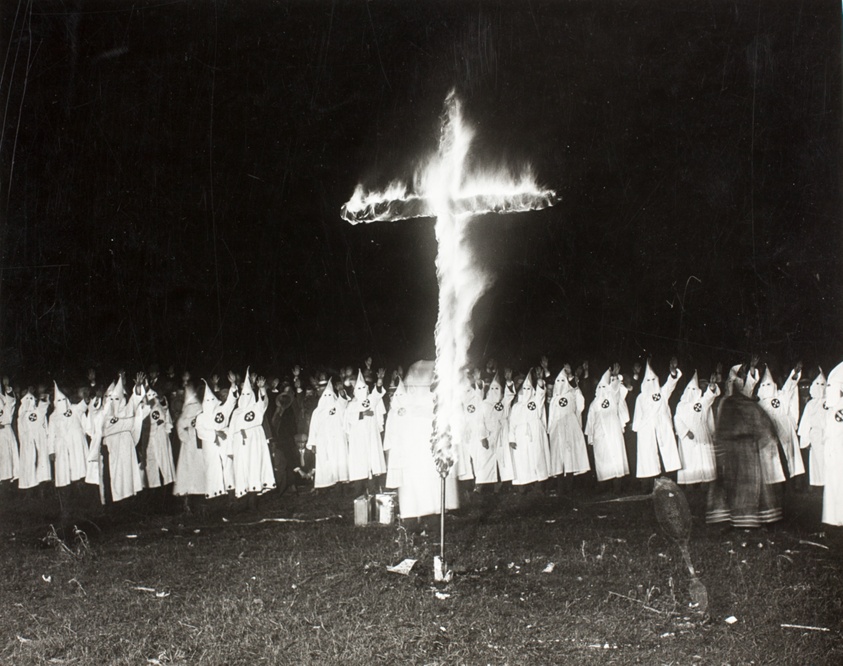
    In 1966, my father was walking with my grandfather from their car to one of the libraries in Dayton Ohio. While they were in route, my dad looked over and saw a group of people he didn’t recognize. So he asked my grandfather, “dad, why are those guys walkin’ around in nothin’ but their bed sheets?” The way my dad tells it, my grandfather shook his head and responded with, “Mike, that right there, is ignorance personified.” As the story goes, the white supremacists were showing up in hopes to intimidate the Dayton School Board to cave to their wishes. I was in early high school or late junior high when my dad told me about this, and it something I will never forget.

    How my grandfather described the ku klux klan in those two words has latched on to my soul, and has shaped my implicit bias when it comes to white supremacy. Anyone who thinks they are better than someone else, that has to “other” a fellow human based on the color of their skin is ignorant. However this description doesn’t pertain to just white supremacy, but it is a great encapsulation of the concept of bullies as a whole.

    It is not hyperbolic to say that we are living in a time where white supremacy is being enforced in ways two generations have not seen, but if we had only listened to black women and had taken them seriously it could all have been avoided.

    Like most decent people, I have been feeling a mix of speechlessness, disgust, and dismay with how this current administration has carried itself for the past year and a half (as well as the first four years of it). Not because I am shocked by anything they have done, for over a decade those of us who have been paying attention and doing the work have been told we are overreacting. So while sitting with this puddle of emotions I started a new book that is uncomfortably relevant. Last year my wife read, A Fever in the Heartland: The Ku Klux Klan’s Plot to Take Over America, and the Woman Who Stopped Them, penned by Timothy Egan, she told me I needed to pick it up, and I finally did. It is about the rise of the KKK in the early 20th century focused on Indiana, and it touches on how it shaped membership, American policy, and the murder of a young woman. Yesterday I was reading when I stumbled upon this little section:

    To the major victories of outlawing alcohol, disenfranchising black voters, and closing the door on most new immigrants ,the klan now hoped to set up a parallel government in the capital just as it had done in Indiana. The other goal was to prohibit the teaching of evolution.

    The klan backed a law in Tennessee that made it a crime for a public school teacher to explain any theory that denies the story of divine creation of man as taught in the Bible. The fear was that if evolution were accepted it would imply that all people have a common origin.

    For the klan that meant that there was no fundamental difference from themselves and the race they pretend to despise.

    I added the underlining in the quote above, but today people are still pushing klan ideology. None of this should be surprising, considering the moral majority and religious right were born out of the racist gripe of not wanting to integrate schools. Vouchers, and school of choice became the voice of this version of christanity before Roe v. Wade would be a glimmer in their eye. For myself, this is part of what makes the voter suppression and rights stripped over the past few weeks so hard to stomach.

    In 2021 Georgia passed SB 202, which changed early voting, and prohibited anyone other than poll workers from handing out water, which is what many of us call voter suppression. As mentioned previously, the past week we have seen what remained of the Voter Rights Act of 1965 stripped away. In that time, the states that originally voted against this act, have responded quickly with suppressing black voices by gerrymandering new maps. All decent people watching this happen in real time are reminded how deep white supremacy runs, and how much it ruins. What our current Supreme Court has done to this country is not only disgusting, but continues to prove white supremacy is alive and well in the halls of “justice.”

    However, upholding white supremacy in these halls is nothing new, so why are we surprised when they come after the rights of people of color. The truth is, what is happening now is breaking norms we naively thought would not be undone. Did we worry about it? Absolutely. Did white people take seriously the concerns of people of color when it came to what was on the line for the past decade? Absolutely not. For over a year we have been living with the domestic terrorism that the federal government has sanctioned when it comes to the disappearance of citizens and migrantes. It reminded me of another passage from Egan’s book:

    The klan would be a major force at the national conventions, no one onboard… doubted that the future of the country belonged to an organization of shrouded men clinging to the past.

    The fight over the last decade from the “America First” crowd has led us to this moment where the lives of our neighbors have been disrupted and destroyed by men in masks who are being led by others clinging to the past. Egan wrote in his book about the state elections that occured in just barely 100 years ago in Indiana that resulted in, “hundreds of small ways these [klan] loyalists could make life worse for those who were not white Protestants.” For years we have been seeing people say the quiet part out loud, and in reading that line I was disgusted by how relevant it still is. What is happening in Tennessee, Louisiana, Alabama, and other southern strongholds to suppress black and people of color’s voice right now is exactly why we must not remain silent.

    The reintroduction of Jim Crow voting districts, and the stripping of rights by christian nationalists, and others, does not reflect the values of Jesus. Groups like this do not want Jesus, because to follow him means to seek out the other and care for them. To be a good neighbor does not mean to have a mirror image next door, it is to welcome the diversity that makes all of us better. It is to say no to ignorance and yes to curiosity. It also means to practice the paradox of tolerance that Karl Popper made famous. This act where your society remains intolerant of the intolerant, by stamping out hate speech or othering, and uprooting white supremacy wherever it tries to flourish.

    I know that I am not the only one who feels the weight sitting on their chest about what is happening right now in the United States, and it feels like nothing can be done. We are not alone, and we can do many good things together, we just need to be brave and curious. This is a time to make our voices heard, one way is to follow this link to 5 Calls. It will take you to their, “Protect the Right to Vote and Fair Representation” page where you can call your representatives and ask them to support fair voting rights. Get friends together and turn it into a party, you’d be surprised to find out how much easier it is to do this with a crowd of those you love and trust.

    My friends, it is up to us to carry on this work, and I am asking you to do your part in this peacemaking. Non-violence resistance has worked in the past, and it will continue to work if we remain steadfast and curious.

    Grace and peace my friends.

  • Wake Up Sheeple

    Wake Up Sheeple

    Hey, I am back after a bit of some time off. It was nice to take a short break from writing a few times a week and to observe Lent, Easter, and a bit of vacation without having to worry about this.

    Now I’m back on my bullcrap, and today’s post is brought to you by John 10:1-10:

    John 10:1-10

    Jesus said, “Very truly, I tell you, anyone who does not enter the sheepfold by the gate but climbs in by another way is a thief and a bandit. The one who enters by the gate is the shepherd of the sheep. The gatekeeper opens the gate for him, and the sheep hear his voice. He calls his own sheep by name and leads them out. When he has brought out all his own, he goes ahead of them, and the sheep follow him because they know his voice. They will not follow a stranger, but they will run from him because they do not know the voice of strangers.” Jesus used this figure of speech with them, but they did not understand what he was saying to them.

    So again Jesus said to them, “Very truly, I tell you, I am the gate for the sheep. All who came before me are thieves and bandits; but the sheep did not listen to them. I am the gate. Whoever enters by me will be saved, and will come in and go out and find pasture. The thief comes only to steal and kill and destroy. I came that they may have life, and have it abundantly.”

    The parable found here should give us pause and time to reflect because of how relevant Jesus’ teachings continue to be in our world. While I am sure we can all think of times when we have been involved in a conversation or situation where one of us is thinking, “there is no way this sibling in Christ reads the same Bible I do.” This has happened to me probably more times in the past 11 years than the rest of my life combined.

    As I was reading and preparing for my noonday prayer service, two verses struck me which are, “the sheep follow him because they know his voice” and “they will not follow a stranger, but they will run from him because they do not know the voice of strangers.

    For a few moments I just sat staring out the window, because all I could think of was, “this is the gap of the Gospel, and people who are stuck on the idea that it is woke propaganda.

    In an interview with NPR in 2023, Russell Moore, Editor and Chief of Christianity Today stated the following on the crisis of Christianity in these churches:

    It was the result of having multiple pastors tell me, essentially, the same story about quoting the Sermon on the Mount, parenthetically in their preaching— “turn the other cheek” —[and] to have someone come up after to say, “Where did you get those liberal talking points?” And what was alarming to me is that in most of these scenarios when the pastor would say, “I’m literally quoting Jesus Christ” would not be, “I apologize.” The response would be, “Yes, but that doesn’t work anymore. That’s weak.” And when we get to the point where the teachings of Jesus are subversive to us, I think we’re in a crisis.

    In his book, John’s Wisdom, theologian Ben Witherington writes:

    John 10 it appears, in fact that we are dealing with two parabolic images that have been combined here, one having to do with Jesus ads the good shepherd, and one having to do with Jesus as the door, or gate, for the sheep. (pg. 187)

    Witherington goes on to write that:

    It should be seen from the general tone of this material that this teaching is directed to a situation where there are competing claims about who is the true leader and way for God’s people…

    …this material does not suggest a purely defensive and in-house situation (a flock is being raided by outsiders, but suggests competition for the same sheep and a situation where Jesus and his followers are still reaching out for “other sheep” not of his fold. In other words, it will not do to interpret this material without due attention to its missionary overtones. (pg. 188)

    Christian nationalism has ripped the mask off of the nice white gospel in a way that has not been seen or at least felt this public, since the Civil Rights era. When John writes about the confusion of the listeners, it is not so hard to believe how true it rings almost 2,000 years later.

    When we are wake up to accepting our place in God’s family, we are called to give up some things, usually revolving around our ego. Not that we cannot use our talents, but I am thinking more about how we feel when there is a clear line drawn between us and the “other.” How we give into the class system that keeps our collective humanity separated, and the need and want to drive down “others.”

    My friends, may we realize that there is a better way, and that as we shepherd others, we continue to not hop gates, but to seek learning and understanding from the one who reminds us to love our neighbors as ourselves.

    Grace and peace my friends.