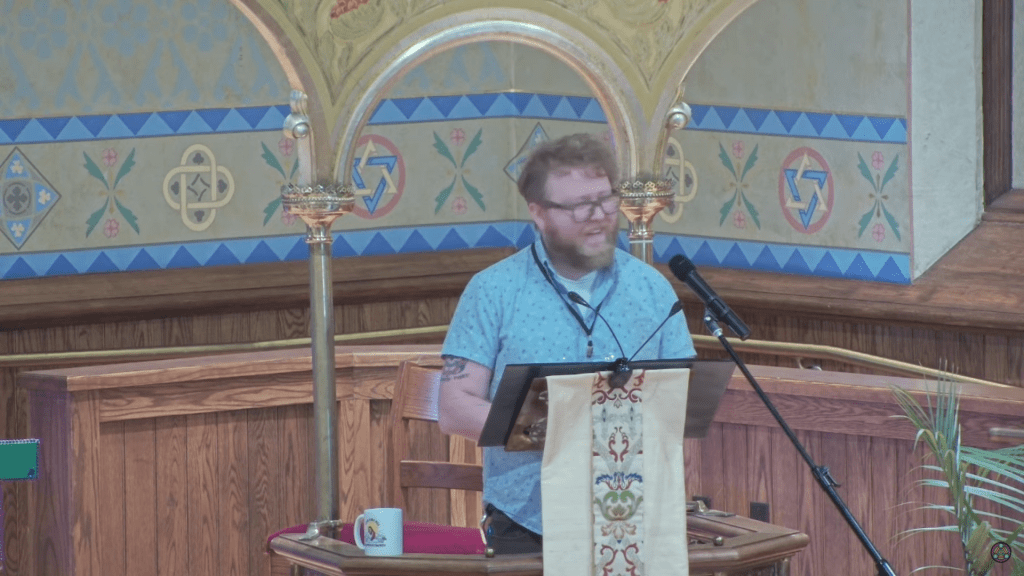
This past Sunday I had the honor to preach at my home church. Below is the sermon, but if you feel like watching it you can start the above link at 27:20 and enjoy all the little jokes I put in.
I’d like to open with a quote that I couldn’t find a home for, but it has latched onto me. It is from one of my favorite theologians, Ben Witherington. “It would appear that Mary’s announcement of the good news was insufficient to transform the mood of these male disciples.”[1]
I doubt, at times, there is any disciple more relatable than Thomas. I mean, you miss one hangout with the crew and suddenly, you’re supposed to believe your teacher is alive. It makes no sense. It sounds like a giant practical joke if you’re Thomas. It would be difficult not to respond with the, “I won’t believe anything until I put a finger through his hand!”
After all, it wasn’t like people came back from the dead all the time. But when Jesus comes back, and Thomas sees him, and while we are not told Thomas touches the wounds, we know for Thomas, the world is turned upside down.
Jesus has pulled one over on humanity, and the rest of the world because here was someone who has moved from death to life, from cursed to redeemed.
When Jesus asks Thomas, “have you believed because you have seen me?” what answer could be expected other than yes?
When I read this section of John’s Gospel, the space between the crucifixion wound, the time it took for Thomas to hear of Jesus’ resurrection and seeing him really stood out.
How many times do you think the Spirit tried to make contact with Thomas that week?
Where their times when Thomas was sitting alone at night, awake wondering if this was true that Jesus was back, and was he pushing the door shut while the Spirit was trying to break it open?
What makes the Apostle Thomas so relatable for me, is there is space for his doubt. Space for his thoughts. And space for him to allow God to enter his midst and partner with him.
It is that doubt that drives Thomas back to meet with the other disciples, and it is that doubt that shatters in the face of hope.
There is no way we get to our first reading from Acts without doubt. Everyone one in that group was Thomas, except for the people the entire history of the church owes its allegiance to, and that is the women.
Now, this newfound hope in the future of the world changes the disciples in a way that is still echoed almost two thousand years later into this very room. I say this because there is no way we go from doubts of resurrection to the hope of the holes in Jesus’ palms and not end up in the position Peter and the apostles find themselves in, in Acts 5.
So, this council that Peter and the others find themselves in front of, what the heck is it? Well, according to the Oxford Annotated Mishnah, we can be certain of a few things.
When we ask, who was this council we can say:[2]
- It is the judicial and deliberative body that was presided over by the high priest
- This was the justice system for ancient Palestinian Jews
- This group covered civil and penal law
- There were two courts of judges depending on the severity of what was being decided, 23 judges or 71 judges
- It was made up of the elders, sages, and various priestly factions of the day
- Because it was controlled by the high priest, this group the apostles find themselves in front of, the same group that fought for the condemnation of Jesus, are the Sadducees
What did this council do?[3]
- Yes, they deliberated over civil and penal law, but that meant a few things
- They oversaw when civil procedure and criminal procedure acted as a fulcrum, depending on how the case went it would be a fulcrum for criminal proceedings
- They also were in charge of the criminal execution and capital crimes, along with the liability for each one
Finally, who ran this council:[4]
- At this time, the Sadducees. The Chief Priest Caiaphas that we heard from taking Jesus to Pilate during Holy Week was in charge of this group
- According to Rabbi Jacob Neusner the Sadducees their name means “righteous one” so that’s hard to argue with
- But they also, at the time in first century Palestine, rejected the “recent belief” of the afterlife and resurrection. Resurrection and afterlife theology belonged to the Pharisees.
The Sadducees are only spoken of a few times, as we see Jesus mostly go toe-to-toe against the Pharisees in the Gospels.
So why does all of this matter?
The Apostles are standing in front of people that have the ability to kill them. The Mishnah I quoted from earlier also says that there are, “…four execution methods—stoning, burning, decapitation, and strangulation—and, while it lists almost thirty capital crimes, it gives greatest attention to blasphemy…[5]”
Now, something I want to be clear about is, this is not a bloodthirsty group, and if not careful, they can be portrayed as one. The Mishnah says, A Sanhedrin that executes a transgressor once in seven years is characterized as a destructive tribunal. Since the Sanhedrin would subject the testimony to exacting scrutiny, it was extremely rare for a defendant to be executed.[6] The care for the life of a person was extremely important to this council.
But, if you are a person preaching of the resurrection of a perceived blaspheming rabbi, it is easy to see why the high priest would want that locked down. Not only do the Sadducees in charge not believe in resurrection or an afterlife, they had just had Jesus killed.
Peter says, “we must obey God rather than human authority.” The God of our ancestors raised up Jesus, whom you had killed by hanging him on a tree.” Part of the culture in first century Palestine with members of ancient Judaism is calling out scripture in conversation.
Everyone sitting in that room knew that Peter was connecting what happened with Jesus to Deuteronomy 21:22-23 which reads, When someone is convicted of a crime punishable by death and is executed, and you hung him on a tree, his corpse must not remain all night upon the tree; you shall bury him that same day, for anyone hung on a tree is under God’s curse.
Scholar Ben Witherington writes that Josephus, a Jewish historian who was alive during the first century in Palestine, “indicates that such a public hanging of the body followed stoning and was the punishment for the crime of blasphemy”[7] So if someone blasphemed, and they were stoned for it, their body was hung on a tree as a deterrent. If you know your American history, it should be no surprise that the incredible Dr. James Cone connected this in his book The Cross and The Lynching Tree.
When Jesus died, he was taken off the tree branches fastened into a cross and buried the same day. What Thomas is feeling in today’s gospel is the same thing the disciples felt walking on the road to Emmaus. It is the same thing Judas felt when he killed himself in the same way his friend died. Despair because the person they loved, the person they thought was going to overthrow power, empire, Rome, etc. was killed and cursed.
For the disciples before easter, there is no coming back from death, and to be cursed by God in the manner of your death must mean it was all a waste.
Every blister, every hungry night, every thirsty morning, the family and business you left behind to follow this Jesus around for three years amounted to nothing, because in the end he is cursed.
That is, until God turns that doubt and despair into hope and conviction.
This conviction and hope that the spirit burns into Peter and the rest of the Apostles, is the same hope and conviction the spirit burns into us today.
This is the same Spirit, hope, and conviction that pushes us to say that while some may not recognize our non-binary siblings, we are emboldened to say we see you, we name you, and we love you.
This is the same Spirit, hope, and conviction that pushes us to say that what is happening in Middle East right now breaks God’s heart, and Palestinian children deserve to grow old.
This is the same Spirit, hope, and conviction that pushes us to say that Black lives still and always will matter.
This is the same Spirit, hope, and conviction that pushes us to say that we love all our queer siblings.
This is the same Spirit, hope, and conviction that pushes us to say that we must protect trans kids at all costs.
This is the same Spirit, hope, and conviction that pushes us to say that we, know no person is illegal, and we must care and watch out for our neighbors.
This is the same Spirit, hope, and conviction that pushes us to say that pushes us to wake up every Sunday morning and make breakfast.
This is the same Spirit, hope, and conviction that pushes us to say that we, like Father Greg Boyle, see and know the unshakeable good in all people.
This is the same Spirit, hope, and conviction that pushes us to say that at Trinity Episcopal Church, in downtown Toledo, you are welcome, wanted, and safe.
This is the same Spirit, hope, and conviction that pushes us to say thanks be to God, and amen.
[1] Witherington, John’s Wisdom, pg. 342
[2] Cohen, Oxford Annotated Mishnah vol 2., pg. 490
[3] Cohen, Oxford Annotated Mishnah vol 2, pg. 490
[4] Cohen, Oxford Annotated Mishnah vol 2, pg. 490
[5] Cohen, Oxford Annotated Mishnah vol 2 Pg. 491
[6] https://www.sefaria.org/Mishnah_Makkot.1.10?lang=bi&with=all&lang2=en
[7] Witherington, Acts, pg. 232
 George of Sylvania
Leave a comment