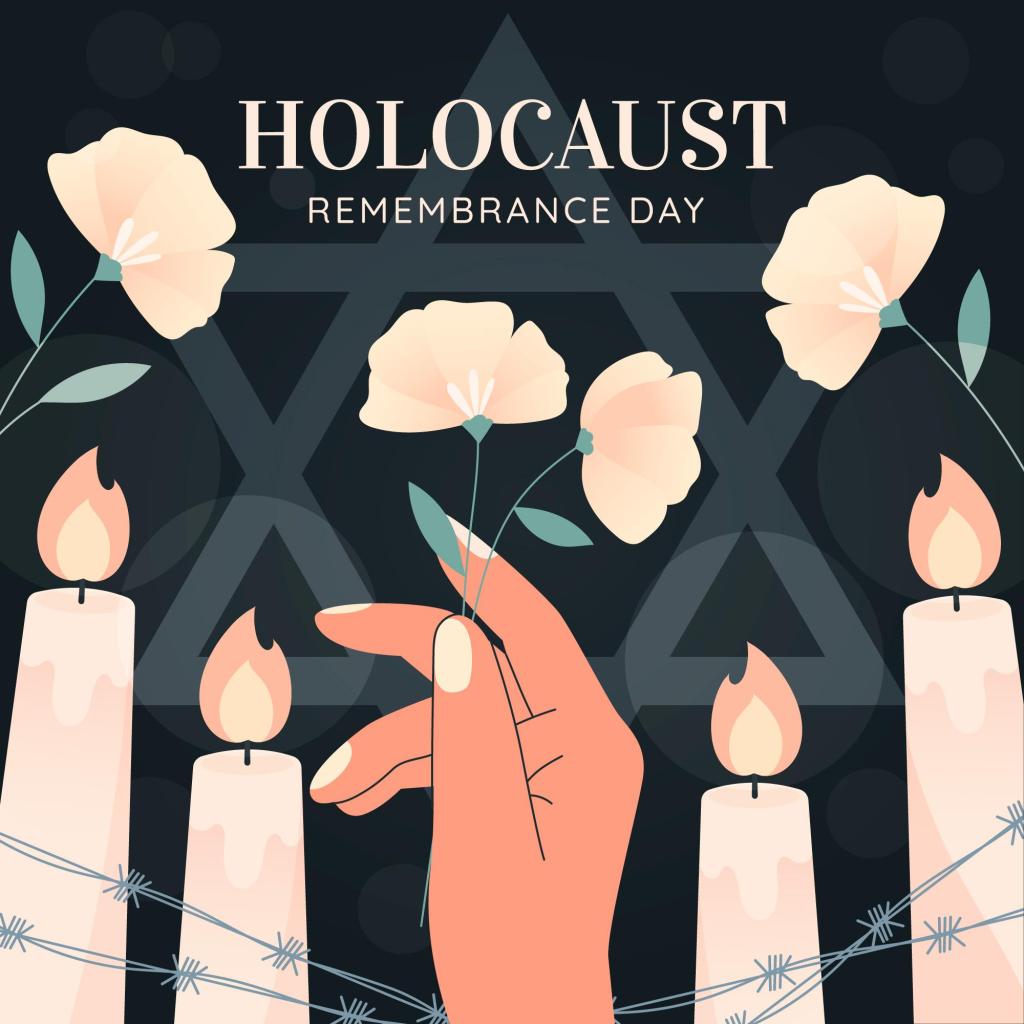
Image by pikisuperstar on Freepik
*This was written before the cease fire in Palestine*
Today is Holocaust Remembrance Day.
Every year, I spend quite a lot of my time in January studying the Holocaust. This comes about in different ways: reading books, watching documentaries, or listening to podcasts. With my love of Jewish roots in Christianity, and seeing how Christians have perpetuated anti-Semitic theology over the past two thousand years, I work very hard not to. Often, because I work in a church in the United States, there are a lot of assumptions I support what is happening currently in nation-state of Israel.
I do not support ethnic cleansing or genocide in any form. Especially those that my tax dollars are helping to fund.
This year, instead of focusing on the Shoah (usually what is refereed to as the Jewish peoples experienced during the Holocaust), I’ve branched out to wider accounts of murder and ethnic cleansing.
One book I finished this month was, The Ethnic Cleansing of Palestine, written by Ilan Pappé. Born in Haifa Israel to parents that fled n*zi persecution in the 1930’s, he is a historian and author. If I had not read a few books on what happened in the 1940’s to the Jewish peoples of Europe, personally, Pappé’s book would not have been as devastating. The tactics described in the book between the Israeli and British forces against the Palestinians will make you sick. There is a lot of similarity to what persecuted European Jews experienced in the mid 20th century.
Something that really stood out toward the beginning of the book was when Pappé speaks about the history of occupation of Palestine. How, this was something Palestinians were used to. However, for the first time, Palestinians experienced being displaced from land and homes their families had worked and lived on for generations.
What is happening right now to the Palestinians is unacceptable.
What happened to European Jews in the 1930’s and 1940’s (as well as pogroms throughout history against them) is also unacceptable.
What is happening to the Uyghurs in China right now is unacceptable.
The persecution or mass deaths of any group of people because of their ethnicity or religious affiliation is unacceptable.
May our prayers and actions remember that today of all days, and those that follow. Be sure to read the prayer by Rabbi David Katz at the end of this.
If you are interested in learning more about the Shoah, or other instances of genocide, I highly recommend the following (in no particular order):
The Holocaust: A New History by Laurence Rees
Shoah: A Documentary by Claude Lanzmann
Night by Elie Weisel
Man in Search of Meaning by Viktor Frankl
A Shortest History of Israel and Palestine by Michael Scott-Baumann
The Ethnic Cleansing of Palestine by Ilan Pappé
Auschwitz: A Doctor’s Eyewitness Account by Dr. Richard Seaver
On Palestine by Noam Chomsky and Ilan Pappé
The War on Uyghurs: China’s Internal Campaign against a Muslim Minority by Sean Roberts
The Uyghurs: Strangers in their Own Land by Gardner Bovingdon
We Uyghurs Have No Voice: An Imprisoned Writer Speaks by Ilham Tohti
A Prayer for Yom Hashoah / Holocaust Remembrance Day
By Rabbi David KatzRibbono shel Olam – Master of the Universe:
On this most solemn of occasions, we open our hearts, minds, and souls to you.
As we remember the six million, the eleven million, the indifference, and the evil;
As we honor the heroes, the martyrs, the survivors, and the victims;
We ask you to soothe our souls, to amplify our memories, to strengthen our resolve, and to hear our prayers.
We ask for your presence in our midst; for healing, light, and love to soothe and ease our pain, as we commemorate the horrors that were committed not long ago. Please, oh Holy One, be gentle with our souls.
We ask that you help us to forever remember the stories we hear. As tales of the atrocities are shared, as we re-encounter the unthinkable, we ask that these memories be strengthened and never fade, in the hope that those who remember the mistakes of the past will not repeat them. Please, oh Holy One, amplify our ability to remember.
We ask that you strengthen our will, that you help us to ensure that the world does not again see such monstrosities. We say “never again” and we dedicate ourselves to this principle, to the idea that justice does not allow persecution, that genocide shall not be repeated, and that vigilance is the responsibility of freedom, at all costs. Please, oh Holy One, make manifest our resolve that these horrors remain but memories.
We ask that you answer our prayers. We pray that the call of evil falls on deaf ears, that those who fight for freedom and justice always prevail, that those who need protection do not become victims. We pray that the lessons we learn from this darkest hour allow all humankind to better itself, and to truly and nobly embody the idea that we are each made in Your image. We pray for the souls of the millions and millions of victims of this brutality; we pray that we honor their lives and their memories by observing this day, and by doing everything in our power and beyond to make sure that no such shadow again darkens our world.
Above all, we pray for shalom—for wholeness and peace—to be in our midst, now and forever. Please, oh Holy One, answer our prayers and bring us a world devoid of hatred, filled instead with peace.
Ken yehi ratzon – may this be God’s will. And may we all say together, Amen.



 George of Sylvania