About six months ago, I purchased a bottle of Absinthe because, for some unknown reason, I thought it was a good idea. It had been at least a decade since I had tried it, and it did not go down very well. The wormwood in the drink, if you have never had it, leaves an incredibly bitter taste in your mouth if you don’t mix the properly. The other day, as I sat drinking my morning coffee, I was wondering what mixture of mouthwash/seltzer water/whatever I had that is now leaving this similar taste in my mouth.
That’ll flavor combination will wake you up.
As I am sipping this, I have been working my way through the prophet Amos in my morning quiet time. This reading of the prophet has been compounding some outlying frustration. A genocide has been broadcasting in real time, in spite of murdering journalists, in Palestine for those of us paying attention. Children, and people of all ages have been intentionally starved, and the footage of it will leave a mark. Kids, and others, have been murdered while waiting in line for water, food, etc. The intentional cruelty, and war crimes committed is an abomination.
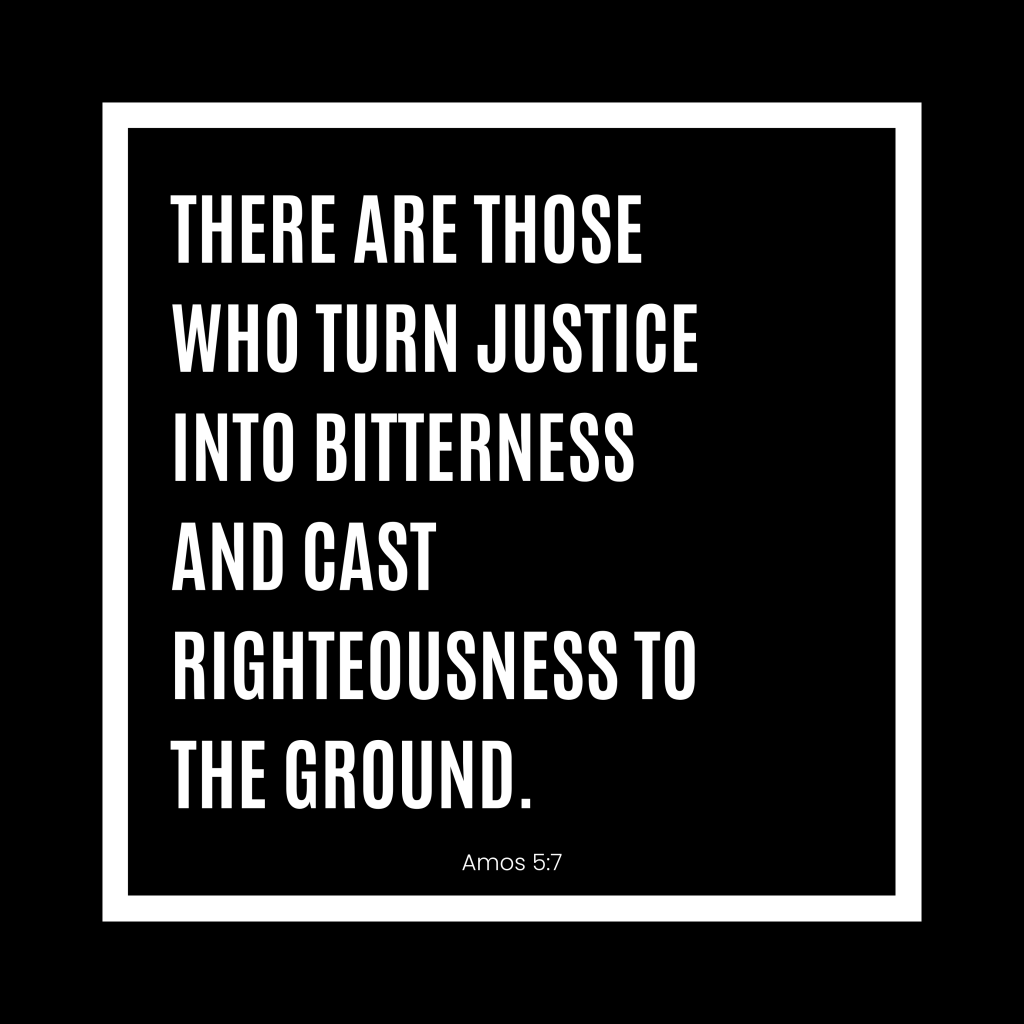
So reading through Amos, seeing this massacre play out in real time over the past 18 months and all of it taking place in the region the prophet is talking about has brought a new flavor to the text. For about a week, Amos 5:7 (NIV) has had its claws in me, “There are those who turn justice into bitterness and cast righteousness to the ground.” I have been meditating on this, and it has like a stick in my craw, but I couldn’t figure out why.
There is the obvious tug at what Amos is saying on face value, but I decided to check out the Apostolic Polyglot, an interlinear literal Greek-English of the Christian Bible. When I read it, and it made no sense, I looked to the New Oxford Annotated Bible. It is just a fancier version of the New Revised Standard Version, which reads:
“Ah, you that turn justice to wormwood, and bring righteousness to the ground!”
There it is, the stick in my craw.
The verse in the New International Version was too nice for me. Bitterness can be a variety of things. I love lemons, and they can be bitter as hell. But you know what, wormwood will make almost anyone gag!
Every time we read or see what has been happening in Palestine, Sudan, and to the Uyghurs, we should taste wormwood in our mouths.
Every time we read about those fighting against releasing the Epstein client list, we should taste wormwood in our mouths.
Every time we see another mass shooting in the news, we should taste wormwood in our mouths.
Every time we see or hear reports of ICE agents snatching people off of the streets, we should taste wormwood in our mouths.
Every time we see military personnel being mobilized against citizens, we should taste wormwood in our mouths.
In fascism, there is no peace. There is no peace without reconciliation. There is no reconciliation without justice. There is no justice in attempting to control others. Control is void of love, and without love, God can be incredibly difficult to find.
It may seem like nothing, but speaking about what is going on may help wake people up. Going on the record and contacting your representatives is called slow activism for a reason, but it is worth doing. If you have not tried 5 Calls yet, follow the link, and use it for good.
Everyone has to start somewhere, and I hope the bitter taste in your mouth that the Trump administration has helped bring about in the past eight months spurs you into action.
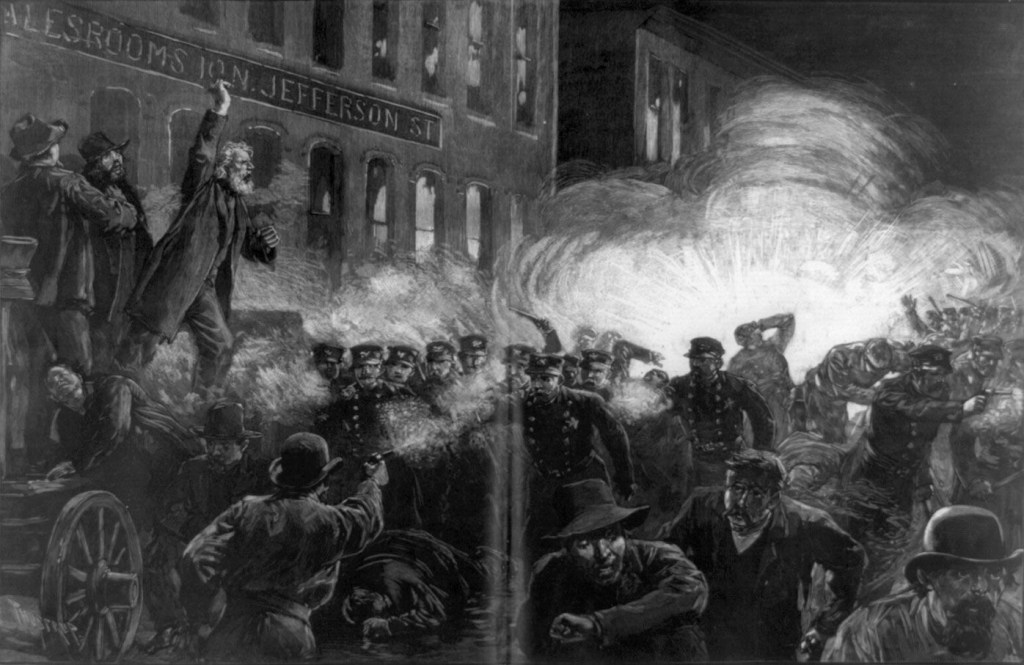
Wood engraving of the Haymarket Riot by Thure de Thulstrup, published in Harper’s Weekly on May 15, 1886
Every week my church releases an e-newsletter that starts with a section called “dear friends.” This is usually a letter written by a rotating crew of people focused on something happening around the church community, or has recently occurred. This week I had the pleasure of writing about Labor Day. The following is that section:
Dear friends,
It is Labor Day Weekend, which means the church office is closed Monday, and will re-open on Tuesday. While this is a time for rest, hopeful relaxation, and a nice cookout, it is important to remember how we got here. Labor Day wasn’t a federal holiday until 1894, when President Grover Cleveland signed it into law. While we now recognize this weekend as a time where summer ends, and school begins, it is something so much more. It is a time we remember the blood that was shed by union leaders to bring about fair working conditions, and to remove power from the few, the all. From the Haymarket Affair in 1886 and the Pullman Strike in 1894, to our own autoworkers in Toledo and the Libby Glass strike that started this past week, standing up for the rights of workers remains a justice issue.
In the words of Dorothy Day, the infamous Catholic Worker leader, I offer up a prayer she wrote while praying at the Shrine of the Immaculate Conception, “I offered up a special prayer, a prayer which came with tears and with anguish, that some way would open up for me to use that talents I possessed for my fellow workers, for the poor.”
This week flyers for the knights of the klu klux klan was found scattered around in Norwalk Ohio, and according to the news story from 13ABC Toledo (which you can watch by clicking here), this is the second time in a few months this has happened.
I have been relatively quiet on the writing front even though there has been much to say. There is so much shit going on, I haven’t known where to start, so here are four things that have happened since I posted my last sermon:
President Trump has occupied Washington DC with armed National Guard personnel, including those from my own state of Ohio. (Click here)
President Trump decided to comb through the Smithsonian and remake history in his image. (Click here)
The concentration camp Alligator Alcatraz has opened up, and is on its third attempt to stay open. (Click here)
Don’t get me started on the Epstein list. Everyone on it needs to be arrested.
Israel continues to commit war crimes against Palestinians killing journalists, people trying to get food, and mass amounts of children. (Click here)
And now, I pull open the news to see KKK flyers in my neck of the woods, while having sifted through conservative hate messages and comments targeted at my place of worship for our incredible presence at Toledo Pride. In addition to that, a friend of mine shared a first hand account with me of racists trying to instigate a fight at a baby shower.
This year the state of Ohio passed our version of the Parents Bill of Rights, and kids are being introduced to Lifewise Academy during their school hours at their parents permission. Lifewise is a christian nationalist curriculum and should have no place in public schools. The flyer found in Norwalk has a line written on it that says, “stop attacking our christian values.” Any religion that puts national values first, and upholds whiteness is void of Jesus’ love.
Full stop.
I’d say it is not that hard, but it is because following the call of Jesus costs us, it costs everyone.
Jesus’ love is not found in exclusion, but inclusion.
Jesus’ love is nowhere near white power, because Jesus remains with the powerless.
Jesus’ love casts out hate, and emboldens righteous indignation surrounding those on the margins (see table flipping, sermon on the mount, etc.).
To paraphrase Matthew 6:24 you cannot love and seek power, you cannot love and seek money, you cannot love and uphold whiteness, and serve Jesus at the same time.
Keep an eye on each other, it’s not dark yet, but it’s getting there.
The day I was finishing up the sermon, the US bombed Iran. The context is important for how this starts.
Whenever there is a global, national, or local tragedy and I am preaching, I leave a minute for us to center ourselves. With the United States bombing Iran yesterday, I am sure we are all feeling and thinking different things right now. So please, let us take a moment to remember the community God calls us to be in this world.
There is so much that happens in this passage that it is so easy to get caught up in not the details but some of the larger aspects of the story. So, I am going to address two specific things, then move on to what I believe is the core of the story. These two things are demon possession and what it means to be the opposite of Galilee.
What we read as demon possession in the Bible can often be seen and understood today are mental health problems. Not everything is Regan from The Exorcist spewing pea soup. For example, if there was a story of someone Jesus encountered that could not make a decision due to a demon that had kept them in a spot of fear, there is a good chance you’d be reading about me and my anxiety struggles. Thank God for SSRI’s, can I get an amen [pause for amen]?
Scholars cannot agree on where this particular city was located. What is agreed upon is that it was somewhere in the Decaplilis. So, the question remains then, what does it mean to be the opposite of Galilee? Well, to be taken at face value, we generally know that while the region was on a trade route, there were, like today, few people who held a lot of wealth, while most people were poor. So, when we think of Gerasene, a jumping off point is this is an area where people had access to money, or at least, were middle class. We also know that Galilee was a Jewish settlement, Gerasene was an area where gentiles roamed and lived. What makes this story even better is that, if we remember, Luke is the only author of the New Testament that was gentile. So, this story does a great job foreshadowing the ministry to come in Acts of Jesus’ message reaching past the borders of Roman Palestine.
This man that Jesus meets on the shores of this city is the model opposite of himself, and Luke makes sure to recount the story as such. Elaine Heath, current abbess of Spring Forest, an intentional Christian community, and former Dean of Dude divinity School points out a few interesting things:
He is in every way “unclean.” Driven by a legion of demonic forces, the man is scarcely human anymore. He lives in the tombs among the dead. He is naked, unpredictable, violent, and alone. He is also a Gentile; thus, the phrase “opposite Galilee” refers to much more than geography.[1]
What the author is trying to convey here, is that this region and person is the opposite of what Jesus and Galilee represent. With that in mind, I would like to get to the heart of what I have been meditating on with this passage. It is no secret that I spend a lot of my time reading historical and contextual books or articles when preparing for preaching. I do that because it is how I learn, how I process, and I enjoy bringing nuance to the text. I enjoy working with something ancient and pointing out the incredible relevance.
In my opinion, this passage needs none of that work. It is important to understand the context, and mental health awareness. But a surface reading of this could suffice.
At the heart of this is someone who is hearting almost beyond repair, and his community thought it was best to chain him up. When that didn’t work, they let him run around naked among the dead because sometimes ignoring the people who need the most help is easier.
What breaks my heart about this passage is that the more things change, the more they remain the same.
For several years, a man named Dan Rogers was the head honcho at Cherry Street Missions. Every year he taught a leadership course to those in non-profit, ministry, etc. That were interested in understanding the unhoused, other needs in downtown Toledo. He would start almost every new class with a story that went like this. One day he was walking down the street on his way to lunch, and he saw someone who had been a resident of Cherry Street.
It was a busy sidewalk with people passing by, and Dan called out to this man by name. After a few minutes of talking, the man started crying because he had been there for three days with people passing by, and Dan was the first person to talk with him. The first to recognize this guy’s humanity, and unshakeable goodness.
Now, I personally do not care if that actually happened, or if it happened that way, because it rings as true as this story in Luke does. This man was sick, and in need of dire help. There is a moment when the demons inside the man plead with Jesus that he does not send them back to the abyss. I would like to think about this in a new way. So often when we are caught up in our own trauma and demons, we become comfortable with them. They keep us company when no one else will.
The known is always more comfortable than the unknown, even if it is unhealthy. James Thompson wrote that, “this story also suggests that the salvation of some creates hostility with others.”[2] Thompson is specifically referring to Jesus potentially ruining someone’s livelihood when he sends the possessed pigs into the water to drown. But if we think about salvation found in the Greek word Soteria, salvation will always cost us something.
You have heard me preach on this before, Soteria, means to provide safety, and providing a safe space costs us. We know this not just because of our individual experiences but communally with restarting our community breakfast. Trinity is now no longer just a safe place for those of us who gather to worship, but the 90-100 people that come weekly to lay their burden down and be cared for.
But there is one thing we all have in common with the suffering man in this story. At the end of the day, I am confident in saying that we would all much prefer to go with Jesus physically. To follow him as he teaches, preaches, and heals. But like the man, after our time is done here today, we will be sent back out into the streets. At the end of service, we will be invited to share what the lord has done for us as we navigate the known abyss.
My friends, this encounter in Luke is boiled down to how communities at times other those who need community the most. As we move through the week ahead, may we remember that the cost of maintaining safety and deliverance can be high, but it is a load we carry together. And that, in community there is no thing that divides us because of Christ in us as the Apostle Paul wrote in Galatians. The only thing that divides us, is how we choose to measure and “other” those around us.
Amen.
[1] Heath, E. Feasting on the Word: Year C vol 3, pg. 166
[2] Thompson, J. Feasting on the Word: Year C, vol 3. Pg. 169
Jesus said to his disciples, “These are my words that I spoke to you while I was still with you– that everything written about me in the law of Moses, the prophets, and the psalms must be fulfilled.” Then he opened their minds to understand the scriptures, and he said to them, “Thus it is written, that the Messiah is to suffer and to rise from the dead on the third day, and that repentance and forgiveness of sins is to be proclaimed in his name to all nations, beginning from Jerusalem. You are witnesses of these things. And see, I am sending upon you what my Father promised; so stay here in the city until you have been clothed with power from on high.” Then he led them out as far as Bethany, and, lifting up his hands, he blessed them. While he was blessing them, he withdrew from them and was carried up into heaven. And they worshiped him, and returned to Jerusalem with great joy; and they were continually in the temple blessing God.
Luke 24:44-53
Every other week, I have the privilege of leading a noon prayer service. This week I decided to use the Ascension of Jesus early, and this is what you get.
Jesus has a way of revealing to us what is already present, but we, like the disciples at times, are unaware. In the Sermon on the Mount, he drills down on the underlying feelings that we can harbor until they become too much and come out in various ways. Whether that is anger that turns into murder, lust that turns into adultery, or praying and giving money to the poor so we can be seen doing it. When he speaks about the kin-dom of heaven in Matthew 13:47 and speaks of it as a fishing net that is full and brought into the boat, then the bad fish are discarded. Something that makes sense when we realize that in a new heaven and earth, where love and justice reign, those who continue to choose and seek power over others would not be happy there.
In Mark’s Gospel, Jesus teaches the Parable of the Sower, where the different seed falls on various terrain, and the plants that grow reflect wisdom and following his teachings, or the rejection of it. These are people that the disciples would have experienced first-hand but presented to them in a new way. We all know the Parable of the Prodigal Son where we are confronted with our own internal conflicts of being the younger son, older son, and parent in that position. However, what Jesus does here is something kind of new, but what their ancestors would have wrestled with. While God sends the power of the Holy Spirit to the disciples, that power is all around us. It is easy to forget that at the time God showed Godself to Abraham, religion was regionally based.
When the Temple was destroyed and the ancient Israelite’s found themselves enslaved in Babylon, they believed God left the temple and went to dwell with them. When they moved back to ancient Palestine and rebuilt the temple, God went back to dwell in it. Even in parts of Christian theology when the temple curtain is ripped from top to bottom, it has been said that was when God left the temple because of Jesus’ sacrifice. The idea being, there was no barrier between God and God’s people anymore.
But what Jesus points out in this part of Luke’s gospel, is that Jesus’s students will be sent what was promised. The power of the Holy Spirit will come to the disciples after Jesus ascends to be with God. While the delivery may look differently, Jesus is telling the disciples to expect something that has always been around them. While I cannot remember if I had read it, or was told this, but there was an idea that the burning bush Moses found himself in front of had been on fire or generations. This bush that was on fire but not consumed by fire was just sitting there for who knows how many years just waiting to be noticed, and it wasn’t until Moses came along that it was. Similar to Jacob waking up after seeing the dream of the ladder and realizing God was that place and he did not know it.
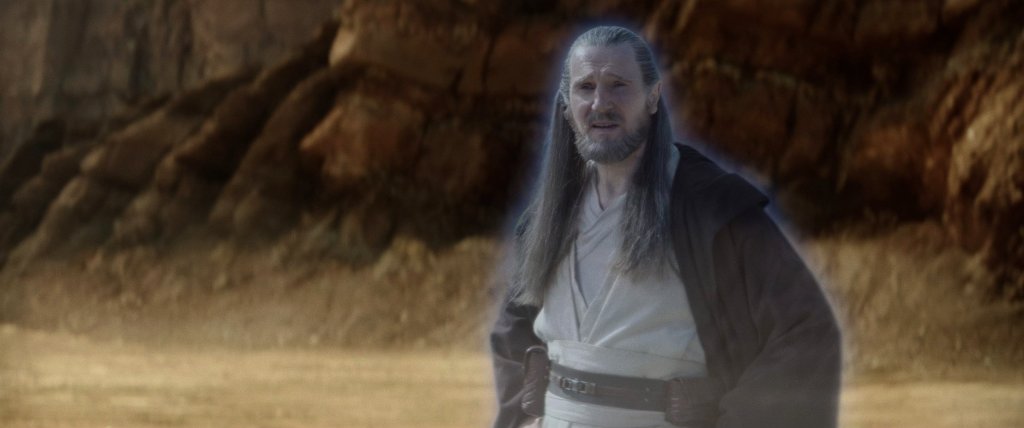
What comes to mind when I find myself in this dichotomy is the ending of the Obi-Wan Kenobi television show from Disney+. Kenobi has just completed a mission and re-found his purpose in a new way. Through the season, Kenobi is desperately alone and calling out to his old Jedi Master, Qui-Gon Jinn for guidance. It is believed that the living force can bring those from beyond to the present. When we think the series is over, out in the desert, we see an image appear. A blueish ghost of Qui-Gon appears, and Kenobi is surprised. In his reaction to seeing his old master, the Jedi responds with, “I was always here Obi-Wan, you were just not ready to see.” It is easy to compare spirituality of today to Acts 1 and forget that the same Spirit Jesus promises his students here, is the same that is alive and well today.
Friends, may we remember that, although some of us don’t speak in tongues, we do have the ability to awaken to the spirit around us unrealized.
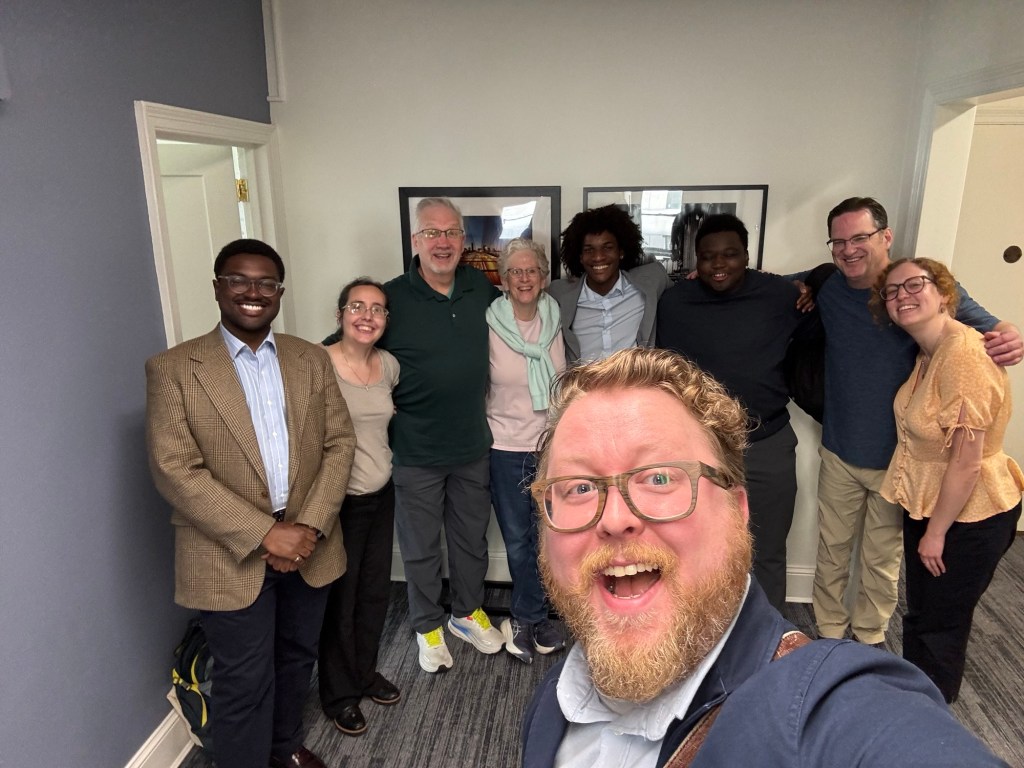
This past week a few of us from the church I work at, Trinity Episcopal Church, went to Washington D.C. to share our concerns with a few people. These people were Rep. Jim McGovern’s Legislative Director Cindy Buhl, Rep. Marcy Kaptur, and Senior Aid to Sen. Jon Husted, Sean Dunn. Unfortunately, Sen. Bernie Moreno’s office could not supply someone to meet with us. We also met up with members of the Episcopal Public Policy Network; Susie Faria, Lindsey Delks, and Troy Collazo, wonderful people doing incredibly important and hard work.
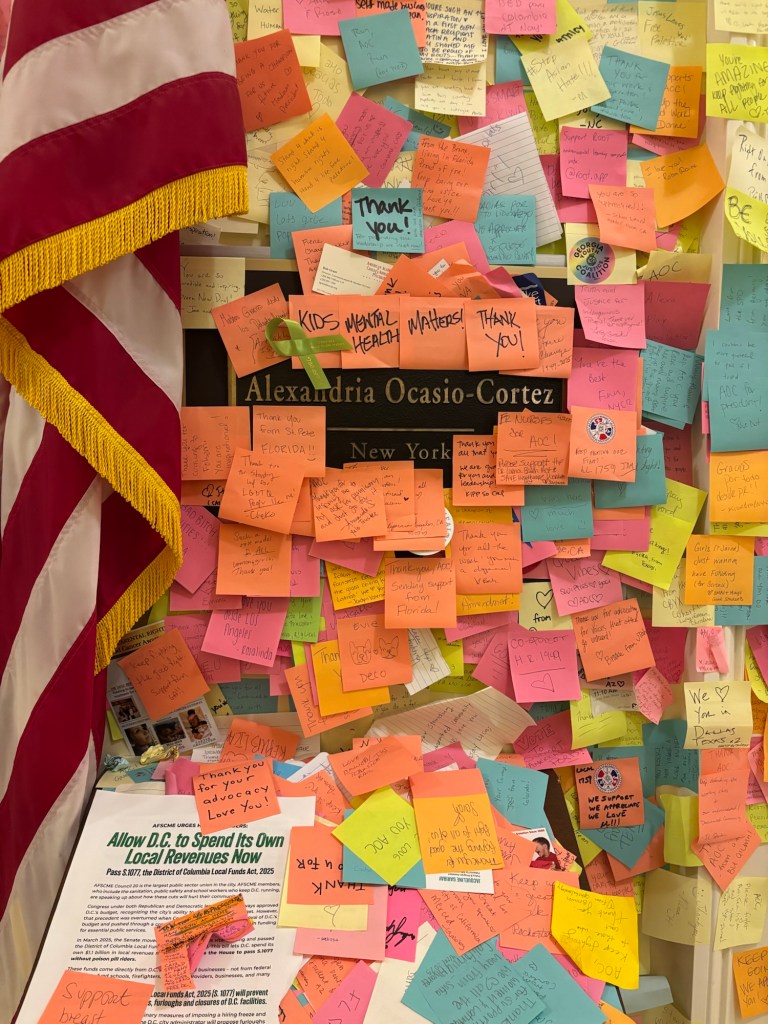
At the end of our meetings we provided a summary of our talking points we were able to get to, and some we couldn’t. Below you can read them, along with some pictures from our trip. We look forward to going back in the fall and following up with these concerns.
EPPN and our team
LGBTQIA+ support
The Trevor Project has been an incredible safety net for the LGBTQIA+ community, and the current administration has called to defund this. Trinity Episcopal Church is if not one of, then the most open and affirming Episcopal congregation in Toledo. We see first-hand people who walk through our doors that have been affected by gender identity and sexual orientation discrimination. Removing funding for this lifeline is not only unthinkable but cruel. The administration’s push of a “traditional family structure” as a source of stability and the lament for the lack of childbirth, coupled with the current administration wanting to cut programs like head start is not only confusing but shows they do not actually care for the American family. Queer families have been here from the beginning and will not disappear because this administration chooses to ignore them. With wages low, student and medical debt, cutting programs like head start continues to burden families of all kinds.
This suggestion of funding cut not only hurts at a federal level, but Ohio House Bill 616, is a slap in the face of history and decency. While we know you work at the federal level, we encourage you to reach out to your fellow legislators at the state level (as will we), to encourage voting against it. We believe reconciliation can only happen when people are willing to have open and honest conversations, and what HB616 offers leads to more pain and ignorance. Our children deserve to know the real history of America, this includes our queer siblings and how we have treated them and people of color, warts and all. Our Christian community is called to love our neighbors as ourselves, and to recognized and serve the dignity in all peoples. Our children deserve better than to be told they do not belong.
A very tired version of me at the end of the day.
Medicaid cut concern
Medicaid makes up 93% of the non-mandatory spending and cuts to this must happen to reach the $880 billion according to the non-partisan Congressional Spending Office. President Trump says Medicaid, Medicare and Social Security will not be touched. How are we to trust this when in a recent interview with Meet the Press he stated he wasn’t sure if he is responsible for upholding the constitution? The truth is, cuts to Medicaid threaten the viability of hospitals, nursing homes to name a few. Every week, we serve a free meal to those who live on the margins to get to know our neighbors. There are real concerns about medical coverage from those who attend, and they run the spectrum of age and race. Part of the baptismal covenant we recite in the Episcopal Church is that with Gods help, we will seek and serve Christ in all peoples. Cutting medical coverage to the most vulnerable amongst us is unacceptable, and we are pleading you to help us uphold this covenant by standing against Medicaid cuts.
Our team with Rep. Kaptur
USAID concern
Ohio Farmer’s Union President Bryn Bird, who farms in Licking County, underscored the importance of USAID’s food commodity purchases on prices at the farm gate:
“USAID plays a crucial role, not only providing food aid to millions around the world but also directly purchasing grains from Ohio farmers. Our farmers deserve predictable, fair market conditions to plan and grow their businesses. A pause on these programs will only add more uncertainty and volatility to an already challenging marketplace, leaving many Ohio farmers facing an unpredictable season. Ohio farmers are more than capable of rising to the challenge of feeding the world, but they need stability to do so.”
A shutdown of USAID would also have devastating consequences for the people of food-insecure nations that rely on USAID’s food assistance programs. These programs provide vital nutrition to millions of human beings. To end these USAID programs with no replacement in sight will at a minimum, lead to increased hunger, malnutrition, and disease in the affected countries, cause the deaths of huge numbers of people worldwide, and could trigger political instability in countries that are already facing food crises.
As previously stated, every week we host a free meal and see the effects this would have stateside. Prices continue to go up and as we seek to make this breakfast ministry sustainable, it becomes harder as more people cannot afford groceries.
Future POTUS
Gun violence concern
In the summer of 2023 our deacon, the Rev. Meribah Mansfield and Mike Linehan (Community Mission Team Leader at Olivet Lutheran Church in Sylvania, OH) formed the Northwest Ohio Multifaith Coalition to Reduce Gun Violence. This coalition helps to enable faith communities to work collaboratively to reduce gun violence through education, advocacy, and healing. Since its formation, it has grown to involve 41 congregations and more than 200 people throughout the Toledo area. Mike and Meribah met while marching with Moms Demand Action in a community festival parade in June 2023. It was there that the idea of a multifaith coalition began to take shape. Soon after, they began organizing a series of gun violence reduction forums.
Five faith-based forums have been held so far on topics including survivor testimonies, legislative action and advocacy training, safe gun storage, and updates on efforts of the City of Toledo’s Mayor’s Office of Neighborhood Safety and Engagement (MONSE). Coalition members worked with MONSE to develop Peace in Motion, Toledo’s 5-Year Comprehensive Safety Plan. It includes 42 targeted recommendations to reduce gun violence by fostering safer neighborhoods and creating opportunities for all residents. Gun violence not only continues to be an epidemic in Ohio, but nationwide.
Celebration after a long day.
Immigration and deportation concern
As of this week, CBS reported the current administration seeks to put into place deals with Angola and Equatorial Guinea to accept migrants. Everything that is going on with this administration’s handling of migrants, legal or otherwise, goes against one of the core tenants of Christianity. To watch over for one’s neighbor, to help the widow, the orphan, and the foreigner, is critical to living out our faith. Not only that, but the way the administration has been going around the courts, and not providing due processes, a constitutional right, flies in the face of what it means to uphold American ideals.
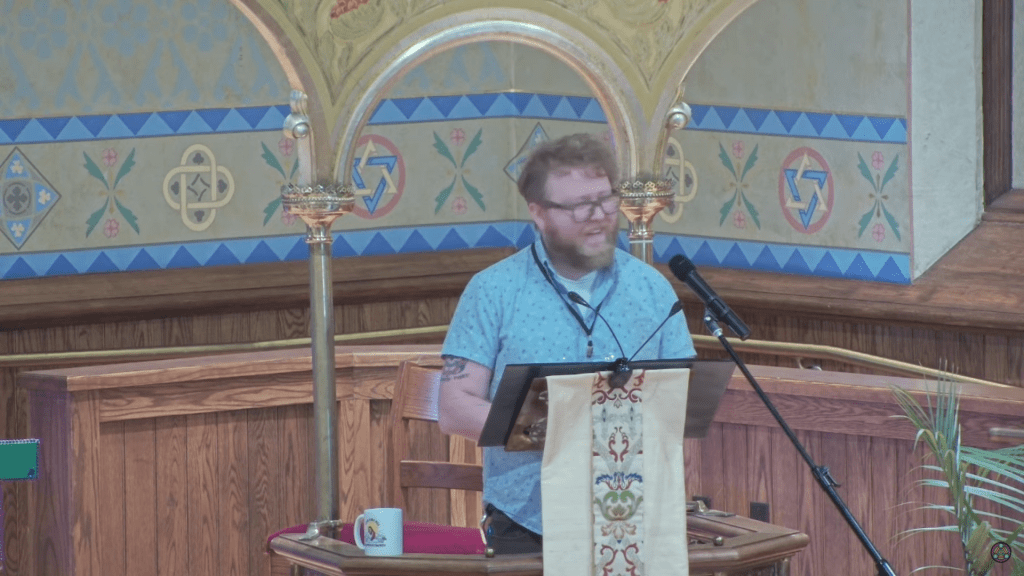
This past Sunday I had the honor to preach at my home church. Below is the sermon, but if you feel like watching it you can start the above link at 27:20 and enjoy all the little jokes I put in.
I’d like to open with a quote that I couldn’t find a home for, but it has latched onto me. It is from one of my favorite theologians, Ben Witherington. “It would appear that Mary’s announcement of the good news was insufficient to transform the mood of these male disciples.”[1]
I doubt, at times, there is any disciple more relatable than Thomas. I mean, you miss one hangout with the crew and suddenly, you’re supposed to believe your teacher is alive. It makes no sense. It sounds like a giant practical joke if you’re Thomas. It would be difficult not to respond with the, “I won’t believe anything until I put a finger through his hand!”
After all, it wasn’t like people came back from the dead all the time. But when Jesus comes back, and Thomas sees him, and while we are not told Thomas touches the wounds, we know for Thomas, the world is turned upside down.
Jesus has pulled one over on humanity, and the rest of the world because here was someone who has moved from death to life, from cursed to redeemed.
When Jesus asks Thomas, “have you believed because you have seen me?” what answer could be expected other than yes?
When I read this section of John’s Gospel, the space between the crucifixion wound, the time it took for Thomas to hear of Jesus’ resurrection and seeing him really stood out.
How many times do you think the Spirit tried to make contact with Thomas that week?
Where their times when Thomas was sitting alone at night, awake wondering if this was true that Jesus was back, and was he pushing the door shut while the Spirit was trying to break it open?
What makes the Apostle Thomas so relatable for me, is there is space for his doubt. Space for his thoughts. And space for him to allow God to enter his midst and partner with him.
It is that doubt that drives Thomas back to meet with the other disciples, and it is that doubt that shatters in the face of hope.
There is no way we get to our first reading from Acts without doubt. Everyone one in that group was Thomas, except for the people the entire history of the church owes its allegiance to, and that is the women.
Now, this newfound hope in the future of the world changes the disciples in a way that is still echoed almost two thousand years later into this very room. I say this because there is no way we go from doubts of resurrection to the hope of the holes in Jesus’ palms and not end up in the position Peter and the apostles find themselves in, in Acts 5.
So, this council that Peter and the others find themselves in front of, what the heck is it? Well, according to the Oxford Annotated Mishnah, we can be certain of a few things.
It is the judicial and deliberative body that was presided over by the high priest
This was the justice system for ancient Palestinian Jews
This group covered civil and penal law
There were two courts of judges depending on the severity of what was being decided, 23 judges or 71 judges
It was made up of the elders, sages, and various priestly factions of the day
Because it was controlled by the high priest, this group the apostles find themselves in front of, the same group that fought for the condemnation of Jesus, are the Sadducees
Yes, they deliberated over civil and penal law, but that meant a few things
They oversaw when civil procedure and criminal procedure acted as a fulcrum, depending on how the case went it would be a fulcrum for criminal proceedings
They also were in charge of the criminal execution and capital crimes, along with the liability for each one
At this time, the Sadducees. The Chief Priest Caiaphas that we heard from taking Jesus to Pilate during Holy Week was in charge of this group
According to Rabbi Jacob Neusner the Sadducees their name means “righteous one” so that’s hard to argue with
But they also, at the time in first century Palestine, rejected the “recent belief” of the afterlife and resurrection. Resurrection and afterlife theology belonged to the Pharisees.
The Sadducees are only spoken of a few times, as we see Jesus mostly go toe-to-toe against the Pharisees in the Gospels.
So why does all of this matter?
The Apostles are standing in front of people that have the ability to kill them. The Mishnah I quoted from earlier also says that there are, “…four execution methods—stoning, burning, decapitation, and strangulation—and, while it lists almost thirty capital crimes, it gives greatest attention to blasphemy…[5]”
Now, something I want to be clear about is, this is not a bloodthirsty group, and if not careful, they can be portrayed as one. The Mishnah says, A Sanhedrin that executes a transgressor once in seven years is characterized as a destructive tribunal. Since the Sanhedrin would subject the testimony to exacting scrutiny, it was extremely rare for a defendant to be executed.[6] The care for the life of a person was extremely important to this council.
But, if you are a person preaching of the resurrection of a perceived blaspheming rabbi, it is easy to see why the high priest would want that locked down. Not only do the Sadducees in charge not believe in resurrection or an afterlife, they had just had Jesus killed.
Peter says, “we must obey God rather than human authority.” The God of our ancestors raised up Jesus, whom you had killed by hanging him on a tree.” Part of the culture in first century Palestine with members of ancient Judaism is calling out scripture in conversation.
Everyone sitting in that room knew that Peter was connecting what happened with Jesus to Deuteronomy 21:22-23 which reads, When someone is convicted of a crime punishable by death and is executed, and you hung him on a tree, his corpse must not remain all night upon the tree; you shall bury him that same day, for anyone hung on a tree is under God’s curse.
Scholar Ben Witherington writes that Josephus, a Jewish historian who was alive during the first century in Palestine, “indicates that such a public hanging of the body followed stoning and was the punishment for the crime of blasphemy”[7] So if someone blasphemed, and they were stoned for it, their body was hung on a tree as a deterrent. If you know your American history, it should be no surprise that the incredible Dr. James Cone connected this in his book The Cross and The Lynching Tree.
When Jesus died, he was taken off the tree branches fastened into a cross and buried the same day. What Thomas is feeling in today’s gospel is the same thing the disciples felt walking on the road to Emmaus. It is the same thing Judas felt when he killed himself in the same way his friend died. Despair because the person they loved, the person they thought was going to overthrow power, empire, Rome, etc. was killed and cursed.
For the disciples before easter, there is no coming back from death, and to be cursed by God in the manner of your death must mean it was all a waste.
Every blister, every hungry night, every thirsty morning, the family and business you left behind to follow this Jesus around for three years amounted to nothing, because in the end he is cursed.
That is, until God turns that doubt and despair into hope and conviction.
This conviction and hope that the spirit burns into Peter and the rest of the Apostles, is the same hope and conviction the spirit burns into us today.
This is the same Spirit, hope, and conviction that pushes us to say that while some may not recognize our non-binary siblings, we are emboldened to say we see you, we name you, and we love you.
This is the same Spirit, hope, and conviction that pushes us to say that what is happening in Middle East right now breaks God’s heart, and Palestinian children deserve to grow old.
This is the same Spirit, hope, and conviction that pushes us to say that Black lives still and always will matter.
This is the same Spirit, hope, and conviction that pushes us to say that we love all our queer siblings.
This is the same Spirit, hope, and conviction that pushes us to say that we must protect trans kids at all costs.
This is the same Spirit, hope, and conviction that pushes us to say that we, know no person is illegal, and we must care and watch out for our neighbors.
This is the same Spirit, hope, and conviction that pushes us to say that pushes us to wake up every Sunday morning and make breakfast.
This is the same Spirit, hope, and conviction that pushes us to say that we, like Father Greg Boyle, see and know the unshakeable good in all people.
This is the same Spirit, hope, and conviction that pushes us to say that at Trinity Episcopal Church, in downtown Toledo, you are welcome, wanted, and safe.
This is the same Spirit, hope, and conviction that pushes us to say thanks be to God, and amen.
Nebuchadnezzar said to them, “Is it true, O Shadrach, Meshach, and Abednego, that you do not serve my gods and you do not worship the golden statue that I have set up? Now if you are ready when you hear the sound of the horn, pipe, lyre, trigon, harp, drum, and entire musical ensemble to fall down and worship the statue that I have made, well and good. But if you do not worship, you shall immediately be thrown into a furnace of blazing fire, and who is the god that will deliver you out of my hands?”
Shadrach, Meshach, and Abednego answered the king, “O Nebuchadnezzar, we have no need to present a defense to you in this matter. If our God whom we serve is able to deliver us from the furnace of blazing fire and out of your hand, O king, let him deliver us. But if not, be it known to you, O king, that we will not serve your gods and we will not worship the golden statue that you have set up.”
Then Nebuchadnezzar was so filled with rage against Shadrach, Meshach, and Abednego that his face was distorted. He ordered the furnace heated up seven times more than was customary, and ordered some of the strongest guards in his army to bind Shadrach, Meshach, and Abednego and to throw them into the furnace of blazing fire.
Then King Nebuchadnezzar was astonished and rose up quickly. He said to his counselors, “Was it not three men that we threw bound into the fire?” They answered the king, “True, O king.” He replied, “But I see four men unbound, walking in the middle of the fire, and they are not hurt; and the fourth has the appearance of a god.” Nebuchadnezzar then approached the door of the furnace of blazing fire and said, “Shadrach, Meshach, and Abednego, servants of the Most High God, come out! Come here!” So Shadrach, Meshach, and Abednego came out from the fire. And the satraps, the prefects, the governors, and the king’s counselors gathered together and saw that the fire had not had any power over the bodies of those men; the hair of their heads was not singed, their tunics were not harmed, and not even the smell of fire came from them.
Nebuchadnezzar said, “Blessed be the God of Shadrach, Meshach, and Abednego, who has sent his angel and delivered his servants who trusted in him. They disobeyed the king’s command and yielded up their bodies rather than serve and worship any god except their own God.
Daniel 3:14–20,24–28
There was one question as I was reading this passage from Daniel that I do not have just one answer to.
It is also really hard for me to read this and not think about the political environment of the past decade. The amount of comparison done between King Nebuchadnezzar and President Donald Trump is at this point, is almost exhausting. I have known and read of so many Christians that have excused voting for him, or his political actions using Nebuchadnezzar saying that God can use sinful people to move God’s will. In 2020 author William Henley released his book titled, Two Men from Babylon: Nebuchadnezzar, Trump, and the Lord of History.
Henley walks the reader through the creation of the city of Babylon starting in Genesis 10 where he points out the mighty hunter named Nimrod that subdued the neighbors around him and forced them to submit to his rule. In this excerpt Henley writes:
Centuries later in 620 BC, Nebuchadnezzar, a successor to Nimrod, became the ruler of Babylon and would demonstrate that founders of a nation inject their spiritual DNA into their offspring. Nimrod himself bore the DNA of the “giants,” the “mighty ones” who descended from the Nephilim (Genesis 6:4). The Bible reveals that at the core of the Nephilim spirit was self-pride and a passion for self-exaltation. This is the essence of “all that is in the world, the lust of the flesh and the lust of the eyes and the boastful pride of life” (1 John 2:16). This also is the essence of Babylon in all its forms. Nebuchadnezzar, in his time as Babylon’s ruler, would pursue these lusts extravagantly— until, in a chaotic period in his personal life…[1]
In this Daniel passage, Nebuchadnezzar has built a statue of gold and expects everyone to bow down and worship this image. If any of you have been on social media since January when President Trump regained power, you may have seen a gross AI video of his view of Gaza. There were no Palestinians, but instead glitzy hotels, a casino, Trump and Netanyahu relaxing by a pool with drinks, and a tall golden statue of Donald Trump.
This AI golden statue of President Trump had peaked the comparison between the two, and I remember sitting in almost stunned disbelief. Disbelief not only of my surprise of this video, but that I was surprised by it. But here is what sticks in my crawl with this comparison, I do not believe that Trump could ever be as humble as Nebuchadnezzar.
In chapter 2 of Daniel, at the end, we see that Nebuchadnezzar had a dream of a statue that Daniel interpreted. After the interpretation, the king then fell on his face to worship Daniel and give him a grain offering. He then makes Daniel a ruler of parts of Babylon, and Shadrach, Meshach, and Abednego are placed in positions of power. However, we find out in the full context of this chapter, that these three Israelites refuse to worship the gods of the king, and to bow down at the golden statue to worship as well. The king had no problem doing this himself, because it was the god of all gods for him. However, if we know our history, Israelites are forbidden from worshiping graven images and other gods. If we remember, it did not go very well for the ancient Israelites at the foot of Mount Sinai during the exodus.
Now, something Nebuchadnezzar said to Daniel in chapter two was, “truly, your God is God of gods and Lord of kings and a revealer of mysteries, for you have been able to reveal this mystery.”
Two questions about the golden statue:
Why was Daniel not forced to kneel and worship the statue like his friends?
Who was the statue of?
I am of the mindset that the statue was of Daniel.
After all, the king worshiped Daniel as God at the end of chapter two, and it is not like Daniel can stand down and worship himself. This for me, is why the argument of President Trump and King Nebuchadnezzar will always fall apart. Humility, when we unharden our heart, will always breakthrough in unexpected ways. Pharaoh did not have to unharden his heart, not because God was allegedly doing it, but because he was never affected directly. That is until the commerce of Egypt was affected by the plague of hail.
Today is the last Wednesday in Lent, and this has been such a long journey to Palm Sunday. Citizens have been snatched off the street for voicing their dissent of the current administration and its stance on Palestine. Saturday, some of us participated in the almost 5,000 strong Hands-Off protest in Toledo. The city of ancient Babylon may have fallen, but it does not mean that people don’t want to return to it. Like the Israelites in the wilderness groaning that they could have died slaves in Egypt with pots of meat instead of wandering.
But what happens in Babylon and the wilderness for the ancient Israelites? God shows up and teaches God’s people a new way to live. To paint with a broad brush, in Babylon they reconstructed what it meant to worship God outside of a Temple, and in the wilderness, they learned reliance and trust.
So, as I read about Shadrach, Meshach, and Abednego, one question kept coming to mind that I have no answer to:
What golden statues are trying to be built now, that we must deny so we do not lose our foundation in God?
The following is my reflection from the prayer meeting held at Trinity’s 12 Noon service on 3/25.
Matthew 5:17–19 (NRSV)
Jesus said, “Do not think that I have come to abolish the law or the prophets; I have come not to abolish but to fulfill. For truly I tell you, until heaven and earth pass away, not one letter, not one stroke of a letter, will pass from the law until all is accomplished. Therefore, whoever breaks one of the least of these commandments, and teaches others to do the same, will be called least in the kingdom of heaven; but whoever does them and teaches them will be called great in the kingdom of heaven.”
The sermon on the mount is a teaching I have been spending a lot of time with as of late. I cannot speak for everyone, but this part of the sermon always gave me pause. As a young Christian I was taught that the Old Testament no longer applied to my life because Jesus came and liberated us not just from sin, but from all that “legalism.” Whenever this passage came up in church or wherever, this part always tugged at me, and the best explanation I could get from anyone was that it no longer applied. Paul had written about the law and how it did not apply to us, so we were free from it because of grace.
As I have grown older, I have personally come to realize that I cannot take that view because of how short sighted it is. To determine that something in the text no longer applies to you gives you permission not to take it seriously. It gives permission to be permissive about it, and when we become permissive, we are no longer curious. I find for myself, when curiosity is gone, what was fresh and vibrant become stale. I do not want to personally live in a world where the Sermon on the Mount becomes stale. So, what does it mean for this part of Matthew to continue to breathe new life?
Taking place on a mountain side, Jesus sits down and teaches his twelve disciples while others crowd around him and listen in. This image of Jesus is, I would argue, is what we would recognize today as Jesus at his most rabbinic. Rabbi and scholar Jacob Neusner in his book, A Rabbi talks with Jesus, writes:
…the sage sets for himself a worthy challenge, one that every sage in every generation does well to meet: receive a tradition whole and perfect, hand it on never intact but always unimpaired, so taking a rightful place in the chain of tradition from Sinai.
What Rabbi Neusner writes about, is how traditionally new teachers of the law would be raised up. Those who were picked and went through the training to become a teacher of Torah would be taught the commandments by heart. Then, their teacher would put their spin on it by providing some new perspective. This is what it means when a teacher passes on the law, not intact but always unimpaired. What Jesus is building on in his Sermon on the Mount, is the Torah, the law given at Siani to Moses and the ancient Israelites.
When we talk about no longer being subject to the law of the Old Testament and say that we must follow teachings like the sermon on the mount, something important is left out. What Jesus does with the Sermon on the Mount is what rabbis would call, “building a hedge around Torah.” Imagine that this law is so precious to you, not because of sin or persecution, but because you believe it is the best and you want to live it, that you put a buffer between yourself and it. Like a house with a hedge surrounding, it for protection, is what Jesus is doing in this sermon. The hedge, as Rabbi Neusner puts it, the hedge is important because it allows us to, “…conduct yourself in such a way you will avoid even the things that cause you to sin, not only the sin itself.”
There is a famous teaching associated with the Hillel the Elder where a gentile comes up to him and asks to be taught the Torah while standing on one foot. Hillel responds with something like, “that which is bad for you, do not to your neighbor, that is the Torah, the rest is commentary.”
For Jesus to give this teaching, encouraging us that not murdering is not enough, and we must not even have hate in our hearts. It is not just about not cheating on your spouse, but to not even to look at someone lustfully, and if you do, cut your eye out (because it is not the person’s fault you are looking at them like that). When I sit with this part of Matthew, as I have for the past year, I am reminded that for me, if all of Torah is about caring for my neighbor, and as Rabbi Neusner confirms, Torah is all about teaching us how to show mercy, then I am proud to teach others to show it.
I am excited to invite others along the path to teach and show mercy and love in ways that may not be new but are still worth doing. Especially in the climate we find ourselves in, this yoke, this teaching, must be passed on. When you hear it, it may not be intact, but it will at least be unimpaired.
On Sunday, Black History Month kicked off, and things are a little bit different this year. While the current president made a proclamation on 1/31 of the celebrating of Black history, federal agencies are baring the celebration/observation of it and other things. In this post, I just want to share a few things about it’s official founding, a bit of importance of it, the way my denomination has been impacted by Black history, and some books to read.
In 1976 Republican President Gerald Ford designated the month of February as Black History Month. This came after years of work from scholar Carter G. Woodson, who established the original, “Negro History Week” which took place the second week of February (make no mistake, Woodson never confined Black history education and celebration to just one week). The reason for this, was it held both Abraham Lincoln and Fredrick Douglas’s birthdays. The Association for the Study of African American Life and History (ASAALH) continues Woodson’s work and continues to be a great resource for learning about Black history. For a reading of Black history and the Episcopal Church, Joyce Crittenden has an incredible article titled, Condensed History of the Black Episcopalian, published on the website for Episcopal Church of All Saints and Ascension’s website that can be reached here.
The importance of learning Black history can never be understated. Black history is the history of America, and we are tied to it in ways that will never be undone, no matter how may people try. It is a history that must be celebrated even if it is embarrassing or hard for white people to read. With that, I’d like to recommend a few books that changed my life for this month that will open your eyes and break your heart for the better (in no particular order):
The Fire Next Time by James Baldwin
Black AF History: The Un-Whitewashed Story of America by Michael Harriot
The Color of Compromise: The Truth about the American Church’s Complicity in Racism by Jemar Tisby
The Assassination of Fred Hampton: How the FBI and Chicago Police Murdered a Black Panther by Jeffery Haas
Reading While Black: African American Biblical Interpretation as an Exercise in Hope by Esau McCauley
On Juneteenth by Annette Gordon-Reed
Between the World and Me by Ta-Nehisi Coates
Medical Apartheid: The Dark History of Medical Experiments on Black Americans from Colonial Times to the Present by Harriet A. Washington
Black Birds in the Sky: The Story and Legacy of the 1921 Tulsa Race Massacre by Brandy Colbert
The Sword and the Shield: The Revolutionary Lives of Malcolm X and Martin Luther King Jr. by Peniel E. Joseph
The Cross and the Lynching Tree by James H. Cone
Black Against Empire: The History and Politics of the Black Panther Party by Joshua Bloom and Waldo E. Martin Jr.
The Autobiography of Malcolm X as told to Alex Haley
Tears We Cannot Stop by Michael Eric Dyson
As I close out this first short post on Black History Month, I would like to share the following prayer by Canon Carla Robinson. It was prayed at a Circles of Color meeting in 2023 and can be found here. This was shortly after the death of another young Black man, Tyre Nichols. Nichols was beaten by five police officers during a traffic stop, and died in the hospital three days later:
May God bless the memory of Tyre Nichols. We pray for his family during this time of unspeakable loss and grief. His life mattered. Tragically we have been here time & time again. Lord, grants us the strength and courage to never accept injustice & cruelty as the price for public safety. And give us grace to truly strive for justice and peace and to honestly respect the dignity of every human being.
Creator, we lift up and thank you for our Black siblings who have shaped history. We pray that the learning happening this month in schools, homes and workplaces will be meaningful and deep-rooted. We pray for open hearts and minds, and spirits willing to learn and be transformed by you. May this month be a time of curiosity and sharing, conversations and celebrations, challenge and encouragement. Loving God, help us to dig deeper, look closer, and think bigger.
In Jesus name, amen.
As we celebrate our beloved siblings and continue to work towards being beloved community, may we continue to learn what we do not know, and celebrate from the mountain top.
Black Lives Matter. Black Trans Lives Matter. Black Queer Lives Matter. Black Women Lives Matter. Black Men Lives Matter. Black Children Lives Matter. Black Healthcare Matters.
May we never stop saying it, may we never lose sight of it, and may we never forget it.







 George of Sylvania