Hello friends, and happy new year! What a weird and interesting post for the first one, but here we are. As you may know, the United States decided to abduct the President and First Lady of Venezuela. President Trump also said that U.S. oil companies will be taking over Venezuela’s oil.
As an Episcopalian, I thought I’d widely share the official statement on what has happened. You can read it more on the church’s stances here.
The people of The Episcopal Church offer prayers for our beloved siblings in Christ in the Episcopal Diocese of Venezuela, and for people across the region following this morning’s U.S. military operation that removed President Nicolás Maduro.
Episcopalians in Venezuela carry out vital ministries in increasingly challenging conditions, and we fear for their well-being and their church community if these military interventions, and any form of U.S. occupation, lead to more instability and violence. Episcopal Church Center staff have spoken with and offered support to the Rt. Rev. Cristobal León Lozano, bishop of the Episcopal Diocese of Ecuador Litoral and bishop provisional of Venezuela; the Rt. Rev. Lloyd Allen, bishop of the Episcopal Diocese of Honduras and president of Province IX; and to standing committee leadership.
The Episcopal Church’s General Convention has long-standing policy that “condemn[s] in any nation the first use of armed force in the form of a preventive or pre-emptive strike that is aimed at disrupting a non-imminent, uncertain military threat.” Even as we recognize that intervention in sovereign states can sometimes be necessary to prevent atrocities, we discourage “the abuse of this norm to rationalize military actions in sovereign states for political ends.”
We urge Congress to call for an investigation and accountability for this most recent unauthorized operation, as well as the related military actions carried out in recent months. We urge all regional parties to support a peaceful transition that respects the rule of law and the will of the Venezuelan people. Join us in praying for our siblings in the Diocese of Venezuela and the Venezuelan people.
I wrote and submitted this as an op-ed, but decided to release it here as well because it is important.
The Ohio State House is attempting to pass House Bill 486, and it should cause us concern. If passed, this bill would allow for educators in state sponsored higher education and public schools to discuss Christianity’s positive influence on culture and history in America. This proposed act also includes examples talking points to be used classrooms, as historical examples and not alleged proselytization. However, the examples in this proposal read as a complete whitewash of American history which does a severe disservice not only to students and educators, but the accuracy of Christianity’s influence in the United States of America.
The influence, whether positive or negative, that Christianity has had on American lives past and present, should be left to religious professionals to teach. To think that an educator can only talk about the positive influence and can willfully ignore the historical stance of white Americans using religion to maintain slavery, segregation, and anti-LGBTQIA+ stances is morally and ethically wrong. And, unfortunately, that is not the only moral issue in this act.
The co-sponsors of this bill have an agenda with which we should be uncomfortable. On the surface, this bill unequivocally pushes the talking points of christian nationalism. A popular movement in this country that, at its core, is antithetical to the Gospel. If we want to talk about the impacts of Christianity in history, we must do so in an unbiased and truthful way, and these conversations should be led by those qualified to do so. Not by someone that holds a degree from a bible college, which is one degree I hold, but from an unbiased institution.
The miseducation of Christian influence on a country that refuses to reconcile its sin of slavery and the mistreatment of Indigenous peoples at best could only lead to prolonged ignorance, and at worse, political or religious based violence. I encourage everyone to call upon their reps and advise against voting for this bill, especially Rep. Josh Williams, who is a co-sponsor. Now is not a time to stay silent, and it is our job to let our representatives know we do not want HB-486 to pass.
To contact OH D41 Rep Erika White, click here. To contact OH D42 Rep Elgin Rogers Jr., click here. To contact OH D43 Rep Michele Grim, click here. To contact OH D44 Rep Josh Williams, click here.
Friends, this is my sermon from this past Sunday on a passage from Luke. If you prefer to watch, you can watch above, it starts at the 24 minute mark-ish. While I go off script in the video, you can read below my notes for the morning of.
This is a good parable. Jesus is tossing out some, what I would call, weird for the day theological ideas, but it’s good. This is one of those passages I would really like to spend time digesting and getting pretty nerdy with you all. Starting with how the afterlife as a concept or belief was one held on to by the Pharisees, or how the rich guy is buried, and Lazarus died and is taken away by angels.
This sermon has gone through many drafts, which is normal, but the content has changed quite a bit. In fact, in hindsight was a joke, I asked Father Jon if he wanted to read what I was confident my final draft on Tuesday. However, as I was working to finalize this, this week, I kept growing increasingly unsettled, not just by the content but by ridiculously relevant it is. In fact, I completely re-wrote it last night after 8pm. Through the Gospels, there are times when Jesus tells a parable and the disciples have no idea what he is talking about, but not here.
There is an assumption I find with most Christians I speak to, and that is, speaking broadly, everything in the New Testament is applicable to them. While you can make the argument, what I would like you all to think about is, does. This parable apply to you or us? If it does not, how are we as readers and followers meant to hear it and interact with it? Hold onto those thoughts as we live out this week and let me know your thoughts.
Lazarus is a man who is poor, a beggar, who lives most of his time outside of a very rich man’s house. Lazarus is so down, dogs lick his open sores, and he cannot do anything about it. There is a lot that we can know about this very rich man by the description, and I am going to nickname him now. Since Lazarus gets a name so does this guy, how about… Elon Musk? I originally had another in mind, but Jon+ threw this out this week, and I decided to run with it.
So, Musk wears purple gowns, throws daily banquets, and most likely parties with his family. Musk also does not celebrate the sabbath, which means all who work for Musk do not get the time off required for their religious beliefs. Not only that, but they also get no rest, and I’m sure their pay isn’t great as well. Musk also does not care about Lazarus who is laying right outside his gate.
In his book, Jesus Through Middle Eastern Eyes, theologian Kenneth E. Bailey points out just how rich Musk is according to this parable:
“He also wore ‘fine linen.’ The word in Greek is busses, which transliterates the Hebrew word butz, which, in turn, refers to the quality Egyptian cotton used for the best underwear… This man not only had expensive outer robes, but in case anyone was interested, he also wore fine quality underwear.”[1]
Musk, in this story, is committing the same sin that God destroyed the city of Sodom over in Genesis. Hording exuberant wealth and not caring for those in need, whether they are neighbors, or those outside of the gates of their property. But we see how it turns out for Musk and Lazarus, and for Lazarus, who is the only person ever named in a parable, and his name means, “one God helps” turns out okay.
You could not get more opposite of the class hierarchy than these two, which is interesting because Baily offers another tidbit in his book. A sort of way to let the rich man off the hook, that I do not agree with. He writes:
“…it is easy to survive by developing compassion fatigue. Beggars are ever present. There are so many of them. One’s resources are limited. Finally, one doesn’t notice anymore. Compassion fatigue becomes a way to cope and a strategy for survival. Perhaps this is what happened to the rich man.”[2]
I completely agree that compassion fatigue is a real thing, and I have experienced it myself. Anyone who has worked in social justice efforts can I am sure relate. But compassion fatigue exists because our society, at almost all levels would rather uphold systems and structures that keep people oppressed then help liberate them. Those who vote for the budget cuts, and believe the lie that anyone, no matter what they are born into have the same chance of pulling themselves up by their bootstraps do not realize they are stuck in the same hole as us.
It is not compassion fatigue that caused Musk to ignore Lazarus, but the status quo. When the world allows for, according to a Forbes article from February of this year, in the USA 71.2% of the wealth is held by the top 10% in the country. Musk doesn’t help the poor because he has compassion fatigue.
Baily continues, “Lazarus was sick, hungry, and covered with sores. But his deepest suffering was psychic. Traditional Middle Eastern villages are geographically tightly compacted. The gate at which Lazarus lay was certainly within easy earshot of the daily sumptuous banquets of the rich man. Only a few feet from Lazarus a group of overfed men” in designer underwear… “while Lazarus lay hungry and in pain, listening to their conversation. Those same men passed him every day as they entered and left the rich man’s house. They didn’t need the food—he did. Help was always near at hand yet withheld from him.”[5]
In this parable, like in life, there is no economic justice, and because of this beggars, the unhoused, will always be with us. When Jesus says that the poor will always be with us, this is what he is talking about. Because we do not live in a just society, we will always have those in need. Back in May, myself, and Trinity Response Team members Becky Koskienen, Mark Dubielak, and Phil Skeldon went to Washington DC to lobby our representatives into a more just world. This meant asking them to vote against the Big Beautiful Bill. Instead of chasing compassion and justice, our Ohio senators chose to support the status quo and give men in our parable more money.
If you have been watching the news or have been on social media in the past few weeks, we have seen it in the coverage of Christian nationalist Charlie Kirk’s death, memorial service, and fallout. His fans are attempting to prop him up like a modern martyr for his faith, and how the gospel was shared in such an impactful way because of his death. But I’m sure I am not the only one that sees the lie in it all.
When there is no room for Lazarus at the celebration, there is no room for the Gospel.
The question I asked at the beginning of this was, does this parable apply to you, and if not, how are we as readers/listeners/followers of Jesus supposed to interact with this. If anyone here had the wealth gap between Lazarus and Musk, I would be surprised you’re still a member.
This parable is supposed to shake us out of apathy and into advocacy.
This parable is why Trinity works hard to develop ministries like Breakfast at Trinity. Sure, Lazarus needed the food, but he isn’t the focus of this story. Musk is the focus. This parable is the Christmas Carol without the three ghosts changing Scrooges mind!
Breakfast at Trinity doesn’t exist solely for feeding the people, but we borrow from our forbears of that space to nourish body and soul. There are a number of people who can make their own food and have the means to, but they are all weary. Musk, in this parable, is weary, but he doesn’t know a better way exists.
All Musk knows is the status quo, which are the systems that keep him in place to be that rich, and isolated.
Like water dripping on a stone, the Gospel breaks through everything and everyone. But sometimes, we need to be like Jesus and point that out for people who are unaware of how bad it is out there.
[1] Bailey, Jesus Through Middle Eastern Eyes, pg. 382
[2] Bailey, Jesus Through Middle Eastern Eyes, pg. 382/383
A few weeks ago I passed a uniquely American parental milestone: I dropped my child off at preschool after a mass shooting where two children were murdered. This, of course, was the shooting in Minneapolis at Annunciation Catholic School where kids were murdered during their chapel service. Some of you may have seen the clip of the kid talking about his friend Victor that protected him from the shooting, and Victor was struck in the back. I have been an outspoken advocate for tighter gun laws for years, and the fear at drop off that something *could* happen was horrifying.
Just another day in America.
Of course last week there were two school shootings, one in Colorado where a few kids were injured. Then there was the one in Utah were a christian nationalist podcaster was killed in front of a group of people, that has set the country on fire, as he was a divisive person that had no problem perpetuating racist, misogynistic, and homophobic rhetoric. But considering that is the current brand of conservatism in this country, it is no surprise they are trying to make a martyr out of him. Finally, Trey Reed, a young black man, was found hung from a tree near his college in Mississippi with no fowl play suspected somehow.
Just another week in America.
Two mass shootings in an unhoused encampment, again, in Minneapolis where 13 people are injured which comes on the heels of f*x news anchor Brian Kilmeade suggested euthanizing the unhoused. Of course nothing is going to happen to Kilmeade, even though real news reporters have lost their jobs for pointing out the podcaster who was killed spoke hatefully.
Another week in Ameri— wait, it’s only Wednesday.
At times like this, I return to a book written by Krister Stendahl called, The Roots of Violence: Creating Peace through Spiritual Reconciliation. In this section, he wrote about the political assassinations of the 60’s, people trying to make political change for the good, not like the guy we’ve seen in the news lately. While I do not believe there is room for political violence in this world, I understand it is here. Unfortunately, pointing out the hypocrisy of those calling for it to end, that continue to actively oppress people of color, the LGBTQ+ community, women, you name it, will do nothing but fall on deaf ears or echo chambers. So instead, I leave you with the words of Stendhal:
“We are surrounded by mass assassinations and executions, deeds that we call “terrorist” if others do them and “defense” if we do them. There is torture, which some people try to dress up by saying that it is not so bad if it is done by authoritarians, but it is bad when it is done by totalitarian. But the thumbscrews feel the same no matter who puts them on.”
– pg. 15, Roots of Violence
Stay safe, and watch out for one another. Grace and peace.
About six months ago, I purchased a bottle of Absinthe because, for some unknown reason, I thought it was a good idea. It had been at least a decade since I had tried it, and it did not go down very well. The wormwood in the drink, if you have never had it, leaves an incredibly bitter taste in your mouth if you don’t mix the properly. The other day, as I sat drinking my morning coffee, I was wondering what mixture of mouthwash/seltzer water/whatever I had that is now leaving this similar taste in my mouth.
That’ll flavor combination will wake you up.
As I am sipping this, I have been working my way through the prophet Amos in my morning quiet time. This reading of the prophet has been compounding some outlying frustration. A genocide has been broadcasting in real time, in spite of murdering journalists, in Palestine for those of us paying attention. Children, and people of all ages have been intentionally starved, and the footage of it will leave a mark. Kids, and others, have been murdered while waiting in line for water, food, etc. The intentional cruelty, and war crimes committed is an abomination.
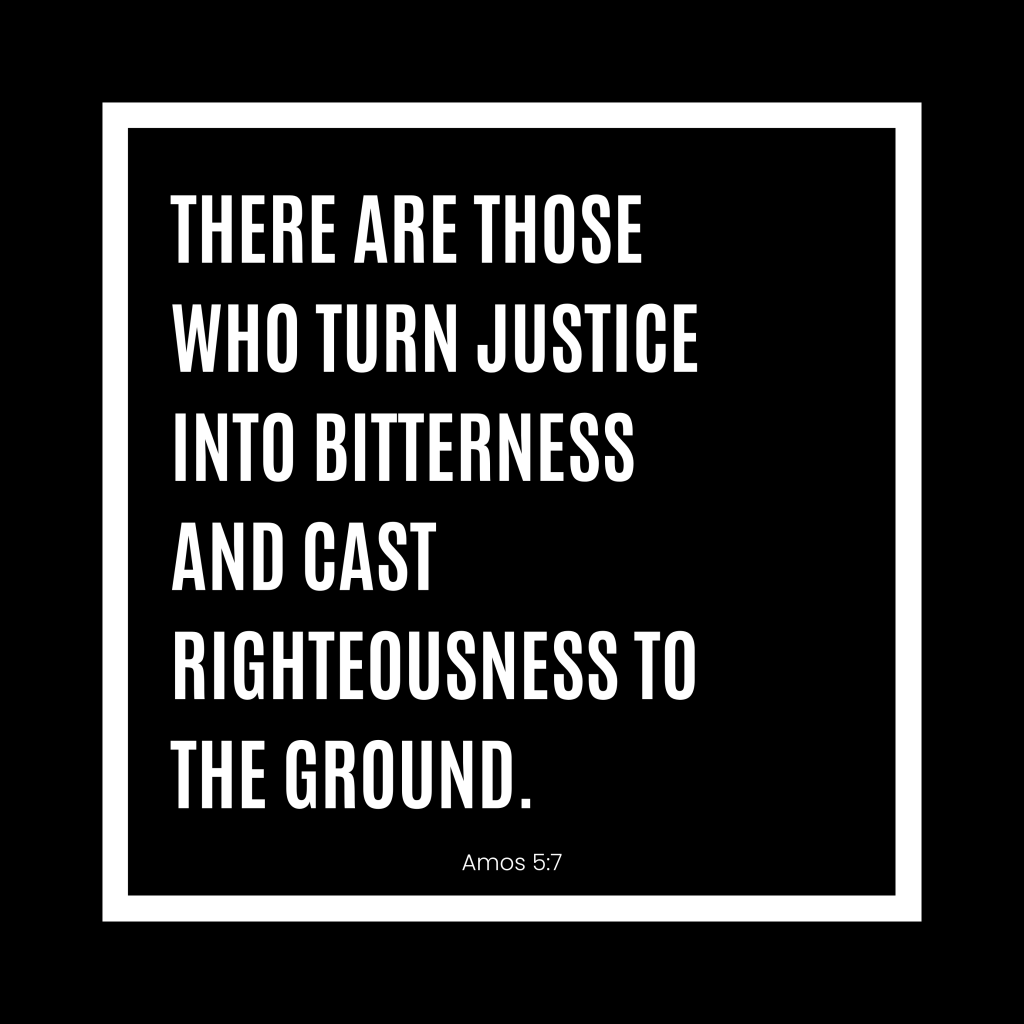
So reading through Amos, seeing this massacre play out in real time over the past 18 months and all of it taking place in the region the prophet is talking about has brought a new flavor to the text. For about a week, Amos 5:7 (NIV) has had its claws in me, “There are those who turn justice into bitterness and cast righteousness to the ground.” I have been meditating on this, and it has like a stick in my craw, but I couldn’t figure out why.
There is the obvious tug at what Amos is saying on face value, but I decided to check out the Apostolic Polyglot, an interlinear literal Greek-English of the Christian Bible. When I read it, and it made no sense, I looked to the New Oxford Annotated Bible. It is just a fancier version of the New Revised Standard Version, which reads:
“Ah, you that turn justice to wormwood, and bring righteousness to the ground!”
There it is, the stick in my craw.
The verse in the New International Version was too nice for me. Bitterness can be a variety of things. I love lemons, and they can be bitter as hell. But you know what, wormwood will make almost anyone gag!
Every time we read or see what has been happening in Palestine, Sudan, and to the Uyghurs, we should taste wormwood in our mouths.
Every time we read about those fighting against releasing the Epstein client list, we should taste wormwood in our mouths.
Every time we see another mass shooting in the news, we should taste wormwood in our mouths.
Every time we see or hear reports of ICE agents snatching people off of the streets, we should taste wormwood in our mouths.
Every time we see military personnel being mobilized against citizens, we should taste wormwood in our mouths.
In fascism, there is no peace. There is no peace without reconciliation. There is no reconciliation without justice. There is no justice in attempting to control others. Control is void of love, and without love, God can be incredibly difficult to find.
It may seem like nothing, but speaking about what is going on may help wake people up. Going on the record and contacting your representatives is called slow activism for a reason, but it is worth doing. If you have not tried 5 Calls yet, follow the link, and use it for good.
Everyone has to start somewhere, and I hope the bitter taste in your mouth that the Trump administration has helped bring about in the past eight months spurs you into action.
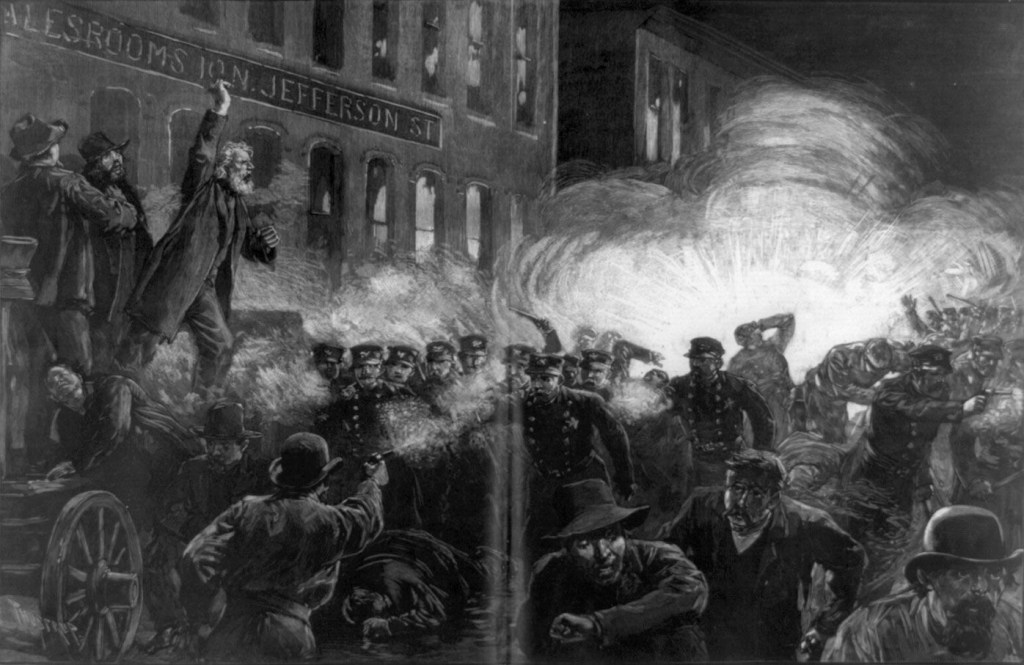
Wood engraving of the Haymarket Riot by Thure de Thulstrup, published in Harper’s Weekly on May 15, 1886
Every week my church releases an e-newsletter that starts with a section called “dear friends.” This is usually a letter written by a rotating crew of people focused on something happening around the church community, or has recently occurred. This week I had the pleasure of writing about Labor Day. The following is that section:
Dear friends,
It is Labor Day Weekend, which means the church office is closed Monday, and will re-open on Tuesday. While this is a time for rest, hopeful relaxation, and a nice cookout, it is important to remember how we got here. Labor Day wasn’t a federal holiday until 1894, when President Grover Cleveland signed it into law. While we now recognize this weekend as a time where summer ends, and school begins, it is something so much more. It is a time we remember the blood that was shed by union leaders to bring about fair working conditions, and to remove power from the few, the all. From the Haymarket Affair in 1886 and the Pullman Strike in 1894, to our own autoworkers in Toledo and the Libby Glass strike that started this past week, standing up for the rights of workers remains a justice issue.
In the words of Dorothy Day, the infamous Catholic Worker leader, I offer up a prayer she wrote while praying at the Shrine of the Immaculate Conception, “I offered up a special prayer, a prayer which came with tears and with anguish, that some way would open up for me to use that talents I possessed for my fellow workers, for the poor.”
This week flyers for the knights of the klu klux klan was found scattered around in Norwalk Ohio, and according to the news story from 13ABC Toledo (which you can watch by clicking here), this is the second time in a few months this has happened.
I have been relatively quiet on the writing front even though there has been much to say. There is so much shit going on, I haven’t known where to start, so here are four things that have happened since I posted my last sermon:
President Trump has occupied Washington DC with armed National Guard personnel, including those from my own state of Ohio. (Click here)
President Trump decided to comb through the Smithsonian and remake history in his image. (Click here)
The concentration camp Alligator Alcatraz has opened up, and is on its third attempt to stay open. (Click here)
Don’t get me started on the Epstein list. Everyone on it needs to be arrested.
Israel continues to commit war crimes against Palestinians killing journalists, people trying to get food, and mass amounts of children. (Click here)
And now, I pull open the news to see KKK flyers in my neck of the woods, while having sifted through conservative hate messages and comments targeted at my place of worship for our incredible presence at Toledo Pride. In addition to that, a friend of mine shared a first hand account with me of racists trying to instigate a fight at a baby shower.
This year the state of Ohio passed our version of the Parents Bill of Rights, and kids are being introduced to Lifewise Academy during their school hours at their parents permission. Lifewise is a christian nationalist curriculum and should have no place in public schools. The flyer found in Norwalk has a line written on it that says, “stop attacking our christian values.” Any religion that puts national values first, and upholds whiteness is void of Jesus’ love.
Full stop.
I’d say it is not that hard, but it is because following the call of Jesus costs us, it costs everyone.
Jesus’ love is not found in exclusion, but inclusion.
Jesus’ love is nowhere near white power, because Jesus remains with the powerless.
Jesus’ love casts out hate, and emboldens righteous indignation surrounding those on the margins (see table flipping, sermon on the mount, etc.).
To paraphrase Matthew 6:24 you cannot love and seek power, you cannot love and seek money, you cannot love and uphold whiteness, and serve Jesus at the same time.
Keep an eye on each other, it’s not dark yet, but it’s getting there.
The day I was finishing up the sermon, the US bombed Iran. The context is important for how this starts.
Whenever there is a global, national, or local tragedy and I am preaching, I leave a minute for us to center ourselves. With the United States bombing Iran yesterday, I am sure we are all feeling and thinking different things right now. So please, let us take a moment to remember the community God calls us to be in this world.
There is so much that happens in this passage that it is so easy to get caught up in not the details but some of the larger aspects of the story. So, I am going to address two specific things, then move on to what I believe is the core of the story. These two things are demon possession and what it means to be the opposite of Galilee.
What we read as demon possession in the Bible can often be seen and understood today are mental health problems. Not everything is Regan from The Exorcist spewing pea soup. For example, if there was a story of someone Jesus encountered that could not make a decision due to a demon that had kept them in a spot of fear, there is a good chance you’d be reading about me and my anxiety struggles. Thank God for SSRI’s, can I get an amen [pause for amen]?
Scholars cannot agree on where this particular city was located. What is agreed upon is that it was somewhere in the Decaplilis. So, the question remains then, what does it mean to be the opposite of Galilee? Well, to be taken at face value, we generally know that while the region was on a trade route, there were, like today, few people who held a lot of wealth, while most people were poor. So, when we think of Gerasene, a jumping off point is this is an area where people had access to money, or at least, were middle class. We also know that Galilee was a Jewish settlement, Gerasene was an area where gentiles roamed and lived. What makes this story even better is that, if we remember, Luke is the only author of the New Testament that was gentile. So, this story does a great job foreshadowing the ministry to come in Acts of Jesus’ message reaching past the borders of Roman Palestine.
This man that Jesus meets on the shores of this city is the model opposite of himself, and Luke makes sure to recount the story as such. Elaine Heath, current abbess of Spring Forest, an intentional Christian community, and former Dean of Dude divinity School points out a few interesting things:
He is in every way “unclean.” Driven by a legion of demonic forces, the man is scarcely human anymore. He lives in the tombs among the dead. He is naked, unpredictable, violent, and alone. He is also a Gentile; thus, the phrase “opposite Galilee” refers to much more than geography.[1]
What the author is trying to convey here, is that this region and person is the opposite of what Jesus and Galilee represent. With that in mind, I would like to get to the heart of what I have been meditating on with this passage. It is no secret that I spend a lot of my time reading historical and contextual books or articles when preparing for preaching. I do that because it is how I learn, how I process, and I enjoy bringing nuance to the text. I enjoy working with something ancient and pointing out the incredible relevance.
In my opinion, this passage needs none of that work. It is important to understand the context, and mental health awareness. But a surface reading of this could suffice.
At the heart of this is someone who is hearting almost beyond repair, and his community thought it was best to chain him up. When that didn’t work, they let him run around naked among the dead because sometimes ignoring the people who need the most help is easier.
What breaks my heart about this passage is that the more things change, the more they remain the same.
For several years, a man named Dan Rogers was the head honcho at Cherry Street Missions. Every year he taught a leadership course to those in non-profit, ministry, etc. That were interested in understanding the unhoused, other needs in downtown Toledo. He would start almost every new class with a story that went like this. One day he was walking down the street on his way to lunch, and he saw someone who had been a resident of Cherry Street.
It was a busy sidewalk with people passing by, and Dan called out to this man by name. After a few minutes of talking, the man started crying because he had been there for three days with people passing by, and Dan was the first person to talk with him. The first to recognize this guy’s humanity, and unshakeable goodness.
Now, I personally do not care if that actually happened, or if it happened that way, because it rings as true as this story in Luke does. This man was sick, and in need of dire help. There is a moment when the demons inside the man plead with Jesus that he does not send them back to the abyss. I would like to think about this in a new way. So often when we are caught up in our own trauma and demons, we become comfortable with them. They keep us company when no one else will.
The known is always more comfortable than the unknown, even if it is unhealthy. James Thompson wrote that, “this story also suggests that the salvation of some creates hostility with others.”[2] Thompson is specifically referring to Jesus potentially ruining someone’s livelihood when he sends the possessed pigs into the water to drown. But if we think about salvation found in the Greek word Soteria, salvation will always cost us something.
You have heard me preach on this before, Soteria, means to provide safety, and providing a safe space costs us. We know this not just because of our individual experiences but communally with restarting our community breakfast. Trinity is now no longer just a safe place for those of us who gather to worship, but the 90-100 people that come weekly to lay their burden down and be cared for.
But there is one thing we all have in common with the suffering man in this story. At the end of the day, I am confident in saying that we would all much prefer to go with Jesus physically. To follow him as he teaches, preaches, and heals. But like the man, after our time is done here today, we will be sent back out into the streets. At the end of service, we will be invited to share what the lord has done for us as we navigate the known abyss.
My friends, this encounter in Luke is boiled down to how communities at times other those who need community the most. As we move through the week ahead, may we remember that the cost of maintaining safety and deliverance can be high, but it is a load we carry together. And that, in community there is no thing that divides us because of Christ in us as the Apostle Paul wrote in Galatians. The only thing that divides us, is how we choose to measure and “other” those around us.
Amen.
[1] Heath, E. Feasting on the Word: Year C vol 3, pg. 166
[2] Thompson, J. Feasting on the Word: Year C, vol 3. Pg. 169
Jesus said to his disciples, “These are my words that I spoke to you while I was still with you– that everything written about me in the law of Moses, the prophets, and the psalms must be fulfilled.” Then he opened their minds to understand the scriptures, and he said to them, “Thus it is written, that the Messiah is to suffer and to rise from the dead on the third day, and that repentance and forgiveness of sins is to be proclaimed in his name to all nations, beginning from Jerusalem. You are witnesses of these things. And see, I am sending upon you what my Father promised; so stay here in the city until you have been clothed with power from on high.” Then he led them out as far as Bethany, and, lifting up his hands, he blessed them. While he was blessing them, he withdrew from them and was carried up into heaven. And they worshiped him, and returned to Jerusalem with great joy; and they were continually in the temple blessing God.
Luke 24:44-53
Every other week, I have the privilege of leading a noon prayer service. This week I decided to use the Ascension of Jesus early, and this is what you get.
Jesus has a way of revealing to us what is already present, but we, like the disciples at times, are unaware. In the Sermon on the Mount, he drills down on the underlying feelings that we can harbor until they become too much and come out in various ways. Whether that is anger that turns into murder, lust that turns into adultery, or praying and giving money to the poor so we can be seen doing it. When he speaks about the kin-dom of heaven in Matthew 13:47 and speaks of it as a fishing net that is full and brought into the boat, then the bad fish are discarded. Something that makes sense when we realize that in a new heaven and earth, where love and justice reign, those who continue to choose and seek power over others would not be happy there.
In Mark’s Gospel, Jesus teaches the Parable of the Sower, where the different seed falls on various terrain, and the plants that grow reflect wisdom and following his teachings, or the rejection of it. These are people that the disciples would have experienced first-hand but presented to them in a new way. We all know the Parable of the Prodigal Son where we are confronted with our own internal conflicts of being the younger son, older son, and parent in that position. However, what Jesus does here is something kind of new, but what their ancestors would have wrestled with. While God sends the power of the Holy Spirit to the disciples, that power is all around us. It is easy to forget that at the time God showed Godself to Abraham, religion was regionally based.
When the Temple was destroyed and the ancient Israelite’s found themselves enslaved in Babylon, they believed God left the temple and went to dwell with them. When they moved back to ancient Palestine and rebuilt the temple, God went back to dwell in it. Even in parts of Christian theology when the temple curtain is ripped from top to bottom, it has been said that was when God left the temple because of Jesus’ sacrifice. The idea being, there was no barrier between God and God’s people anymore.
But what Jesus points out in this part of Luke’s gospel, is that Jesus’s students will be sent what was promised. The power of the Holy Spirit will come to the disciples after Jesus ascends to be with God. While the delivery may look differently, Jesus is telling the disciples to expect something that has always been around them. While I cannot remember if I had read it, or was told this, but there was an idea that the burning bush Moses found himself in front of had been on fire or generations. This bush that was on fire but not consumed by fire was just sitting there for who knows how many years just waiting to be noticed, and it wasn’t until Moses came along that it was. Similar to Jacob waking up after seeing the dream of the ladder and realizing God was that place and he did not know it.
What comes to mind when I find myself in this dichotomy is the ending of the Obi-Wan Kenobi television show from Disney+. Kenobi has just completed a mission and re-found his purpose in a new way. Through the season, Kenobi is desperately alone and calling out to his old Jedi Master, Qui-Gon Jinn for guidance. It is believed that the living force can bring those from beyond to the present. When we think the series is over, out in the desert, we see an image appear. A blueish ghost of Qui-Gon appears, and Kenobi is surprised. In his reaction to seeing his old master, the Jedi responds with, “I was always here Obi-Wan, you were just not ready to see.” It is easy to compare spirituality of today to Acts 1 and forget that the same Spirit Jesus promises his students here, is the same that is alive and well today.
Friends, may we remember that, although some of us don’t speak in tongues, we do have the ability to awaken to the spirit around us unrealized.
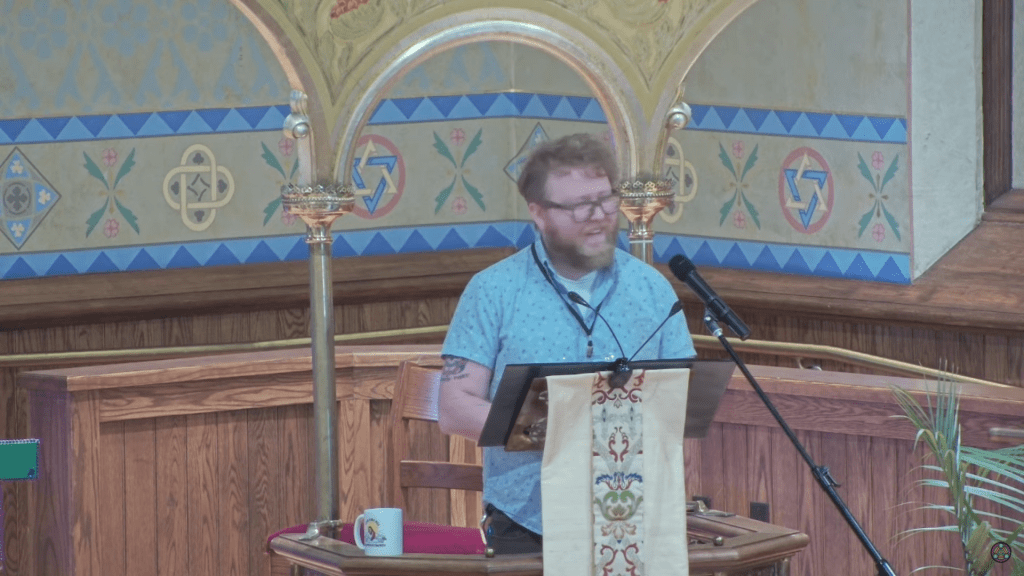
This past Sunday I had the honor to preach at my home church. Below is the sermon, but if you feel like watching it you can start the above link at 27:20 and enjoy all the little jokes I put in.
I’d like to open with a quote that I couldn’t find a home for, but it has latched onto me. It is from one of my favorite theologians, Ben Witherington. “It would appear that Mary’s announcement of the good news was insufficient to transform the mood of these male disciples.”[1]
I doubt, at times, there is any disciple more relatable than Thomas. I mean, you miss one hangout with the crew and suddenly, you’re supposed to believe your teacher is alive. It makes no sense. It sounds like a giant practical joke if you’re Thomas. It would be difficult not to respond with the, “I won’t believe anything until I put a finger through his hand!”
After all, it wasn’t like people came back from the dead all the time. But when Jesus comes back, and Thomas sees him, and while we are not told Thomas touches the wounds, we know for Thomas, the world is turned upside down.
Jesus has pulled one over on humanity, and the rest of the world because here was someone who has moved from death to life, from cursed to redeemed.
When Jesus asks Thomas, “have you believed because you have seen me?” what answer could be expected other than yes?
When I read this section of John’s Gospel, the space between the crucifixion wound, the time it took for Thomas to hear of Jesus’ resurrection and seeing him really stood out.
How many times do you think the Spirit tried to make contact with Thomas that week?
Where their times when Thomas was sitting alone at night, awake wondering if this was true that Jesus was back, and was he pushing the door shut while the Spirit was trying to break it open?
What makes the Apostle Thomas so relatable for me, is there is space for his doubt. Space for his thoughts. And space for him to allow God to enter his midst and partner with him.
It is that doubt that drives Thomas back to meet with the other disciples, and it is that doubt that shatters in the face of hope.
There is no way we get to our first reading from Acts without doubt. Everyone one in that group was Thomas, except for the people the entire history of the church owes its allegiance to, and that is the women.
Now, this newfound hope in the future of the world changes the disciples in a way that is still echoed almost two thousand years later into this very room. I say this because there is no way we go from doubts of resurrection to the hope of the holes in Jesus’ palms and not end up in the position Peter and the apostles find themselves in, in Acts 5.
So, this council that Peter and the others find themselves in front of, what the heck is it? Well, according to the Oxford Annotated Mishnah, we can be certain of a few things.
It is the judicial and deliberative body that was presided over by the high priest
This was the justice system for ancient Palestinian Jews
This group covered civil and penal law
There were two courts of judges depending on the severity of what was being decided, 23 judges or 71 judges
It was made up of the elders, sages, and various priestly factions of the day
Because it was controlled by the high priest, this group the apostles find themselves in front of, the same group that fought for the condemnation of Jesus, are the Sadducees
Yes, they deliberated over civil and penal law, but that meant a few things
They oversaw when civil procedure and criminal procedure acted as a fulcrum, depending on how the case went it would be a fulcrum for criminal proceedings
They also were in charge of the criminal execution and capital crimes, along with the liability for each one
At this time, the Sadducees. The Chief Priest Caiaphas that we heard from taking Jesus to Pilate during Holy Week was in charge of this group
According to Rabbi Jacob Neusner the Sadducees their name means “righteous one” so that’s hard to argue with
But they also, at the time in first century Palestine, rejected the “recent belief” of the afterlife and resurrection. Resurrection and afterlife theology belonged to the Pharisees.
The Sadducees are only spoken of a few times, as we see Jesus mostly go toe-to-toe against the Pharisees in the Gospels.
So why does all of this matter?
The Apostles are standing in front of people that have the ability to kill them. The Mishnah I quoted from earlier also says that there are, “…four execution methods—stoning, burning, decapitation, and strangulation—and, while it lists almost thirty capital crimes, it gives greatest attention to blasphemy…[5]”
Now, something I want to be clear about is, this is not a bloodthirsty group, and if not careful, they can be portrayed as one. The Mishnah says, A Sanhedrin that executes a transgressor once in seven years is characterized as a destructive tribunal. Since the Sanhedrin would subject the testimony to exacting scrutiny, it was extremely rare for a defendant to be executed.[6] The care for the life of a person was extremely important to this council.
But, if you are a person preaching of the resurrection of a perceived blaspheming rabbi, it is easy to see why the high priest would want that locked down. Not only do the Sadducees in charge not believe in resurrection or an afterlife, they had just had Jesus killed.
Peter says, “we must obey God rather than human authority.” The God of our ancestors raised up Jesus, whom you had killed by hanging him on a tree.” Part of the culture in first century Palestine with members of ancient Judaism is calling out scripture in conversation.
Everyone sitting in that room knew that Peter was connecting what happened with Jesus to Deuteronomy 21:22-23 which reads, When someone is convicted of a crime punishable by death and is executed, and you hung him on a tree, his corpse must not remain all night upon the tree; you shall bury him that same day, for anyone hung on a tree is under God’s curse.
Scholar Ben Witherington writes that Josephus, a Jewish historian who was alive during the first century in Palestine, “indicates that such a public hanging of the body followed stoning and was the punishment for the crime of blasphemy”[7] So if someone blasphemed, and they were stoned for it, their body was hung on a tree as a deterrent. If you know your American history, it should be no surprise that the incredible Dr. James Cone connected this in his book The Cross and The Lynching Tree.
When Jesus died, he was taken off the tree branches fastened into a cross and buried the same day. What Thomas is feeling in today’s gospel is the same thing the disciples felt walking on the road to Emmaus. It is the same thing Judas felt when he killed himself in the same way his friend died. Despair because the person they loved, the person they thought was going to overthrow power, empire, Rome, etc. was killed and cursed.
For the disciples before easter, there is no coming back from death, and to be cursed by God in the manner of your death must mean it was all a waste.
Every blister, every hungry night, every thirsty morning, the family and business you left behind to follow this Jesus around for three years amounted to nothing, because in the end he is cursed.
That is, until God turns that doubt and despair into hope and conviction.
This conviction and hope that the spirit burns into Peter and the rest of the Apostles, is the same hope and conviction the spirit burns into us today.
This is the same Spirit, hope, and conviction that pushes us to say that while some may not recognize our non-binary siblings, we are emboldened to say we see you, we name you, and we love you.
This is the same Spirit, hope, and conviction that pushes us to say that what is happening in Middle East right now breaks God’s heart, and Palestinian children deserve to grow old.
This is the same Spirit, hope, and conviction that pushes us to say that Black lives still and always will matter.
This is the same Spirit, hope, and conviction that pushes us to say that we love all our queer siblings.
This is the same Spirit, hope, and conviction that pushes us to say that we must protect trans kids at all costs.
This is the same Spirit, hope, and conviction that pushes us to say that we, know no person is illegal, and we must care and watch out for our neighbors.
This is the same Spirit, hope, and conviction that pushes us to say that pushes us to wake up every Sunday morning and make breakfast.
This is the same Spirit, hope, and conviction that pushes us to say that we, like Father Greg Boyle, see and know the unshakeable good in all people.
This is the same Spirit, hope, and conviction that pushes us to say that at Trinity Episcopal Church, in downtown Toledo, you are welcome, wanted, and safe.
This is the same Spirit, hope, and conviction that pushes us to say thanks be to God, and amen.



 George of Sylvania