Category: history

  • Stand Against HB-486

    Stand Against HB-486

    I wrote and submitted this as an op-ed, but decided to release it here as well because it is important.

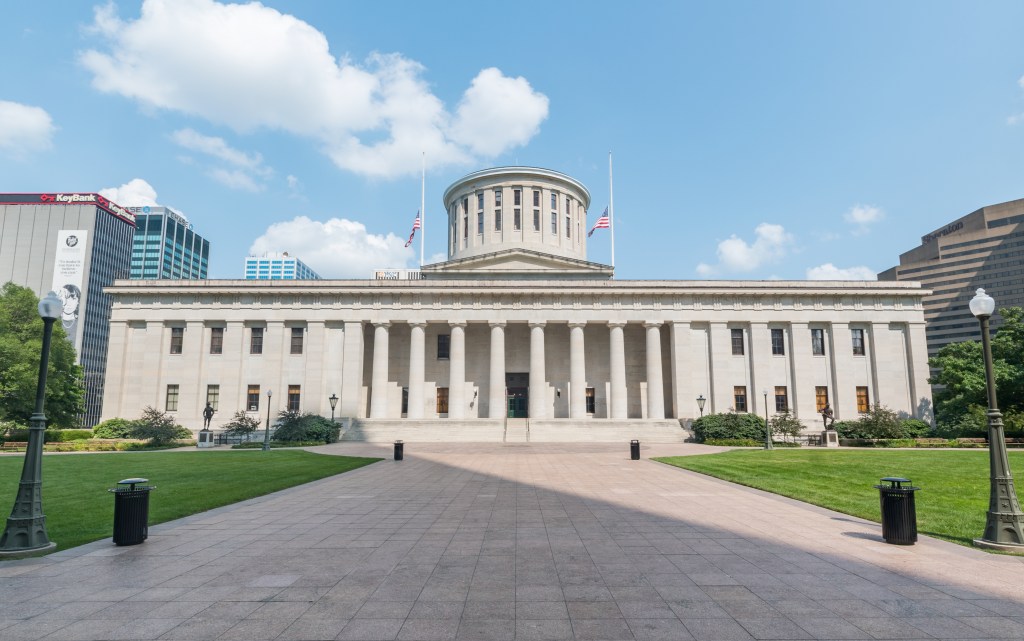
    The Ohio State House is attempting to pass House Bill 486, and it should cause us concern. If passed, this bill would allow for educators in state sponsored higher education and public schools to discuss Christianity’s positive influence on culture and history in America. This proposed act also includes examples talking points to be used classrooms, as historical examples and not alleged proselytization. However, the examples in this proposal read as a complete whitewash of American history which does a severe disservice not only to students and educators, but the accuracy of Christianity’s influence in the United States of America.

    The influence, whether positive or negative, that Christianity has had on American lives past and present, should be left to religious professionals to teach. To think that an educator can only talk about the positive influence and can willfully ignore the historical stance of white Americans using religion to maintain slavery, segregation, and anti-LGBTQIA+ stances is morally and ethically wrong. And, unfortunately, that is not the only moral issue in this act.

    The co-sponsors of this bill have an agenda with which we should be uncomfortable. On the surface, this bill unequivocally pushes the talking points of christian nationalism. A popular movement in this country that, at its core, is antithetical to the Gospel. If we want to talk about the impacts of Christianity in history, we must do so in an unbiased and truthful way, and these conversations should be led by those qualified to do so.  Not by someone that holds a degree from a bible college, which is one degree I hold, but from an unbiased institution.

    The miseducation of Christian influence on a country that refuses to reconcile its sin of slavery and the mistreatment of Indigenous peoples at best could only lead to prolonged ignorance, and at worse, political or religious based violence. I encourage everyone to call upon their reps and advise against voting for this bill, especially Rep. Josh Williams, who is a co-sponsor. Now is not a time to stay silent, and it is our job to let our representatives know we do not want HB-486 to pass.

    To contact OH D41 Rep Erika White, click here.
    To contact OH D42 Rep Elgin Rogers Jr., click here.
    To contact OH D43 Rep Michele Grim, click here.
    To contact OH D44 Rep Josh Williams, click here.

    Not sure who your rep in Ohio is? Follow this link.

  • Bitter is the Mouth

    Bitter is the Mouth

    About six months ago, I purchased a bottle of Absinthe because, for some unknown reason, I thought it was a good idea. It had been at least a decade since I had tried it, and it did not go down very well. The wormwood in the drink, if you have never had it, leaves an incredibly bitter taste in your mouth if you don’t mix the properly. The other day, as I sat drinking my morning coffee, I was wondering what mixture of mouthwash/seltzer water/whatever I had that is now leaving this similar taste in my mouth.

    That’ll flavor combination will wake you up.

    As I am sipping this, I have been working my way through the prophet Amos in my morning quiet time. This reading of the prophet has been compounding some outlying frustration. A genocide has been broadcasting in real time, in spite of murdering journalists, in Palestine for those of us paying attention. Children, and people of all ages have been intentionally starved, and the footage of it will leave a mark. Kids, and others, have been murdered while waiting in line for water, food, etc. The intentional cruelty, and war crimes committed is an abomination.

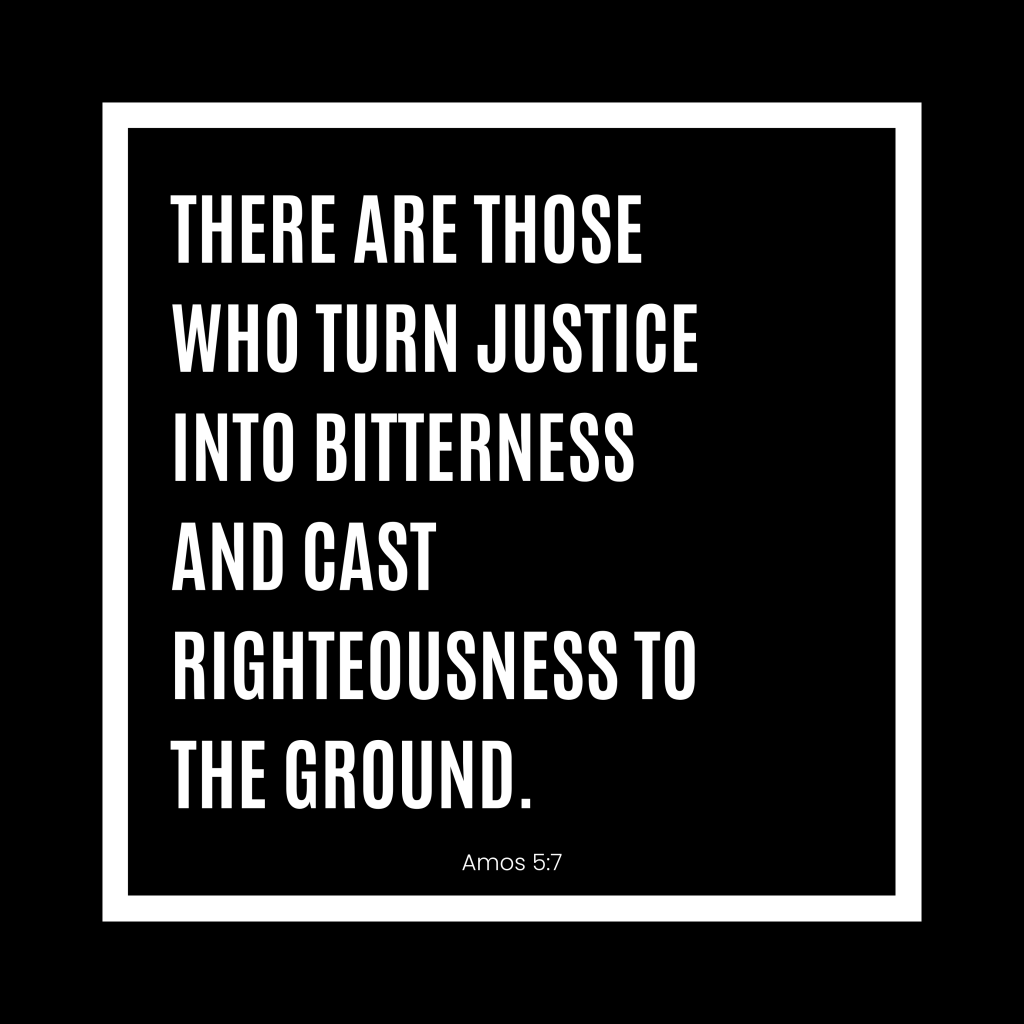
    So reading through Amos, seeing this massacre play out in real time over the past 18 months and all of it taking place in the region the prophet is talking about has brought a new flavor to the text. For about a week, Amos 5:7 (NIV) has had its claws in me, “There are those who turn justice into bitterness and cast righteousness to the ground.” I have been meditating on this, and it has like a stick in my craw, but I couldn’t figure out why.

    There is the obvious tug at what Amos is saying on face value, but I decided to check out the Apostolic Polyglot, an interlinear literal Greek-English of the Christian Bible. When I read it, and it made no sense, I looked to the New Oxford Annotated Bible. It is just a fancier version of the New Revised Standard Version, which reads:

    “Ah, you that turn justice to wormwood, and bring righteousness to the ground!”

    There it is, the stick in my craw.

    The verse in the New International Version was too nice for me. Bitterness can be a variety of things. I love lemons, and they can be bitter as hell. But you know what, wormwood will make almost anyone gag!

    Every time we read or see what has been happening in Palestine, Sudan, and to the Uyghurs, we should taste wormwood in our mouths.

    Every time we read about those fighting against releasing the Epstein client list, we should taste wormwood in our mouths.

    Every time we see another mass shooting in the news, we should taste wormwood in our mouths.

    Every time we see or hear reports of ICE agents snatching people off of the streets, we should taste wormwood in our mouths.

    Every time we see military personnel being mobilized against citizens, we should taste wormwood in our mouths.

    In fascism, there is no peace. There is no peace without reconciliation. There is no reconciliation without justice. There is no justice in attempting to control others. Control is void of love, and without love, God can be incredibly difficult to find.

    It may seem like nothing, but speaking about what is going on may help wake people up. Going on the record and contacting your representatives is called slow activism for a reason, but it is worth doing. If you have not tried 5 Calls yet, follow the link, and use it for good.

    Everyone has to start somewhere, and I hope the bitter taste in your mouth that the Trump administration has helped bring about in the past eight months spurs you into action.

    Grace and peace.

  • Shadrach, Meshach, and Abednego

    Shadrach, Meshach, and Abednego

    Prayer meeting reflection from 4/9/2025:

    Nebuchadnezzar said to them, “Is it true, O Shadrach, Meshach, and Abednego, that you do not serve my gods and you do not worship the golden statue that I have set up? Now if you are ready when you hear the sound of the horn, pipe, lyre, trigon, harp, drum, and entire musical ensemble to fall down and worship the statue that I have made, well and good. But if you do not worship, you shall immediately be thrown into a furnace of blazing fire, and who is the god that will deliver you out of my hands?”

    Shadrach, Meshach, and Abednego answered the king, “O Nebuchadnezzar, we have no need to present a defense to you in this matter. If our God whom we serve is able to deliver us from the furnace of blazing fire and out of your hand, O king, let him deliver us. But if not, be it known to you, O king, that we will not serve your gods and we will not worship the golden statue that you have set up.”

    Then Nebuchadnezzar was so filled with rage against Shadrach, Meshach, and Abednego that his face was distorted. He ordered the furnace heated up seven times more than was customary, and ordered some of the strongest guards in his army to bind Shadrach, Meshach, and Abednego and to throw them into the furnace of blazing fire.

    Then King Nebuchadnezzar was astonished and rose up quickly. He said to his counselors, “Was it not three men that we threw bound into the fire?” They answered the king, “True, O king.” He replied, “But I see four men unbound, walking in the middle of the fire, and they are not hurt; and the fourth has the appearance of a god.” Nebuchadnezzar then approached the door of the furnace of blazing fire and said, “Shadrach, Meshach, and Abednego, servants of the Most High God, come out! Come here!” So Shadrach, Meshach, and Abednego came out from the fire. And the satraps, the prefects, the governors, and the king’s counselors gathered together and saw that the fire had not had any power over the bodies of those men; the hair of their heads was not singed, their tunics were not harmed, and not even the smell of fire came from them.

    Nebuchadnezzar said, “Blessed be the God of Shadrach, Meshach, and Abednego, who has sent his angel and delivered his servants who trusted in him. They disobeyed the king’s command and yielded up their bodies rather than serve and worship any god except their own God.

    Daniel 3:14–20,24–28

    There was one question as I was reading this passage from Daniel that I do not have just one answer to.

    It is also really hard for me to read this and not think about the political environment of the past decade. The amount of comparison done between King Nebuchadnezzar and President Donald Trump is at this point, is almost exhausting. I have known and read of so many Christians that have excused voting for him, or his political actions using Nebuchadnezzar saying that God can use sinful people to move God’s will. In 2020 author William Henley released his book titled, Two Men from Babylon: Nebuchadnezzar, Trump, and the Lord of History.

    Henley walks the reader through the creation of the city of Babylon starting in Genesis 10 where he points out the mighty hunter named Nimrod that subdued the neighbors around him and forced them to submit to his rule. In this excerpt Henley writes:

    Centuries later in 620 BC, Nebuchadnezzar, a successor to Nimrod, became the ruler of Babylon and would demonstrate that founders of a nation inject their spiritual DNA into their offspring. Nimrod himself bore the DNA of the “giants,” the “mighty ones” who descended from the Nephilim (Genesis 6:4). The Bible reveals that at the core of the Nephilim spirit was self-pride and a passion for self-exaltation. This is the essence of “all that is in the world, the lust of the flesh and the lust of the eyes and the boastful pride of life” (1 John 2:16).  This also is the essence of Babylon in all its forms. Nebuchadnezzar, in his time as Babylon’s ruler, would pursue these lusts extravagantly— until, in a chaotic period in his personal life…[1]

    In this Daniel passage, Nebuchadnezzar has built a statue of gold and expects everyone to bow down and worship this image. If any of you have been on social media since January when President Trump regained power, you may have seen a gross AI video of his view of Gaza. There were no Palestinians, but instead glitzy hotels, a casino, Trump and Netanyahu relaxing by a pool with drinks, and a tall golden statue of Donald Trump.

    This AI golden statue of President Trump had peaked the comparison between the two, and I remember sitting in almost stunned disbelief. Disbelief not only of my surprise of this video, but that I was surprised by it. But here is what sticks in my crawl with this comparison, I do not believe that Trump could ever be as humble as Nebuchadnezzar.

    In chapter 2 of Daniel, at the end, we see that Nebuchadnezzar had a dream of a statue that Daniel interpreted. After the interpretation, the king then fell on his face to worship Daniel and give him a grain offering. He then makes Daniel a ruler of parts of Babylon, and Shadrach, Meshach, and Abednego are placed in positions of power. However, we find out in the full context of this chapter, that these three Israelites refuse to worship the gods of the king, and to bow down at the golden statue to worship as well. The king had no problem doing this himself, because it was the god of all gods for him. However, if we know our history, Israelites are forbidden from worshiping graven images and other gods. If we remember, it did not go very well for the ancient Israelites at the foot of Mount Sinai during the exodus.

    Now, something Nebuchadnezzar said to Daniel in chapter two was, “truly, your God is God of gods and Lord of kings and a revealer of mysteries, for you have been able to reveal this mystery.”

    Two questions about the golden statue:

    1. Why was Daniel not forced to kneel and worship the statue like his friends?
    2. Who was the statue of?

    I am of the mindset that the statue was of Daniel.

    After all, the king worshiped Daniel as God at the end of chapter two, and it is not like Daniel can stand down and worship himself. This for me, is why the argument of President Trump and King Nebuchadnezzar will always fall apart. Humility, when we unharden our heart, will always breakthrough in unexpected ways. Pharaoh did not have to unharden his heart, not because God was allegedly doing it, but because he was never affected directly. That is until the commerce of Egypt was affected by the plague of hail.  

    Today is the last Wednesday in Lent, and this has been such a long journey to Palm Sunday. Citizens have been snatched off the street for voicing their dissent of the current administration and its stance on Palestine. Saturday, some of us participated in the almost 5,000 strong Hands-Off protest in Toledo. The city of ancient Babylon may have fallen, but it does not mean that people don’t want to return to it. Like the Israelites in the wilderness groaning that they could have died slaves in Egypt with pots of meat instead of wandering.

    But what happens in Babylon and the wilderness for the ancient Israelites? God shows up and teaches God’s people a new way to live. To paint with a broad brush, in Babylon they reconstructed what it meant to worship God outside of a Temple, and in the wilderness, they learned reliance and trust.

    So, as I read about Shadrach, Meshach, and Abednego, one question kept coming to mind that I have no answer to:

    What golden statues are trying to be built now, that we must deny so we do not lose our foundation in God?


    [1] https://www.christianpost.com/voices/two-men-from-babylon-nebuchadnezzar-trump-and-the-lord-of-history-book-excerpt.html, pulled 4/9/2025
  • Black History Month

    On Sunday, Black History Month kicked off, and things are a little bit different this year. While the current president made a proclamation on 1/31 of the celebrating of Black history, federal agencies are baring the celebration/observation of it and other things. In this post, I just want to share a few things about it’s official founding, a bit of importance of it, the way my denomination has been impacted by Black history, and some books to read.

    In 1976 Republican President Gerald Ford designated the month of February as Black History Month. This came after years of work from scholar Carter G. Woodson, who established the original, “Negro History Week” which took place the second week of February (make no mistake, Woodson never confined Black history education and celebration to just one week). The reason for this, was it held both Abraham Lincoln and Fredrick Douglas’s birthdays. The Association for the Study of African American Life and History (ASAALH) continues Woodson’s work and continues to be a great resource for learning about Black history. For a reading of Black history and the Episcopal Church, Joyce Crittenden has an incredible article titled, Condensed History of the Black Episcopalian, published on the website for Episcopal Church of All Saints and Ascension’s website that can be reached here.

    The importance of learning Black history can never be understated. Black history is the history of America, and we are tied to it in ways that will never be undone, no matter how may people try. It is a history that must be celebrated even if it is embarrassing or hard for white people to read. With that, I’d like to recommend a few books that changed my life for this month that will open your eyes and break your heart for the better (in no particular order):

    • The Fire Next Time by James Baldwin
    • Black AF History: The Un-Whitewashed Story of America by Michael Harriot
    • The Color of Compromise: The Truth about the American Church’s Complicity in Racism by Jemar Tisby
    • The Assassination of Fred Hampton: How the FBI and Chicago Police Murdered a Black Panther by Jeffery Haas
    • Reading While Black: African American Biblical Interpretation as an Exercise in Hope by Esau McCauley
    • On Juneteenth by Annette Gordon-Reed
    • Between the World and Me by Ta-Nehisi Coates
    • Medical Apartheid: The Dark History of Medical Experiments on Black Americans from Colonial Times to the Present by Harriet A. Washington
    • Black Birds in the Sky: The Story and Legacy of the 1921 Tulsa Race Massacre by Brandy Colbert
    • The Sword and the Shield: The Revolutionary Lives of Malcolm X and Martin Luther King Jr. by Peniel E. Joseph 
    • The Cross and the Lynching Tree by James H. Cone
    • Black Against Empire: The History and Politics of the Black Panther Party by Joshua Bloom and Waldo E. Martin Jr.
    • The Autobiography of Malcolm X as told to Alex Haley
    • Tears We Cannot Stop by Michael Eric Dyson

    As I close out this first short post on Black History Month, I would like to share the following prayer by Canon Carla Robinson. It was prayed at a Circles of Color meeting in 2023 and can be found here. This was shortly after the death of another young Black man, Tyre Nichols. Nichols was beaten by five police officers during a traffic stop, and died in the hospital three days later:

    May God bless the memory of Tyre Nichols. We pray for his family during this time of unspeakable loss and grief. His life mattered. Tragically we have been here time & time again. Lord, grants us the strength and courage to never accept injustice & cruelty as the price for public safety. And give us grace to truly strive for justice and peace and to honestly respect the dignity of every human being.

    Creator, we lift up and thank you for our Black siblings who have shaped history. We pray that the learning happening this month in schools, homes and workplaces will be meaningful and deep-rooted. We pray for open hearts and minds, and spirits willing to learn and be transformed by you. May this month be a time of curiosity and sharing, conversations and celebrations, challenge and encouragement. Loving God, help us to dig deeper, look closer, and think bigger.

    In Jesus name, amen.

    As we celebrate our beloved siblings and continue to work towards being beloved community, may we continue to learn what we do not know, and celebrate from the mountain top.

    Black Lives Matter.
    Black Trans Lives Matter.
    Black Queer Lives Matter.
    Black Women Lives Matter.
    Black Men Lives Matter.
    Black Children Lives Matter.
    Black Healthcare Matters.

    May we never stop saying it, may we never lose sight of it, and may we never forget it.

    Grace and peace friends.

  • Holocaust Remembrance Day

    Image by pikisuperstar on Freepik

    *This was written before the cease fire in Palestine*

    Today is Holocaust Remembrance Day.

    Every year, I spend quite a lot of my time in January studying the Holocaust. This comes about in different ways: reading books, watching documentaries, or listening to podcasts. With my love of Jewish roots in Christianity, and seeing how Christians have perpetuated anti-Semitic theology over the past two thousand years, I work very hard not to. Often, because I work in a church in the United States, there are a lot of assumptions I support what is happening currently in nation-state of Israel.

    I do not support ethnic cleansing or genocide in any form. Especially those that my tax dollars are helping to fund.

    This year, instead of focusing on the Shoah (usually what is refereed to as the Jewish peoples experienced during the Holocaust), I’ve branched out to wider accounts of murder and ethnic cleansing.

    One book I finished this month was, The Ethnic Cleansing of Palestine, written by Ilan Pappé. Born in Haifa Israel to parents that fled n*zi persecution in the 1930’s, he is a historian and author. If I had not read a few books on what happened in the 1940’s to the Jewish peoples of Europe, personally, Pappé’s book would not have been as devastating. The tactics described in the book between the Israeli and British forces against the Palestinians will make you sick. There is a lot of similarity to what persecuted European Jews experienced in the mid 20th century.

    Something that really stood out toward the beginning of the book was when Pappé speaks about the history of occupation of Palestine. How, this was something Palestinians were used to. However, for the first time, Palestinians experienced being displaced from land and homes their families had worked and lived on for generations.

    What is happening right now to the Palestinians is unacceptable.

    What happened to European Jews in the 1930’s and 1940’s (as well as pogroms throughout history against them) is also unacceptable.

    What is happening to the Uyghurs in China right now is unacceptable.

    The persecution or mass deaths of any group of people because of their ethnicity or religious affiliation is unacceptable.

    May our prayers and actions remember that today of all days, and those that follow. Be sure to read the prayer by Rabbi David Katz at the end of this.

    If you are interested in learning more about the Shoah, or other instances of genocide, I highly recommend the following (in no particular order):

    The Holocaust: A New History by Laurence Rees

    Shoah: A Documentary by Claude Lanzmann

    Night by Elie Weisel

    Man in Search of Meaning by Viktor Frankl

    A Shortest History of Israel and Palestine by Michael Scott-Baumann

    The Ethnic Cleansing of Palestine by Ilan Pappé

    Auschwitz: A Doctor’s Eyewitness Account by Dr. Richard Seaver

    On Palestine by Noam Chomsky and Ilan Pappé

    The War on Uyghurs: China’s Internal Campaign against a Muslim Minority by Sean Roberts

    The Uyghurs: Strangers in their Own Land by Gardner Bovingdon

    We Uyghurs Have No Voice: An Imprisoned Writer Speaks by Ilham Tohti

    A Prayer for Yom Hashoah / Holocaust Remembrance Day
    By Rabbi David Katz

    Ribbono shel Olam – Master of the Universe:

    On this most solemn of occasions, we open our hearts, minds, and souls to you.

    As we remember the six million, the eleven million, the indifference, and the evil;

    As we honor the heroes, the martyrs, the survivors, and the victims;

    We ask you to soothe our souls, to amplify our memories, to strengthen our resolve, and to hear our prayers.

    We ask for your presence in our midst; for healing, light, and love to soothe and ease our pain, as we commemorate the horrors that were committed not long ago. Please, oh Holy One, be gentle with our souls.

    We ask that you help us to forever remember the stories we hear. As tales of the atrocities are shared, as we re-encounter the unthinkable, we ask that these memories be strengthened and never fade, in the hope that those who remember the mistakes of the past will not repeat them. Please, oh Holy One, amplify our ability to remember.

    We ask that you strengthen our will, that you help us to ensure that the world does not again see such monstrosities. We say “never again” and we dedicate ourselves to this principle, to the idea that justice does not allow persecution, that genocide shall not be repeated, and that vigilance is the responsibility of freedom, at all costs. Please, oh Holy One, make manifest our resolve that these horrors remain but memories.

    We ask that you answer our prayers. We pray that the call of evil falls on deaf ears, that those who fight for freedom and justice always prevail, that those who need protection do not become victims. We pray that the lessons we learn from this darkest hour allow all humankind to better itself, and to truly and nobly embody the idea that we are each made in Your image. We pray for the souls of the millions and millions of victims of this brutality; we pray that we honor their lives and their memories by observing this day, and by doing everything in our power and beyond to make sure that no such shadow again darkens our world.

    Above all, we pray for shalom—for wholeness and peace—to be in our midst, now and forever. Please, oh Holy One, answer our prayers and bring us a world devoid of hatred, filled instead with peace.

    Ken yehi ratzon – may this be God’s will. And may we all say together, Amen.

  • MLK Day 2025

    Photo by Gotta Be Worth It on Pexels.com

    It is an irregular day for a post, but considering all that is happening, I thought I’d write a little something. An attempt to put a little good in the world.

    A few years ago, I was asked to preach on MLK observance Sunday, and it was my first time preaching at the new church I was on staff at. To say it was a little intimidating would be correct. But, a few good things came from it, and as far as sermons go, not the worst I’ve preached. This is a bit of an updated excerpt from it waking toward the idea of how we can move forward.

    How can we fight for a world that is aligned with our kin-dom ideals while making room for those who may not like or agree with us? We advocate. In his letter from Birmingham Jail, Dr. King lays out the four basic steps to nonviolent protesting, to paraphrase they are:

    1. Collect the facts and determine from those facts whether injustice is alive and well in the community you’re focusing on.
    2. Negotiation. Engage in conversation with the gate holders and see if there is a way to work within the law to change what is going on.
    3. Self-purification. The attempt to purge the injustice from oneself, so that their eyes can no longer be shut to them.
    4. Non-violent direct action. Showing up and protesting whether it is a sit in, letter writing, or some other form.

    When I was a student at the University of Toledo, I minored in Peace Studies and Education, and through those courses, these four markers came up in class almost every other week. It’s tempting, when preaching to draw upon the model that Dr. King left behind, at least, the perceived model he left. For a very long time, evangelicals and other white people have used the likeness and words of Dr. King in a way that has almost made him a caricature of who he was. 2018 marked the 50th anniversary of his cold-blooded murder, and Michael Harriot wrote an article for The Root labeled, From Most hated to American Hero: The Whitewashing of Martin Luther King Jr. Harriot does not beat around the bush when he states:

    Contrary to popular belief, when King Died, he was not an icon of freedom and equality. In fact, most of the country disliked him. Sadly, on April 4, 1968, a bullet splattered bits of Martin Luther king Jr.’s brains and blood across the balcony of Memphis, Tenn.’s Lorraine Motel. Then, and only then, was white America ready to make him a hero. [1]


    In part, it was Dr. King’s approach to injustice through non-violent direct action that led to his unpopularity. However, there is another way to put it, a way that I prefer, and it was said by one of his contemporaries, Rabbi Abraham Joshua Heschel. To quote Rabbi Laurie Green:

    Upon marching with Dr. King in Selma, Rabbi Abraham Joshua Heschel famously said: ‘I felt my legs were praying.’ Heschel was as passionate about social justice as he was about the Sabbath and prayer. He taught that prayer must be revolutionary…[2]

    Growing up, I was often taught that prayer was a direct communication from myself to God, and that was about it. When I was introduced to concept of praying with one’s feet by my former mentor Don, it kind of broke my brain open about the possibilities of prayer.

    • So, when I say something like, advocate for the world we want, not the one we live in, that to me is an act of prayer.
    • Going after systems of oppression through non-violent direct action is a type of prayer.
    • Realizing that our liberation isn’t just wrapped up in Christ, but the breaking of chains of oppression for all peoples is an act of prayer.
    • Working hard for justice in an unjust is an act of prayer.

    So, on this Dr. Martin Luther King Jr. Day, 57 years since his assassination, may we remember that the work Dr. King stood for is still on going, and that in the work, we are called to be merciful, just as our God is merciful. We have a lot of work to do, and a ton of dirt to get under our nails.

    Grace and peace.