Prayer meeting reflection from 4/9/2025:
Nebuchadnezzar said to them, “Is it true, O Shadrach, Meshach, and Abednego, that you do not serve my gods and you do not worship the golden statue that I have set up? Now if you are ready when you hear the sound of the horn, pipe, lyre, trigon, harp, drum, and entire musical ensemble to fall down and worship the statue that I have made, well and good. But if you do not worship, you shall immediately be thrown into a furnace of blazing fire, and who is the god that will deliver you out of my hands?”
Shadrach, Meshach, and Abednego answered the king, “O Nebuchadnezzar, we have no need to present a defense to you in this matter. If our God whom we serve is able to deliver us from the furnace of blazing fire and out of your hand, O king, let him deliver us. But if not, be it known to you, O king, that we will not serve your gods and we will not worship the golden statue that you have set up.”
Then Nebuchadnezzar was so filled with rage against Shadrach, Meshach, and Abednego that his face was distorted. He ordered the furnace heated up seven times more than was customary, and ordered some of the strongest guards in his army to bind Shadrach, Meshach, and Abednego and to throw them into the furnace of blazing fire.
Then King Nebuchadnezzar was astonished and rose up quickly. He said to his counselors, “Was it not three men that we threw bound into the fire?” They answered the king, “True, O king.” He replied, “But I see four men unbound, walking in the middle of the fire, and they are not hurt; and the fourth has the appearance of a god.” Nebuchadnezzar then approached the door of the furnace of blazing fire and said, “Shadrach, Meshach, and Abednego, servants of the Most High God, come out! Come here!” So Shadrach, Meshach, and Abednego came out from the fire. And the satraps, the prefects, the governors, and the king’s counselors gathered together and saw that the fire had not had any power over the bodies of those men; the hair of their heads was not singed, their tunics were not harmed, and not even the smell of fire came from them.
Nebuchadnezzar said, “Blessed be the God of Shadrach, Meshach, and Abednego, who has sent his angel and delivered his servants who trusted in him. They disobeyed the king’s command and yielded up their bodies rather than serve and worship any god except their own God.
Daniel 3:14–20,24–28
There was one question as I was reading this passage from Daniel that I do not have just one answer to.
It is also really hard for me to read this and not think about the political environment of the past decade. The amount of comparison done between King Nebuchadnezzar and President Donald Trump is at this point, is almost exhausting. I have known and read of so many Christians that have excused voting for him, or his political actions using Nebuchadnezzar saying that God can use sinful people to move God’s will. In 2020 author William Henley released his book titled, Two Men from Babylon: Nebuchadnezzar, Trump, and the Lord of History.
Henley walks the reader through the creation of the city of Babylon starting in Genesis 10 where he points out the mighty hunter named Nimrod that subdued the neighbors around him and forced them to submit to his rule. In this excerpt Henley writes:
Centuries later in 620 BC, Nebuchadnezzar, a successor to Nimrod, became the ruler of Babylon and would demonstrate that founders of a nation inject their spiritual DNA into their offspring. Nimrod himself bore the DNA of the “giants,” the “mighty ones” who descended from the Nephilim (Genesis 6:4). The Bible reveals that at the core of the Nephilim spirit was self-pride and a passion for self-exaltation. This is the essence of “all that is in the world, the lust of the flesh and the lust of the eyes and the boastful pride of life” (1 John 2:16). This also is the essence of Babylon in all its forms. Nebuchadnezzar, in his time as Babylon’s ruler, would pursue these lusts extravagantly— until, in a chaotic period in his personal life…[1]
In this Daniel passage, Nebuchadnezzar has built a statue of gold and expects everyone to bow down and worship this image. If any of you have been on social media since January when President Trump regained power, you may have seen a gross AI video of his view of Gaza. There were no Palestinians, but instead glitzy hotels, a casino, Trump and Netanyahu relaxing by a pool with drinks, and a tall golden statue of Donald Trump.
This AI golden statue of President Trump had peaked the comparison between the two, and I remember sitting in almost stunned disbelief. Disbelief not only of my surprise of this video, but that I was surprised by it. But here is what sticks in my crawl with this comparison, I do not believe that Trump could ever be as humble as Nebuchadnezzar.
In chapter 2 of Daniel, at the end, we see that Nebuchadnezzar had a dream of a statue that Daniel interpreted. After the interpretation, the king then fell on his face to worship Daniel and give him a grain offering. He then makes Daniel a ruler of parts of Babylon, and Shadrach, Meshach, and Abednego are placed in positions of power. However, we find out in the full context of this chapter, that these three Israelites refuse to worship the gods of the king, and to bow down at the golden statue to worship as well. The king had no problem doing this himself, because it was the god of all gods for him. However, if we know our history, Israelites are forbidden from worshiping graven images and other gods. If we remember, it did not go very well for the ancient Israelites at the foot of Mount Sinai during the exodus.
Now, something Nebuchadnezzar said to Daniel in chapter two was, “truly, your God is God of gods and Lord of kings and a revealer of mysteries, for you have been able to reveal this mystery.”
Two questions about the golden statue:
- Why was Daniel not forced to kneel and worship the statue like his friends?
- Who was the statue of?
I am of the mindset that the statue was of Daniel.
After all, the king worshiped Daniel as God at the end of chapter two, and it is not like Daniel can stand down and worship himself. This for me, is why the argument of President Trump and King Nebuchadnezzar will always fall apart. Humility, when we unharden our heart, will always breakthrough in unexpected ways. Pharaoh did not have to unharden his heart, not because God was allegedly doing it, but because he was never affected directly. That is until the commerce of Egypt was affected by the plague of hail.
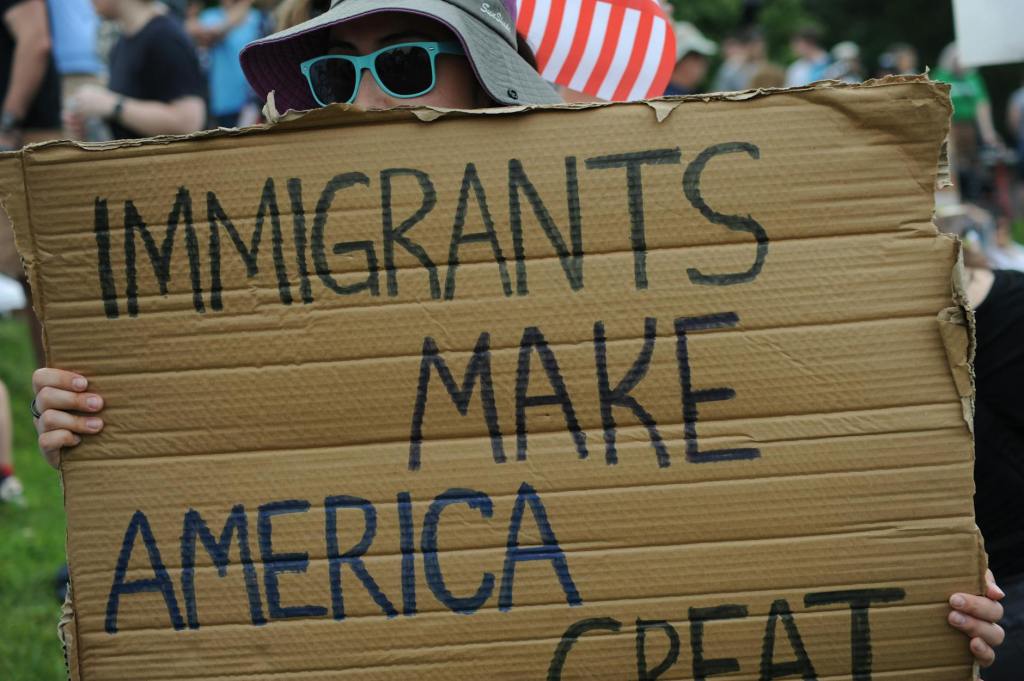
Today is the last Wednesday in Lent, and this has been such a long journey to Palm Sunday. Citizens have been snatched off the street for voicing their dissent of the current administration and its stance on Palestine. Saturday, some of us participated in the almost 5,000 strong Hands-Off protest in Toledo. The city of ancient Babylon may have fallen, but it does not mean that people don’t want to return to it. Like the Israelites in the wilderness groaning that they could have died slaves in Egypt with pots of meat instead of wandering.
But what happens in Babylon and the wilderness for the ancient Israelites? God shows up and teaches God’s people a new way to live. To paint with a broad brush, in Babylon they reconstructed what it meant to worship God outside of a Temple, and in the wilderness, they learned reliance and trust.
So, as I read about Shadrach, Meshach, and Abednego, one question kept coming to mind that I have no answer to:
What golden statues are trying to be built now, that we must deny so we do not lose our foundation in God?
[1] https://www.christianpost.com/voices/two-men-from-babylon-nebuchadnezzar-trump-and-the-lord-of-history-book-excerpt.html, pulled 4/9/2025