A few weeks ago I passed a uniquely American parental milestone: I dropped my child off at preschool after a mass shooting where two children were murdered. This, of course, was the shooting in Minneapolis at Annunciation Catholic School where kids were murdered during their chapel service. Some of you may have seen the clip of the kid talking about his friend Victor that protected him from the shooting, and Victor was struck in the back. I have been an outspoken advocate for tighter gun laws for years, and the fear at drop off that something *could* happen was horrifying.
Just another day in America.
Of course last week there were two school shootings, one in Colorado where a few kids were injured. Then there was the one in Utah were a christian nationalist podcaster was killed in front of a group of people, that has set the country on fire, as he was a divisive person that had no problem perpetuating racist, misogynistic, and homophobic rhetoric. But considering that is the current brand of conservatism in this country, it is no surprise they are trying to make a martyr out of him. Finally, Trey Reed, a young black man, was found hung from a tree near his college in Mississippi with no fowl play suspected somehow.
Just another week in America.
Two mass shootings in an unhoused encampment, again, in Minneapolis where 13 people are injured which comes on the heels of f*x news anchor Brian Kilmeade suggested euthanizing the unhoused. Of course nothing is going to happen to Kilmeade, even though real news reporters have lost their jobs for pointing out the podcaster who was killed spoke hatefully.
Another week in Ameri— wait, it’s only Wednesday.
At times like this, I return to a book written by Krister Stendahl called, The Roots of Violence: Creating Peace through Spiritual Reconciliation. In this section, he wrote about the political assassinations of the 60’s, people trying to make political change for the good, not like the guy we’ve seen in the news lately. While I do not believe there is room for political violence in this world, I understand it is here. Unfortunately, pointing out the hypocrisy of those calling for it to end, that continue to actively oppress people of color, the LGBTQ+ community, women, you name it, will do nothing but fall on deaf ears or echo chambers. So instead, I leave you with the words of Stendhal:
“We are surrounded by mass assassinations and executions, deeds that we call “terrorist” if others do them and “defense” if we do them. There is torture, which some people try to dress up by saying that it is not so bad if it is done by authoritarians, but it is bad when it is done by totalitarian. But the thumbscrews feel the same no matter who puts them on.”
– pg. 15, Roots of Violence
Stay safe, and watch out for one another. Grace and peace.
Jesus said to his disciples, “These are my words that I spoke to you while I was still with you– that everything written about me in the law of Moses, the prophets, and the psalms must be fulfilled.” Then he opened their minds to understand the scriptures, and he said to them, “Thus it is written, that the Messiah is to suffer and to rise from the dead on the third day, and that repentance and forgiveness of sins is to be proclaimed in his name to all nations, beginning from Jerusalem. You are witnesses of these things. And see, I am sending upon you what my Father promised; so stay here in the city until you have been clothed with power from on high.” Then he led them out as far as Bethany, and, lifting up his hands, he blessed them. While he was blessing them, he withdrew from them and was carried up into heaven. And they worshiped him, and returned to Jerusalem with great joy; and they were continually in the temple blessing God.
Luke 24:44-53
Every other week, I have the privilege of leading a noon prayer service. This week I decided to use the Ascension of Jesus early, and this is what you get.
Jesus has a way of revealing to us what is already present, but we, like the disciples at times, are unaware. In the Sermon on the Mount, he drills down on the underlying feelings that we can harbor until they become too much and come out in various ways. Whether that is anger that turns into murder, lust that turns into adultery, or praying and giving money to the poor so we can be seen doing it. When he speaks about the kin-dom of heaven in Matthew 13:47 and speaks of it as a fishing net that is full and brought into the boat, then the bad fish are discarded. Something that makes sense when we realize that in a new heaven and earth, where love and justice reign, those who continue to choose and seek power over others would not be happy there.
In Mark’s Gospel, Jesus teaches the Parable of the Sower, where the different seed falls on various terrain, and the plants that grow reflect wisdom and following his teachings, or the rejection of it. These are people that the disciples would have experienced first-hand but presented to them in a new way. We all know the Parable of the Prodigal Son where we are confronted with our own internal conflicts of being the younger son, older son, and parent in that position. However, what Jesus does here is something kind of new, but what their ancestors would have wrestled with. While God sends the power of the Holy Spirit to the disciples, that power is all around us. It is easy to forget that at the time God showed Godself to Abraham, religion was regionally based.
When the Temple was destroyed and the ancient Israelite’s found themselves enslaved in Babylon, they believed God left the temple and went to dwell with them. When they moved back to ancient Palestine and rebuilt the temple, God went back to dwell in it. Even in parts of Christian theology when the temple curtain is ripped from top to bottom, it has been said that was when God left the temple because of Jesus’ sacrifice. The idea being, there was no barrier between God and God’s people anymore.
But what Jesus points out in this part of Luke’s gospel, is that Jesus’s students will be sent what was promised. The power of the Holy Spirit will come to the disciples after Jesus ascends to be with God. While the delivery may look differently, Jesus is telling the disciples to expect something that has always been around them. While I cannot remember if I had read it, or was told this, but there was an idea that the burning bush Moses found himself in front of had been on fire or generations. This bush that was on fire but not consumed by fire was just sitting there for who knows how many years just waiting to be noticed, and it wasn’t until Moses came along that it was. Similar to Jacob waking up after seeing the dream of the ladder and realizing God was that place and he did not know it.
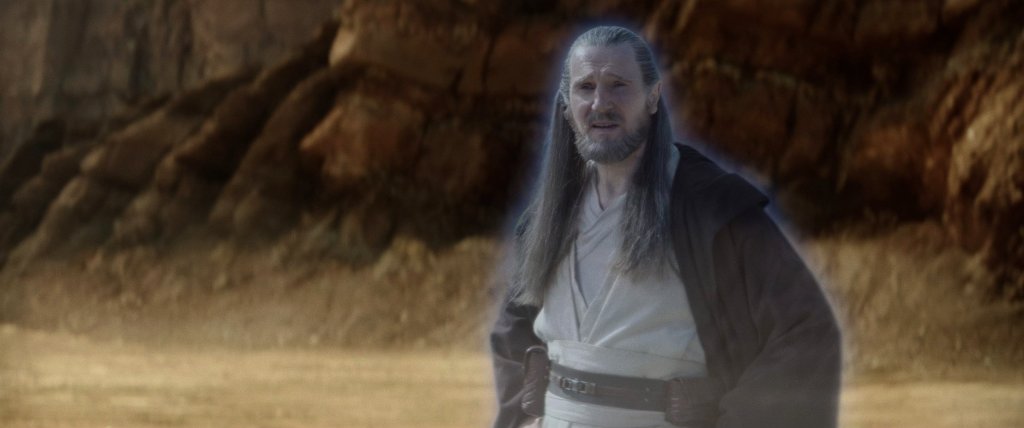
What comes to mind when I find myself in this dichotomy is the ending of the Obi-Wan Kenobi television show from Disney+. Kenobi has just completed a mission and re-found his purpose in a new way. Through the season, Kenobi is desperately alone and calling out to his old Jedi Master, Qui-Gon Jinn for guidance. It is believed that the living force can bring those from beyond to the present. When we think the series is over, out in the desert, we see an image appear. A blueish ghost of Qui-Gon appears, and Kenobi is surprised. In his reaction to seeing his old master, the Jedi responds with, “I was always here Obi-Wan, you were just not ready to see.” It is easy to compare spirituality of today to Acts 1 and forget that the same Spirit Jesus promises his students here, is the same that is alive and well today.
Friends, may we remember that, although some of us don’t speak in tongues, we do have the ability to awaken to the spirit around us unrealized.
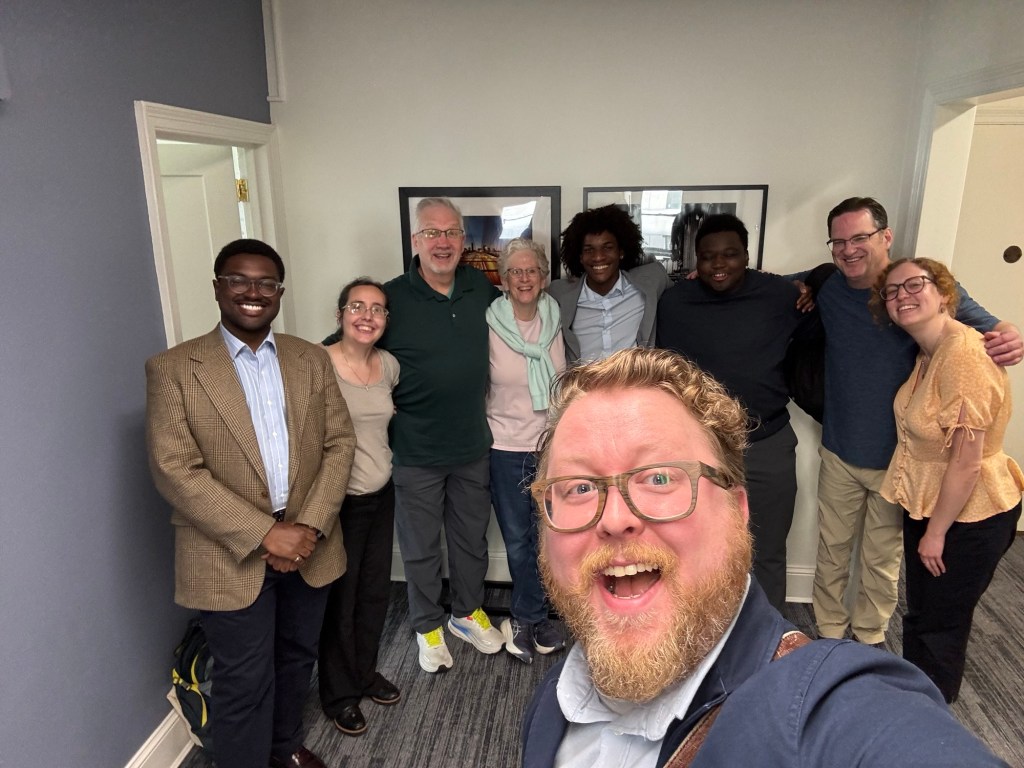
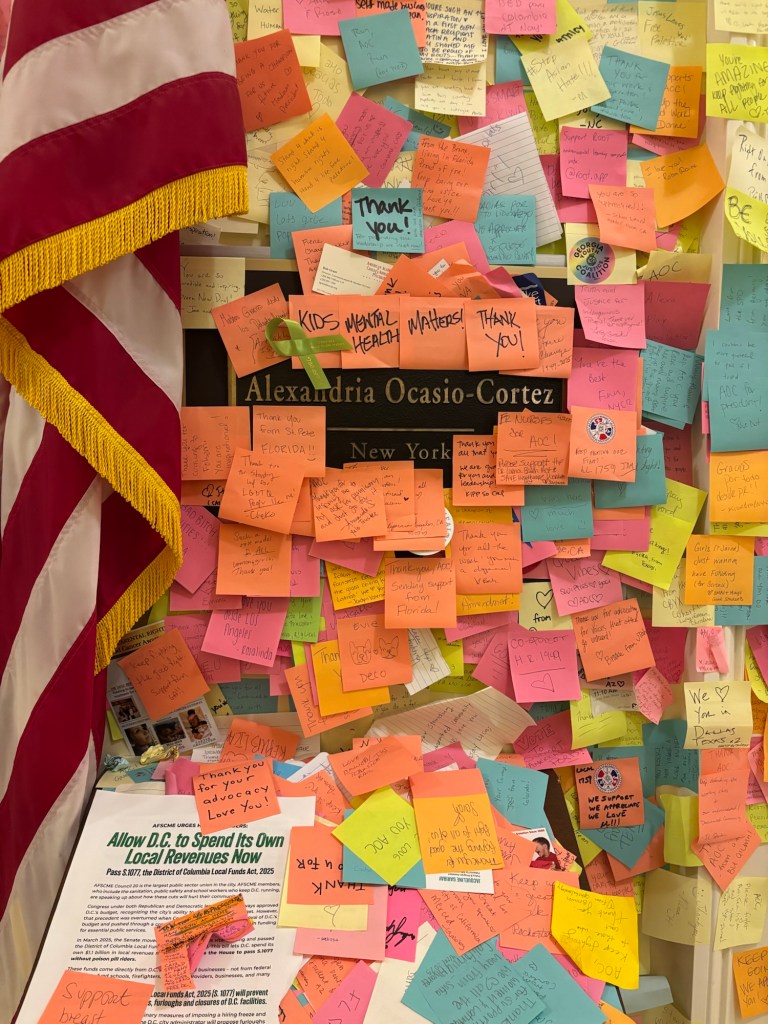
This past week a few of us from the church I work at, Trinity Episcopal Church, went to Washington D.C. to share our concerns with a few people. These people were Rep. Jim McGovern’s Legislative Director Cindy Buhl, Rep. Marcy Kaptur, and Senior Aid to Sen. Jon Husted, Sean Dunn. Unfortunately, Sen. Bernie Moreno’s office could not supply someone to meet with us. We also met up with members of the Episcopal Public Policy Network; Susie Faria, Lindsey Delks, and Troy Collazo, wonderful people doing incredibly important and hard work.
At the end of our meetings we provided a summary of our talking points we were able to get to, and some we couldn’t. Below you can read them, along with some pictures from our trip. We look forward to going back in the fall and following up with these concerns.
EPPN and our team
LGBTQIA+ support
The Trevor Project has been an incredible safety net for the LGBTQIA+ community, and the current administration has called to defund this. Trinity Episcopal Church is if not one of, then the most open and affirming Episcopal congregation in Toledo. We see first-hand people who walk through our doors that have been affected by gender identity and sexual orientation discrimination. Removing funding for this lifeline is not only unthinkable but cruel. The administration’s push of a “traditional family structure” as a source of stability and the lament for the lack of childbirth, coupled with the current administration wanting to cut programs like head start is not only confusing but shows they do not actually care for the American family. Queer families have been here from the beginning and will not disappear because this administration chooses to ignore them. With wages low, student and medical debt, cutting programs like head start continues to burden families of all kinds.
This suggestion of funding cut not only hurts at a federal level, but Ohio House Bill 616, is a slap in the face of history and decency. While we know you work at the federal level, we encourage you to reach out to your fellow legislators at the state level (as will we), to encourage voting against it. We believe reconciliation can only happen when people are willing to have open and honest conversations, and what HB616 offers leads to more pain and ignorance. Our children deserve to know the real history of America, this includes our queer siblings and how we have treated them and people of color, warts and all. Our Christian community is called to love our neighbors as ourselves, and to recognized and serve the dignity in all peoples. Our children deserve better than to be told they do not belong.
A very tired version of me at the end of the day.
Medicaid cut concern
Medicaid makes up 93% of the non-mandatory spending and cuts to this must happen to reach the $880 billion according to the non-partisan Congressional Spending Office. President Trump says Medicaid, Medicare and Social Security will not be touched. How are we to trust this when in a recent interview with Meet the Press he stated he wasn’t sure if he is responsible for upholding the constitution? The truth is, cuts to Medicaid threaten the viability of hospitals, nursing homes to name a few. Every week, we serve a free meal to those who live on the margins to get to know our neighbors. There are real concerns about medical coverage from those who attend, and they run the spectrum of age and race. Part of the baptismal covenant we recite in the Episcopal Church is that with Gods help, we will seek and serve Christ in all peoples. Cutting medical coverage to the most vulnerable amongst us is unacceptable, and we are pleading you to help us uphold this covenant by standing against Medicaid cuts.
Our team with Rep. Kaptur
USAID concern
Ohio Farmer’s Union President Bryn Bird, who farms in Licking County, underscored the importance of USAID’s food commodity purchases on prices at the farm gate:
“USAID plays a crucial role, not only providing food aid to millions around the world but also directly purchasing grains from Ohio farmers. Our farmers deserve predictable, fair market conditions to plan and grow their businesses. A pause on these programs will only add more uncertainty and volatility to an already challenging marketplace, leaving many Ohio farmers facing an unpredictable season. Ohio farmers are more than capable of rising to the challenge of feeding the world, but they need stability to do so.”
A shutdown of USAID would also have devastating consequences for the people of food-insecure nations that rely on USAID’s food assistance programs. These programs provide vital nutrition to millions of human beings. To end these USAID programs with no replacement in sight will at a minimum, lead to increased hunger, malnutrition, and disease in the affected countries, cause the deaths of huge numbers of people worldwide, and could trigger political instability in countries that are already facing food crises.
As previously stated, every week we host a free meal and see the effects this would have stateside. Prices continue to go up and as we seek to make this breakfast ministry sustainable, it becomes harder as more people cannot afford groceries.
Future POTUS
Gun violence concern
In the summer of 2023 our deacon, the Rev. Meribah Mansfield and Mike Linehan (Community Mission Team Leader at Olivet Lutheran Church in Sylvania, OH) formed the Northwest Ohio Multifaith Coalition to Reduce Gun Violence. This coalition helps to enable faith communities to work collaboratively to reduce gun violence through education, advocacy, and healing. Since its formation, it has grown to involve 41 congregations and more than 200 people throughout the Toledo area. Mike and Meribah met while marching with Moms Demand Action in a community festival parade in June 2023. It was there that the idea of a multifaith coalition began to take shape. Soon after, they began organizing a series of gun violence reduction forums.
Five faith-based forums have been held so far on topics including survivor testimonies, legislative action and advocacy training, safe gun storage, and updates on efforts of the City of Toledo’s Mayor’s Office of Neighborhood Safety and Engagement (MONSE). Coalition members worked with MONSE to develop Peace in Motion, Toledo’s 5-Year Comprehensive Safety Plan. It includes 42 targeted recommendations to reduce gun violence by fostering safer neighborhoods and creating opportunities for all residents. Gun violence not only continues to be an epidemic in Ohio, but nationwide.
Celebration after a long day.
Immigration and deportation concern
As of this week, CBS reported the current administration seeks to put into place deals with Angola and Equatorial Guinea to accept migrants. Everything that is going on with this administration’s handling of migrants, legal or otherwise, goes against one of the core tenants of Christianity. To watch over for one’s neighbor, to help the widow, the orphan, and the foreigner, is critical to living out our faith. Not only that, but the way the administration has been going around the courts, and not providing due processes, a constitutional right, flies in the face of what it means to uphold American ideals.
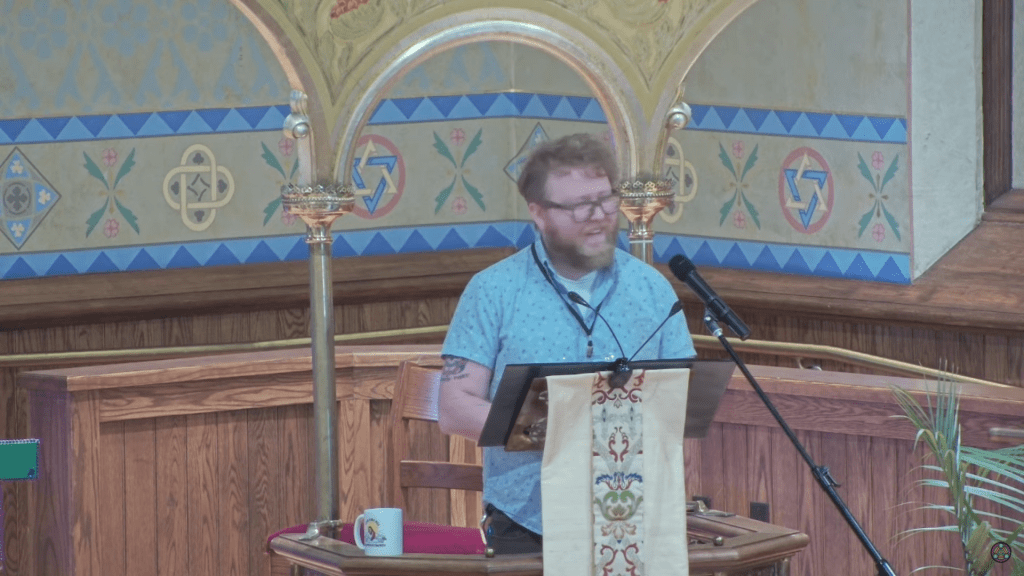
This past Sunday I had the honor to preach at my home church. Below is the sermon, but if you feel like watching it you can start the above link at 27:20 and enjoy all the little jokes I put in.
I’d like to open with a quote that I couldn’t find a home for, but it has latched onto me. It is from one of my favorite theologians, Ben Witherington. “It would appear that Mary’s announcement of the good news was insufficient to transform the mood of these male disciples.”[1]
I doubt, at times, there is any disciple more relatable than Thomas. I mean, you miss one hangout with the crew and suddenly, you’re supposed to believe your teacher is alive. It makes no sense. It sounds like a giant practical joke if you’re Thomas. It would be difficult not to respond with the, “I won’t believe anything until I put a finger through his hand!”
After all, it wasn’t like people came back from the dead all the time. But when Jesus comes back, and Thomas sees him, and while we are not told Thomas touches the wounds, we know for Thomas, the world is turned upside down.
Jesus has pulled one over on humanity, and the rest of the world because here was someone who has moved from death to life, from cursed to redeemed.
When Jesus asks Thomas, “have you believed because you have seen me?” what answer could be expected other than yes?
When I read this section of John’s Gospel, the space between the crucifixion wound, the time it took for Thomas to hear of Jesus’ resurrection and seeing him really stood out.
How many times do you think the Spirit tried to make contact with Thomas that week?
Where their times when Thomas was sitting alone at night, awake wondering if this was true that Jesus was back, and was he pushing the door shut while the Spirit was trying to break it open?
What makes the Apostle Thomas so relatable for me, is there is space for his doubt. Space for his thoughts. And space for him to allow God to enter his midst and partner with him.
It is that doubt that drives Thomas back to meet with the other disciples, and it is that doubt that shatters in the face of hope.
There is no way we get to our first reading from Acts without doubt. Everyone one in that group was Thomas, except for the people the entire history of the church owes its allegiance to, and that is the women.
Now, this newfound hope in the future of the world changes the disciples in a way that is still echoed almost two thousand years later into this very room. I say this because there is no way we go from doubts of resurrection to the hope of the holes in Jesus’ palms and not end up in the position Peter and the apostles find themselves in, in Acts 5.
So, this council that Peter and the others find themselves in front of, what the heck is it? Well, according to the Oxford Annotated Mishnah, we can be certain of a few things.
It is the judicial and deliberative body that was presided over by the high priest
This was the justice system for ancient Palestinian Jews
This group covered civil and penal law
There were two courts of judges depending on the severity of what was being decided, 23 judges or 71 judges
It was made up of the elders, sages, and various priestly factions of the day
Because it was controlled by the high priest, this group the apostles find themselves in front of, the same group that fought for the condemnation of Jesus, are the Sadducees
Yes, they deliberated over civil and penal law, but that meant a few things
They oversaw when civil procedure and criminal procedure acted as a fulcrum, depending on how the case went it would be a fulcrum for criminal proceedings
They also were in charge of the criminal execution and capital crimes, along with the liability for each one
At this time, the Sadducees. The Chief Priest Caiaphas that we heard from taking Jesus to Pilate during Holy Week was in charge of this group
According to Rabbi Jacob Neusner the Sadducees their name means “righteous one” so that’s hard to argue with
But they also, at the time in first century Palestine, rejected the “recent belief” of the afterlife and resurrection. Resurrection and afterlife theology belonged to the Pharisees.
The Sadducees are only spoken of a few times, as we see Jesus mostly go toe-to-toe against the Pharisees in the Gospels.
So why does all of this matter?
The Apostles are standing in front of people that have the ability to kill them. The Mishnah I quoted from earlier also says that there are, “…four execution methods—stoning, burning, decapitation, and strangulation—and, while it lists almost thirty capital crimes, it gives greatest attention to blasphemy…[5]”
Now, something I want to be clear about is, this is not a bloodthirsty group, and if not careful, they can be portrayed as one. The Mishnah says, A Sanhedrin that executes a transgressor once in seven years is characterized as a destructive tribunal. Since the Sanhedrin would subject the testimony to exacting scrutiny, it was extremely rare for a defendant to be executed.[6] The care for the life of a person was extremely important to this council.
But, if you are a person preaching of the resurrection of a perceived blaspheming rabbi, it is easy to see why the high priest would want that locked down. Not only do the Sadducees in charge not believe in resurrection or an afterlife, they had just had Jesus killed.
Peter says, “we must obey God rather than human authority.” The God of our ancestors raised up Jesus, whom you had killed by hanging him on a tree.” Part of the culture in first century Palestine with members of ancient Judaism is calling out scripture in conversation.
Everyone sitting in that room knew that Peter was connecting what happened with Jesus to Deuteronomy 21:22-23 which reads, When someone is convicted of a crime punishable by death and is executed, and you hung him on a tree, his corpse must not remain all night upon the tree; you shall bury him that same day, for anyone hung on a tree is under God’s curse.
Scholar Ben Witherington writes that Josephus, a Jewish historian who was alive during the first century in Palestine, “indicates that such a public hanging of the body followed stoning and was the punishment for the crime of blasphemy”[7] So if someone blasphemed, and they were stoned for it, their body was hung on a tree as a deterrent. If you know your American history, it should be no surprise that the incredible Dr. James Cone connected this in his book The Cross and The Lynching Tree.
When Jesus died, he was taken off the tree branches fastened into a cross and buried the same day. What Thomas is feeling in today’s gospel is the same thing the disciples felt walking on the road to Emmaus. It is the same thing Judas felt when he killed himself in the same way his friend died. Despair because the person they loved, the person they thought was going to overthrow power, empire, Rome, etc. was killed and cursed.
For the disciples before easter, there is no coming back from death, and to be cursed by God in the manner of your death must mean it was all a waste.
Every blister, every hungry night, every thirsty morning, the family and business you left behind to follow this Jesus around for three years amounted to nothing, because in the end he is cursed.
That is, until God turns that doubt and despair into hope and conviction.
This conviction and hope that the spirit burns into Peter and the rest of the Apostles, is the same hope and conviction the spirit burns into us today.
This is the same Spirit, hope, and conviction that pushes us to say that while some may not recognize our non-binary siblings, we are emboldened to say we see you, we name you, and we love you.
This is the same Spirit, hope, and conviction that pushes us to say that what is happening in Middle East right now breaks God’s heart, and Palestinian children deserve to grow old.
This is the same Spirit, hope, and conviction that pushes us to say that Black lives still and always will matter.
This is the same Spirit, hope, and conviction that pushes us to say that we love all our queer siblings.
This is the same Spirit, hope, and conviction that pushes us to say that we must protect trans kids at all costs.
This is the same Spirit, hope, and conviction that pushes us to say that we, know no person is illegal, and we must care and watch out for our neighbors.
This is the same Spirit, hope, and conviction that pushes us to say that pushes us to wake up every Sunday morning and make breakfast.
This is the same Spirit, hope, and conviction that pushes us to say that we, like Father Greg Boyle, see and know the unshakeable good in all people.
This is the same Spirit, hope, and conviction that pushes us to say that at Trinity Episcopal Church, in downtown Toledo, you are welcome, wanted, and safe.
This is the same Spirit, hope, and conviction that pushes us to say thanks be to God, and amen.
The following is my reflection from the prayer meeting held at Trinity’s 12 Noon service on 3/25.
Matthew 5:17–19 (NRSV)
Jesus said, “Do not think that I have come to abolish the law or the prophets; I have come not to abolish but to fulfill. For truly I tell you, until heaven and earth pass away, not one letter, not one stroke of a letter, will pass from the law until all is accomplished. Therefore, whoever breaks one of the least of these commandments, and teaches others to do the same, will be called least in the kingdom of heaven; but whoever does them and teaches them will be called great in the kingdom of heaven.”
The sermon on the mount is a teaching I have been spending a lot of time with as of late. I cannot speak for everyone, but this part of the sermon always gave me pause. As a young Christian I was taught that the Old Testament no longer applied to my life because Jesus came and liberated us not just from sin, but from all that “legalism.” Whenever this passage came up in church or wherever, this part always tugged at me, and the best explanation I could get from anyone was that it no longer applied. Paul had written about the law and how it did not apply to us, so we were free from it because of grace.
As I have grown older, I have personally come to realize that I cannot take that view because of how short sighted it is. To determine that something in the text no longer applies to you gives you permission not to take it seriously. It gives permission to be permissive about it, and when we become permissive, we are no longer curious. I find for myself, when curiosity is gone, what was fresh and vibrant become stale. I do not want to personally live in a world where the Sermon on the Mount becomes stale. So, what does it mean for this part of Matthew to continue to breathe new life?
Taking place on a mountain side, Jesus sits down and teaches his twelve disciples while others crowd around him and listen in. This image of Jesus is, I would argue, is what we would recognize today as Jesus at his most rabbinic. Rabbi and scholar Jacob Neusner in his book, A Rabbi talks with Jesus, writes:
…the sage sets for himself a worthy challenge, one that every sage in every generation does well to meet: receive a tradition whole and perfect, hand it on never intact but always unimpaired, so taking a rightful place in the chain of tradition from Sinai.
What Rabbi Neusner writes about, is how traditionally new teachers of the law would be raised up. Those who were picked and went through the training to become a teacher of Torah would be taught the commandments by heart. Then, their teacher would put their spin on it by providing some new perspective. This is what it means when a teacher passes on the law, not intact but always unimpaired. What Jesus is building on in his Sermon on the Mount, is the Torah, the law given at Siani to Moses and the ancient Israelites.
When we talk about no longer being subject to the law of the Old Testament and say that we must follow teachings like the sermon on the mount, something important is left out. What Jesus does with the Sermon on the Mount is what rabbis would call, “building a hedge around Torah.” Imagine that this law is so precious to you, not because of sin or persecution, but because you believe it is the best and you want to live it, that you put a buffer between yourself and it. Like a house with a hedge surrounding, it for protection, is what Jesus is doing in this sermon. The hedge, as Rabbi Neusner puts it, the hedge is important because it allows us to, “…conduct yourself in such a way you will avoid even the things that cause you to sin, not only the sin itself.”
There is a famous teaching associated with the Hillel the Elder where a gentile comes up to him and asks to be taught the Torah while standing on one foot. Hillel responds with something like, “that which is bad for you, do not to your neighbor, that is the Torah, the rest is commentary.”
For Jesus to give this teaching, encouraging us that not murdering is not enough, and we must not even have hate in our hearts. It is not just about not cheating on your spouse, but to not even to look at someone lustfully, and if you do, cut your eye out (because it is not the person’s fault you are looking at them like that). When I sit with this part of Matthew, as I have for the past year, I am reminded that for me, if all of Torah is about caring for my neighbor, and as Rabbi Neusner confirms, Torah is all about teaching us how to show mercy, then I am proud to teach others to show it.
I am excited to invite others along the path to teach and show mercy and love in ways that may not be new but are still worth doing. Especially in the climate we find ourselves in, this yoke, this teaching, must be passed on. When you hear it, it may not be intact, but it will at least be unimpaired.
It is an irregular day for a post, but considering all that is happening, I thought I’d write a little something. An attempt to put a little good in the world.
A few years ago, I was asked to preach on MLK observance Sunday, and it was my first time preaching at the new church I was on staff at. To say it was a little intimidating would be correct. But, a few good things came from it, and as far as sermons go, not the worst I’ve preached. This is a bit of an updated excerpt from it waking toward the idea of how we can move forward.
How can we fight for a world that is aligned with our kin-dom ideals while making room for those who may not like or agree with us? We advocate. In his letter from Birmingham Jail, Dr. King lays out the four basic steps to nonviolent protesting, to paraphrase they are:
Collect the facts and determine from those facts whether injustice is alive and well in the community you’re focusing on.
Negotiation. Engage in conversation with the gate holders and see if there is a way to work within the law to change what is going on.
Self-purification. The attempt to purge the injustice from oneself, so that their eyes can no longer be shut to them.
Non-violent direct action. Showing up and protesting whether it is a sit in, letter writing, or some other form.
When I was a student at the University of Toledo, I minored in Peace Studies and Education, and through those courses, these four markers came up in class almost every other week. It’s tempting, when preaching to draw upon the model that Dr. King left behind, at least, the perceived model he left. For a very long time, evangelicals and other white people have used the likeness and words of Dr. King in a way that has almost made him a caricature of who he was. 2018 marked the 50th anniversary of his cold-blooded murder, and Michael Harriot wrote an article for The Root labeled, From Most hated to American Hero: The Whitewashing of Martin Luther King Jr. Harriot does not beat around the bush when he states:
Contrary to popular belief, when King Died, he was not an icon of freedom and equality. In fact, most of the country disliked him. Sadly, on April 4, 1968, a bullet splattered bits of Martin Luther king Jr.’s brains and blood across the balcony of Memphis, Tenn.’s Lorraine Motel. Then, and only then, was white America ready to make him a hero. [1]
In part, it was Dr. King’s approach to injustice through non-violent direct action that led to his unpopularity. However, there is another way to put it, a way that I prefer, and it was said by one of his contemporaries, Rabbi Abraham Joshua Heschel. To quote Rabbi Laurie Green:
Upon marching with Dr. King in Selma, Rabbi Abraham Joshua Heschel famously said: ‘I felt my legs were praying.’ Heschel was as passionate about social justice as he was about the Sabbath and prayer. He taught that prayer must be revolutionary…[2]
Growing up, I was often taught that prayer was a direct communication from myself to God, and that was about it. When I was introduced to concept of praying with one’s feet by my former mentor Don, it kind of broke my brain open about the possibilities of prayer.
So, when I say something like, advocate for the world we want, not the one we live in, that to me is an act of prayer.
Going after systems of oppression through non-violent direct action is a type of prayer.
Realizing that our liberation isn’t just wrapped up in Christ, but the breaking of chains of oppression for all peoples is an act of prayer.
Working hard for justice in an unjust is an act of prayer.
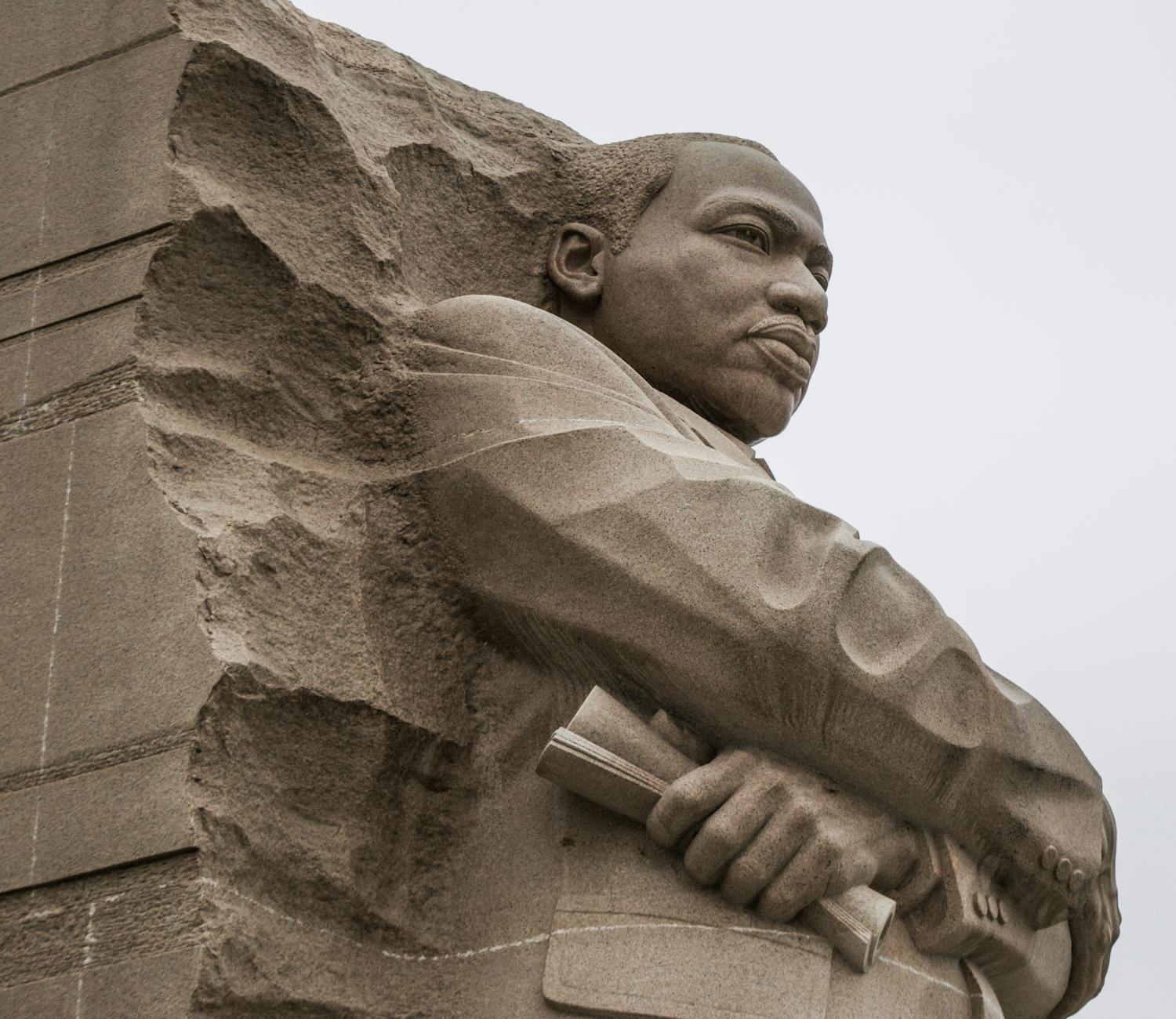
So, on this Dr. Martin Luther King Jr. Day, 57 years since his assassination, may we remember that the work Dr. King stood for is still on going, and that in the work, we are called to be merciful, just as our God is merciful. We have a lot of work to do, and a ton of dirt to get under our nails.
I took that picture on my way into work Monday. What a nice view.
This week, I do not have much to say. The writers block has been very present these past few weeks, and it is what it is. It doesn’t help we said so long to the interim priest we have been working with for over a year, and everyone’s favorite staff member is on tour for the North American production of Dirty Dancing.
So what is blocking the ideas from flowing? Well, we are less than a week away from another nightmare of a presidential term, and I am nervous for friends and loved ones. And if the confirmation hearing of Hegseth that occurred yesterday is a taste of what is to come…
Speaking of cabinet picks, I will never forget when my wife and I lived in West Michigan, and the first Tr*mp administration had been going for a little while. The church we had attended the majority of the time we lived there was Mars Hill Bible Church, founded by Rob Bell. Bell had been long gone by the time we had gotten there, and the place was changing under the newly called pastor. Things started off well, but the moment Betsy DeVos, who had been the Secretary of Education for a few months, came over to me during the passing of the peace. She gave me the most uncomfortable hug I have ever had in my life, and while she was trying to make small talk, I just kept reminding myself that the person standing in front of me was a child of God. We left the church pretty soon after.
The look on my wife’s face though, seared into my memory. One of shock, horror, and concern about what was going to come out of my mouth. I was in such shock at what was unfolding before me that I was pretty much frozen.
Scraping the barrel but still showing up is strength in its self, and that is what I wanted to remind everyone of today. So, to close today, I want to offer up the closing prayer I lead every other week during the Wednesday intercessory prayer services. It was introduced to me by a dear friend who passed away almost a year ago called, The Coventry Litany of Reconciliation. Because it is me however, I tweaked a few things to make it more inclusive.
The Lord be with you my friends, never forget you all are loved, and not alone during this dark time to come.
An updated version of the Coventry Litany of Reconciliation:
All have sinned and fallen short of the glory of God.
The hatred which divides nation from nation, race from race, class from class, Lord, forgive.
The covetous desires of people and nations to poses what is not their own, Lord, forgive.
The greed which exploits the work of human hands and lays waste the earth, Lord, forgive.
Our envy of the welfare and happiness of others, Lord, forgive.
Our indifference to the plight of the imprisoned, the unhoused, the refugee, Lord, forgive.
The lust which dishonors the bodies of men, women, non-binary, and children, Lord, forgive.
The pride which leads us to trust ourselves and not in God, Lord, forgive.
Be kind to one another, tender hearted, forgiving one another as God in Christ forgave you.
There are few scenes from television that I can re-watch like the dart scene from Ted Lasso. I’m sure most of those reading will have seen it but if not, let me set the scene. Two men are playing darts in a crowded English pub, and there is a bet on the line. The bet is that if the former owner of the team Ted works for wins, he can pick the lineup for the rest of the season. If Ted wins, the former owner can’t come near the owners box while Rebecca (his ex-wife) owns the team.
Ted is down in points, and needs to triple twenties and a bullseye to win the game. Before he takes his turn, he begins to speak to his opponent about how he has been underestimated by guys like him his entire life. Ted points out how those people aren’t curious, and their assumptions of him, had nothing to do with who he actually is. Ted comes to this because, curious people ask questions, they don’t make assumptions.
It is a such a simple observation by Ted, but personally, it really packs a blow at the same time.
The ability to be curious in a world we know is such a rare thing found in adulthood. This is why I think Ted Lasso stands out compared to other positive characters written for TV. It is also something I think tends to be lost in the Church, an observation pointed out to me by a former mentor. One of the things I had found most helpful during the major deconstruction phase of my faith were good questions. It took a little while for me to want to be curious about reconstructing my faith, but curiosity is what helped it grow.
Reading rabbinic materials did a great job in re-cultivating the curiosity that evangelicalism killed. Knowing that there is space in faith traditions to play with the text, imagine what it was like, and disagree was such a foreign concept. Rabbi Dr. Tzvi Weinreb in his article, Korack: Two Jews, Three Opinions, writes:
It is noteworthy in this regard that every single chapter of the work known as the Mishnah, which is the core around which the Talmud developed, contains a dispute between the rabbis on one point or another.
With the heaviness of the world to come, and the rhetoric that will continue to ramp up (we saw last week at the capitol over bathrooms), it is good to remember that curiosity and questions belong. Not only do they belong, but it curiosity is how we grow and become humans deeper in the image of God. Only those who are afraid (toxic people, christian nationalists, homophobes, transphobes, etc.) will tell you otherwise. The way the writers of Ted Lasso nail this point home in such a disarming way lends to the longevity of the show.
Stay curious my friends, it will only strengthen our resolve as we march forward. I needed a somewhat uplifting post because I have been stressed, worried, and even a little scared. I hope this gives you room to jump into something new to help balance the way things are going. You can’t fight fascism without remembering the beauty that exists and is worth maintaining. Try Ted Lasso if you haven’t seen it, or Gardner’s World with Monty Don, two sources that allow you to unplug and be filled for an hour.
Two weeks ago today the election results were announced, and things continue to look dire. Today, as the title gives away, is Transgender Day of Remembrance; while I am not a member of the trans community, I am a staunch ally. Now, I know there are going to be a few people who read this, that do not recognize trans people’s right to exist. There will also be those who read, that also think supporting queer people, and, specifically trans people is heresy. Nothing I say to you will change your mind. To borrow a phrase from someone I respect, I do not make nice with oppressors, and I hope you hear God. For those of you who are here that none of this applies to, welcome.
Our LGBTQIA+ siblings have been here from the very beginning and to not recognize that, to me, is the same as ignoring Christ on the cross. Those who know their church history, they should be aware of this, and also know they have always had a place in the family of God. If this is news to you, I highly recommend these two books to get started:
For Christians, to believe that we are made in the image of God, is to (hopefully) accept one of the Jewish concepts in the Talmud that says:
Rabbi Yirmeya ben Elazar: In the hour when the Holy One created the first human, He created him as an androgynos (one having both male and female sexual characteristics), as it is said, “male and female He created them.1
Dr. Rachel Scheinerman wrote an incredible article, The Eight Genders of the Talmud, that you can read right here. The reason why I am posting about this article, is because the Talmud is a compendium of rabbinic commentary, laws, and other writings that has been around for over a millennia. Outside of the Torah, it is the most impactful pieces of Jewish writing. To know that Christianity was a religion born out of ancient Judaism, reading ancient Jewish writings can be very helpful. Of these eight genders, four of them are applicable to our trans siblings.
Less than 1.5% of trans people make up the total population in the United States according to a June 2022 article by the UCLA school of law.2
350 trans siblings have been murdered globally so far in 2024.3
321 trans siblings were murdered globally in 2023.4
391 anti-trans bills have been proposed in the United States in 2024.5
In 1933, one of the life centers of LGBT+ culture and community was in Germany; and when Hitler came to power, his government targeted our trans siblings.6
The incoming presidential administration is terrifying for almost anyone who is not a straight, white, cis, republican male.
Today is a somber day, and unfortunately there is a lot of ground still to cover for our siblings. But I believe it is possible to build a world where they are not only safe, but can be the person God made them to be. And that they will have the support to do so.
May we remember our lost siblings not just today, but every day.
May we remember that our trans siblings need us, not just today, but every day.
May we see the image of God reflected in them, as we do ourselves.
May we stand for them, even if our friends and family do not.
And may we take a moment to recite these words from Rev. Marie A. Trato, the Canon for Community Justice Ministry in the Diocese of Long Island:
Gracious and loving God, you made all of humankind in your image and redeemed us through Jesus your Son: On this International Transgender Day of Remembrance, we remember those who were killed because of their all-encompassing humanity; help us to overcome our anger and our fear of those whose lives move beyond our binary definitions; draw us closer to the mystery and complexity of your infinite creativity and creation; teach us to look upon all of God’s children with love and compassion, that we may all live in safety and in peace; through Jesus Christ our Lord, who lives and reigns with you, in the unity of the Holy Spirit, one God, now and for ever. Amen.7
I just left the line to vote. This is the first time since moving here that I had seen a line that will last more than 5 minutes.
The picture above is one I took while dropping something off to a friend back in August. The heart your neighbor sign came from a group trying to reach out to neighbors. Their mission is, “during a year where neighborly love and values are tested through voting, we strive to bring neighbors together in love and harmony.”
On the surface, it’s a great idea. But I, for the life of me, cannot understand how someone can put a sign like that their yard and vote for hate. Maybe in 2016 I could have understood.
Maybe.
But we know better now, and I’m only speaking for myself.
To love your neighbor is to do what is best for everyone with the privilege you hold. Former Presiding Bishop Michael Curry wrote during the 2016 election:
Go and vote. Vote your conscience. Your conscience informed by what it means to love your neighbor. To participate in the process of seeking the common good. To participate in the process of making this a better world. However you vote, go and vote. And do that as a follower of Jesus.
I would amend that to say, if you are a follower of Jesus;
If you are someone who seeks justice, cares about the poor, widow, and orphan;
If you strive to till the soil of this world to usher in the kin-dom of heaven;
Do not vote for him. Lives are on the line.
Women’s lives are on the line.
LGBTQIA+ lives are on the line.
People of Color lives are in the line.
Those who rely on social security lives are on the line.
Those who live on the margins lives are on the line.
I support Palestinians, and she took too long to talk about Gaza in any “meaningful” way. And I’m not sure I trust the outcome. But like uncle Bernie said, “he must be defeated.”







 George of Sylvania