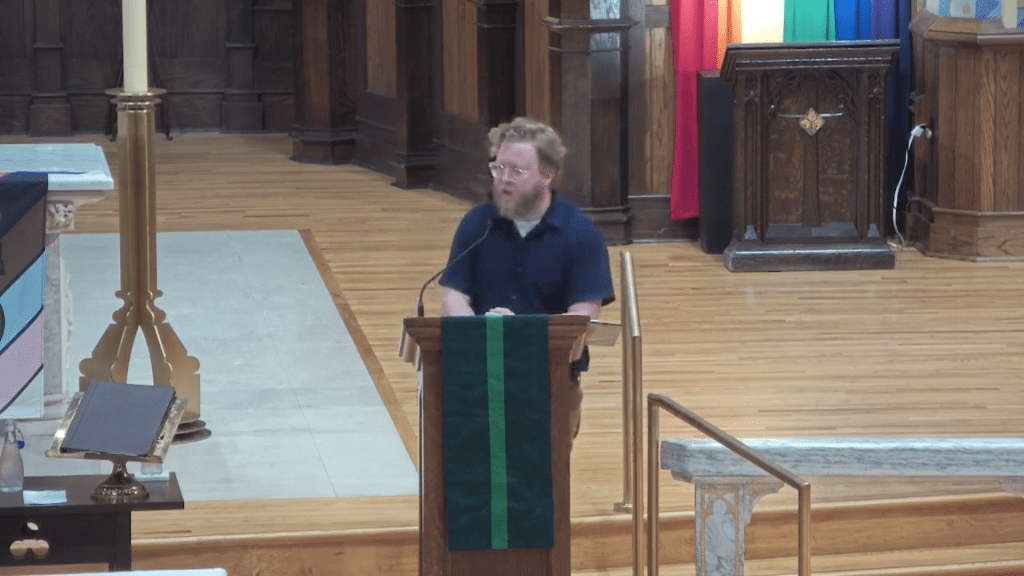
Yesterday I had the honor to preach the sermon at my home, Trinity Episcopal Church, a progressive, inclusive, creative, downtown church. It has been a cornerstone of Toledo since 1837, and a bedrock of those seeking to act justly, love mercy, and walk humbly with God. If you’d like to watch the service you can follow the link here, or watch the sermon itself on my Facebook which is linked here. All of the quotes from Bishop Barber, including the Walter Brueggemann quote, can be found in the book, Revive Us Again: Vision and Action in Moral Organizing by Bishop Barber. A video of his 2015 MLK Jr. Day sermon can be found here. Also, I have updated some action items that allow for online reach out, so here we go!
I am going to start with just naming one of the many elephants in the room, yesterday, the country we call home celebrated its 250th birthday. There is tension, joy, anger, and a weird dash of patriotism if, you have been following Europeans visiting for the world cup. Some of us were on the plaza celebrating until the early hours of the morning, some of celebrated with family, and others, friends of mine, to paraphrase a song written by Ben Stalets, who just wanted to be holed up in a hotel room, hoping to God they could get through the night. There is a lot to sit with in this moment we find ourselves, as Christians in this country. To quote Michael W. Austin, co-author of American Christian Nationalism: Neither American nor Christian, “in one sense love of country is a good thing. But in another, it is deeply problematic. Love of Jesus and love of country can come into conflict.”
It is that conflict, and a way to advocate the world we want, not the one we live in, I would like to spend some time talking about.
The passage from Zechariah is very small but powerfully packed. Something that was important to ancient Israel, and current Judaism, is the story of the exodus from Egypt. The origin story of where these people called by God, were brought up out of slavery, rescued from the oppressors, welcomed into covenant with God at Mount Sanai, and ultimately brought through the wilderness. There is a constant call back to this story throughout the Jewish and Christian Bibles, and we can see that in how the author of Zechariah phrased the ancient nation of Judah and Israel. Any time we read about chariots or war horses, it should give us pause, because these descriptors are triggers for the original listeners of this story to be brought back to Egypt.
Pharaoh and his army, with chariots and war horses, chased after the ancient Israelites as Moses led them through the Red Sea. In quick words, the Prophet Zechariah is drawing a one-to-one comparison to Egypt and the people who escaped that oppression to their current status. In their journey to be a blessing to all nations like they promised God to be, the ancient Israelites have become the opposite, they have become the new Egypt, oppressing and enslaving others. This group of people that pledged themselves to God have instead become an empire seeking its own means, claiming it is from God because they are clearly prosperous. It is to this point that Zechariah calls out from God for the dismantling of the military industrial complex, the command that peace be waged in all nations, and for the people who will be doing this work, the prisoners of hope, to be restored.
Over two thousand years later the people of God, these prisoners of hope, continue to call out this need to dismantle our faith from the oppression, violence, and injustice of empire.
But how do we do this work, after all, for the past decade there has been an incredibly charged political climate with culture wars and the like dictating new fronts to fight on. While it is incredibly overwhelming, even if we only have the energy in ourselves to voice opposition and to support the marginalized, targeted, and oppressed it can be enough. There is a Palestinian priest in the Evangelical Lutheran Church named Munther Isaac, and in his book, The Other Side of the Wall: A Palestinian Christian Narrative of Lament and Hope, he writes, “Our silence towards injustice is a political statement itself” and he is right.
With so much turmoil, what are we to do? Zechariah reminds us we need to take our instruments of oppression, and to turn them into plowshares, garden tools, or fine art. Whatever these 21st century swords and shields we still cling to need to be laid down by the riverside, and we must study war no more. When we start to practice this laying down, we can move from prisoners of hope to what Disciples of Christ Bishop, former North Carolina NAACP President, and current co-chair of the Poor People’s Campaign, Bishop William Barber II has coined, Prisoners of Prophetic Hope.
Touching back on the conflict between the love of country and Jesus, it is easy to get frustrated. However, when I look around this room, think of our ministries, I see the truth in the country I love, and it is all of you, and the diversity we offer. When we lay down an old way of life, a new direction and leader is required for us and Jesus offers this in abundance. “Come to me, all you that are weary and are carrying heavy burdens, and I will give you rest. Take my yoke upon you and learn from me; for I am gentle and humble in heart, and you will find rest for your souls. For my yoke is easy, and my burden is light.”
Every Sunday at 8:20am I give a little pre-breakfast peptalk that touches on this passage, because above the plaza doors in My Brother’s Place lives a sign that reads, “A Place To Nourish Both Body and Soul.” It is a remnant of our past, that screams truth into our future, because we want our friends who come to Breakfast at Trinity to lay their burdens down.
Trinity has a long history of guiding and advocating for the world we want to live in and trying to reshape America, and I would like to name four examples:
- Morrison Waite, who served on vestry from 1852-1874 when he was selected by President Grant to serve as Chief Justice of the Supreme Court during Reconstruction. During his time, he expanded the Freedmen’s Bureau, protected people of color from the KKK, and while there was more work to be done to protect Black and people of color during Reconstruction, he showed up and tried.
- There is a legend that the first free kindergarten in Lucas County was founded out of Trinity, and while I am unsure how true that is, what I do know is according to our September 1875 Parish Guide, a new term of school started on Monday the 13th, which the author states, “it is with particular gratification that I have been able to announce the establishment of the Kindergarten department, which I consider a great addition to the educational facilities of our city.”
- In March of 1912 Jennie Barnes and Hester Scrafford founded the Business Woman’s Guild of Trinity Church where women who worked downtown could come and eat their bagged lunch safely, in community with one another. There are pictures of the café that started in the basement because of this, and there is a bronze plaque commemorating this ministry that lasted well through the 20th Century in what is now our AA room.
- If you were present for the Queer Joy Symposium you heard Toledo Councilman Nick Komives talk about how the first Toledo Pride started in this sanctuary with the first Pride interfaith service.
Again, and again, and again these walls have housed fellow prisoners of hope as we step forward in works of justice brought out from love. The continued work of making spaces safe for everyone is a justice issue Jesus calls us to be active members in creating.
“Take my yoke upon you, and learn from me; for I am gentle and humble in heart, and you will find rest for your souls. For my yoke is easy, and my burden is light.”
These words of Jesus would have called his fellow farmers and working class listeners to think of the oxen in the field shouldering the huge wooden yoke to help plow the fields. Every single one of those examples of Trinity members had days where they wanted to give up.
At times they may have thought the strain is too much, the world is too dark, and this burden is not light, but too heavy.
The yoke and burden that Jesus gives us is only light and easy because we have each other to lean on, to help share the load because we mustn’t do this work alone. That is why we must move from being a prisoner of hope, to becoming a Prisoner of Prophetic Hope like those who have come before us.
In January 2015 at Duke University, Bishop Barber preached the Martin Luther King Jr. Day service, and in that sermon, he speaks on this transition from prisoner to prophet. To become a Prisoner of Prophetic Hope, Bishop Barber says that it is crucial to publicly own the despair in the world we feel and know to be true. The need for this is because when we read the prophets we see how the hope in their words is subversive to the suffering and world around them. Bishop Barber is backed up by the words of Old Testament scholar Walter Brueggemann, when he writes “prophets must be able to speak in both grief and hope.”
Because of my role here, I find myself in conversations with random people throughout the week, and there is one consistent throughline in almost every talk that comes up about Trinity. It is not about our building, the pride flags, or any of our ministries. While those do come up, the one consistent thing people tell me about their experience with Trinity is, how welcoming and at home the people here make them feel. The reason why we are so good at welcoming people into Trinty, is because almost all of us that find ourselves through these doors in person or online, we have all been rejected from community. At one point or another, we have found ourselves outside of the place we once called home, and we never want anyone else to feel that way again.
If you feel called to take on the yoke and burden of Jesus, and you want to move from being a prisoner of hope to a Prisoner of Prophetic Hope I have a few opportunities for you. In a way to publicly own this grief we feel, use 5 Calls to contact your senator about HR 1689. It is a recent bill that passed the House with bipartisan effort, House Resolution 1689 which determines the Temporary Protected Status of Haitian and Syrian immigrants.
The second opportunity is on July 22nd from 9-11 there is a protest at the Central Corrections Facility of Northwest Ohio which is now contracted as an ICE detention center. I will be there, reach out and I’d love to have you with us. Finally, It is crucial now, more than ever we show up to support our LGBTQ+ siblings.
To close, I want to leave you again with words from Bishop Barber, because we can be the hope that is missing in the world. “When the rejected get together they can in fact redeem America from hate and discrimination… when all those hands get together and when the rejected join hands our togetherness becomes the instruments of redemption.”
Amen.

